


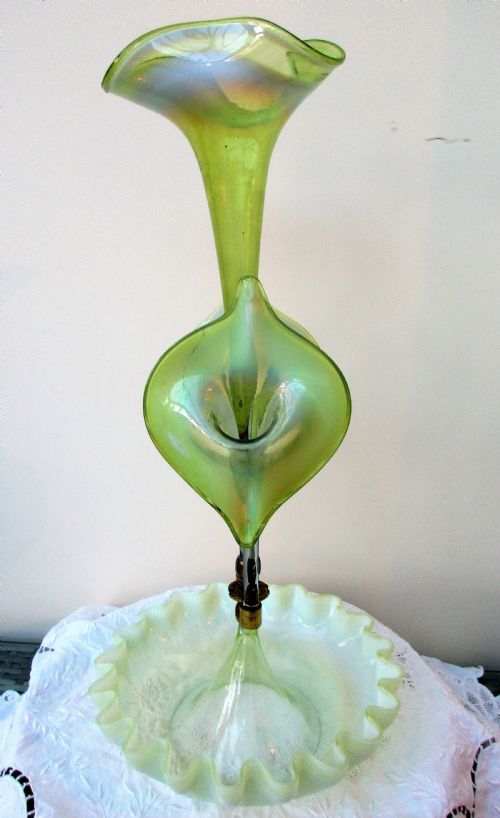


Antique Uranium Glass
Glass given its yellow-to-green tint by a trace of uranium, made as everyday tableware and dressing-table pieces, and known for fluorescing under UV light.

Antique Uranium Glass
Uranium was used as a glass colourant from the earlier 19th century, giving a range of yellow and green tints in table and decorative glass. It was made in quantity through the Victorian years and again between the wars, and production largely stopped when uranium supply was restricted in the mid-20th century.
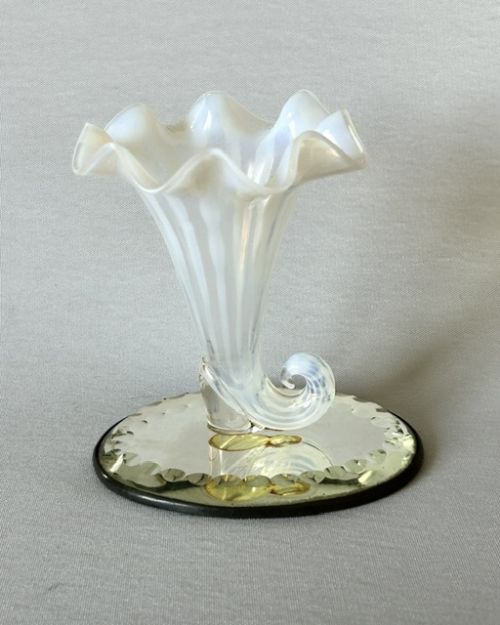
On Sellingantiques the category arrives as domestic glass rather than scientific curiosity. Victorian pieces dominate: the word appears in 31 of 69 titles. Vases lead, with posy, celery and cornucopia forms among them, then stemware, then scent bottles. Pairs and sets are usual for the drinking glasses, with sets of six and eight recorded.
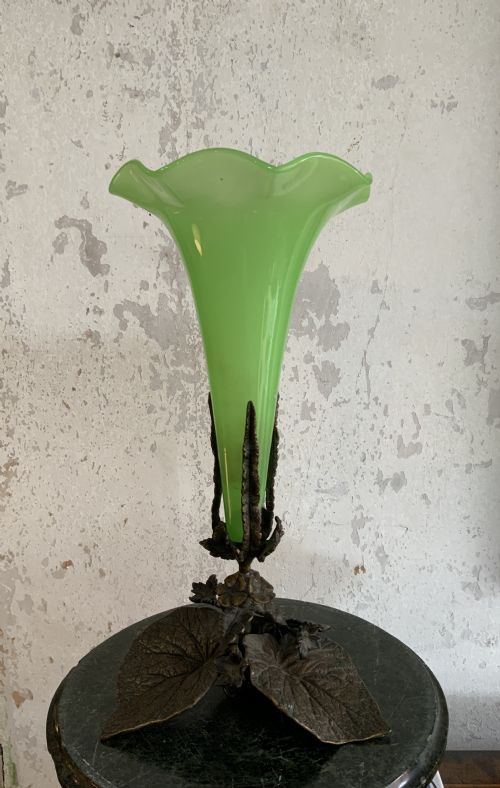
The second cluster is 1930s Czech Art Deco, roughly a quarter of the record: comports, figural centrepieces, enamelled vases and a decanter set. Karl Palda is the one name attached to listings, on nine of them, all 1930s. The dated field runs 1860 to 1930 and is bimodal, 16 Victorian and 16 from the 1930s, with a single Edwardian entry in between.
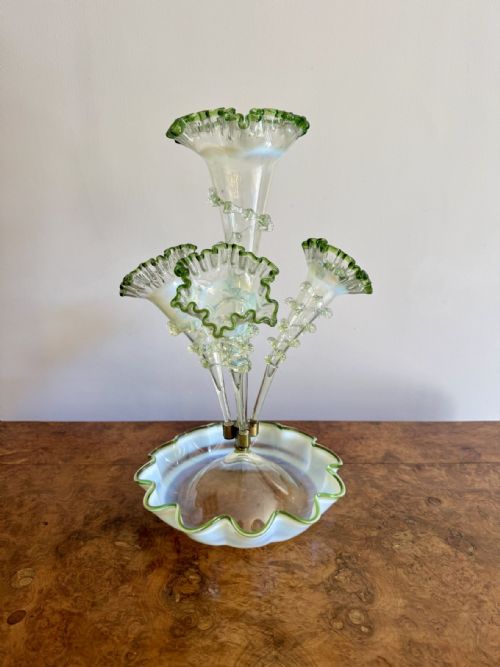
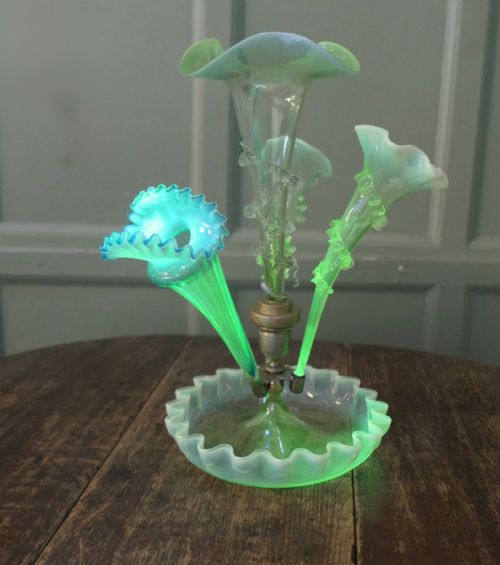
Smaller branches run alongside. Scent bottles and dressing-table pieces, often silver, silver-gilt or gilt mounted, account for around one in seven titles, four of them described as French Palais Royal. Epergnes turn up about five times in the whole record, including a quadruple one on a silver-plated base and another mounted in bronze.
Where Value Sits
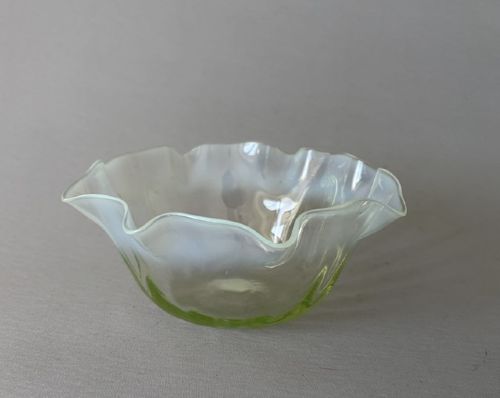
Form does most of the work. Figural comport centrepieces, decanter sets and multi-vase epergnes sit at the top of the range, and one epergne holds the very highest place in the record. Single small bowls and lone posy vases sit at the bottom, and a single wine glass sits lower still.
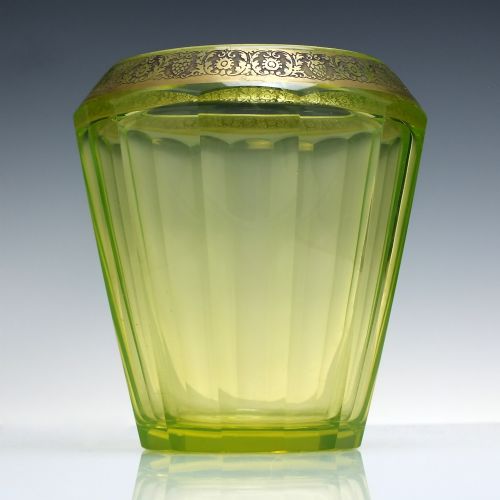
Additions lift a piece. Silver, silver-gilt and bronze mounts, enamelling, gilding and cut crystal drops all recur through the dearer half, as do pieces that combine uranium glass with cranberry, milk glass, turquoise or opaline. The named 1930s Czech attribution behaves the same way: those nine listings all fall in the upper half.
Numbers matter with tableware. Pair appears in 11 titles, and sets of six and eight wine glasses are recorded; the completeness is what separates them from the singles. A listing giving a decade is being more precise than one giving only "19th Century", which eight entries do.
Antique Uranium Glass Retail Price Guide 2026
Typical UK retail prices for uranium glass, calculated from the Sellingantiques database of over a million retail prices indexed since 2003. This retail price guide relies exclusively on Sellingantiques data; no external sources or auction records are used, so the figures do not describe the wider market.
Uranium glass has been listed on Sellingantiques since 2015.
The Antique Uranium Glass Glossary
- Uranium glass
- Glass coloured by a trace of uranium, yellow through to green, fluorescing under UV light.
- Vaseline glass
- The paler, oily yellow-green end of the material. It appears in 15 of 69 titles, and eight of those say uranium in the same breath for the same piece.
- Celery vase
- A tall footed vase for serving celery upright at table, a recurring Victorian form.
- Epergne
- A branched table centrepiece carrying trumpet vases or dishes. Five appear in the record, one with four vases on a silver-plated base.
- Comport
- A raised bowl on a stem or figural support, the characteristic 1930s shape in this archive.
- Palais Royal
- A term used for finely finished small French dressing-table glass, usually gilt-mounted; four titles carry it.
Antique Uranium Glass: Frequently Asked Questions
Is vaseline glass the same as uranium glass?
Titles on Sellingantiques treat the two words as the same material. Fifteen of 69 use vaseline, and eight of those use uranium alongside it for one piece.
Where the words are separated, vaseline describes the paler, oily yellow-green end of the range. Uranium covers the whole yellow-to-green span.
What period does most of it date from?
The dated field runs 1860 to 1930, with 42 listings carrying a clean year. The pattern is bimodal: 16 Victorian entries and 16 from the 1930s.
Only one Edwardian listing falls between the two groups, with six from the 1900s. Eight entries are dated simply "19th Century".
One dish is claimed in its title as Bohemian and around 1820, though it carries no year in the structured date field.
Which forms turn up most often?
Vases lead, at 19 of 69 titles, including posy, celery and cornucopia shapes. Stemware follows, with wine glasses and champagne bowls, then scent bottles at nine.
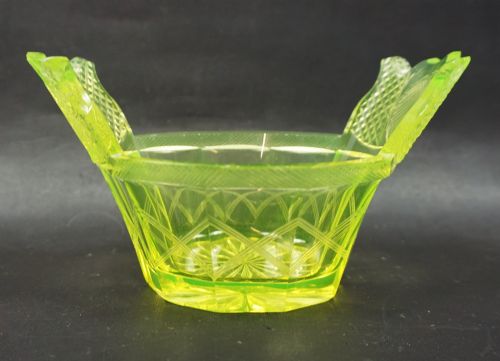
Beyond those, the record holds finger bowls, sweetmeat and preserve dishes, a biscuit barrel, a trinket box, an egg casket and a bowl with an integral glass frog.
Are there named makers in this category?
Karl Palda of Prague is the only name attached to listings, and it appears on nine of them. All nine are 1930s pieces and all sit in the upper half of the range.
Everything else arrives described by type, period and origin rather than by firm.
How much Czech Art Deco glass appears?
About a quarter of the record. Art Deco shows in 16 titles and around 1930 in 14, covering comports, figural centrepieces, enamelled vases and a decanter set.
This is also where the top of the range sits, alongside the mounted epergnes.
Does French glass feature in the listings?
French appears in eight titles, about one in nine. Four of those are Palais Royal dressing-table pieces and two are opaline.
Two scent bottles are described as Grand Tour souvenirs, and one epergne is a hand-blown three-trumpet French piece.