
Antique Marquetry Bureau
Writing furniture decorated with inlaid veneer, from small French ladies' desks to tall Dutch floral marquetry bureau bookcases, made to hold letters and paper and to be looked at.

What Are Marquetry Bureaux?
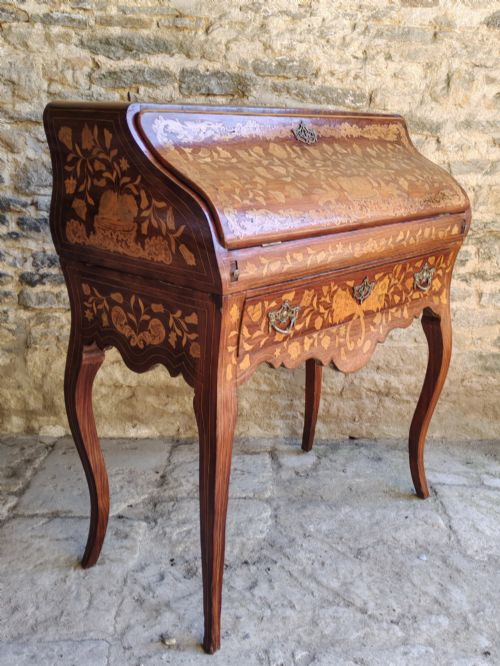
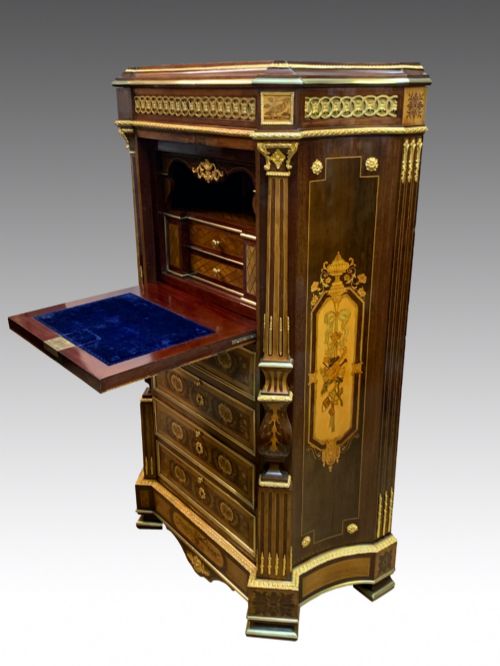
Marquetry is veneer inlay in contrasting woods, laid as patterns or pictures across the surface. It was applied to writing furniture from the later 17th century onwards, once the slope-front and fall-front bureau fitted with drawers and pigeonholes had become the standard domestic writing form across Europe. "Inlaid" is the single commonest word in titles on Sellingantiques, turning up in over a third of them.
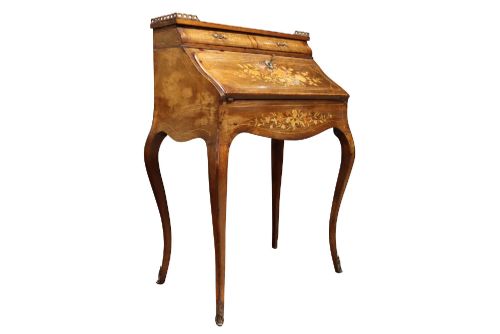
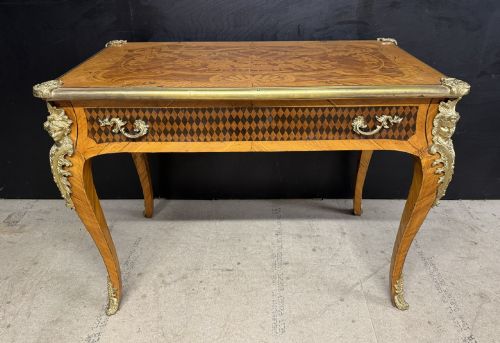
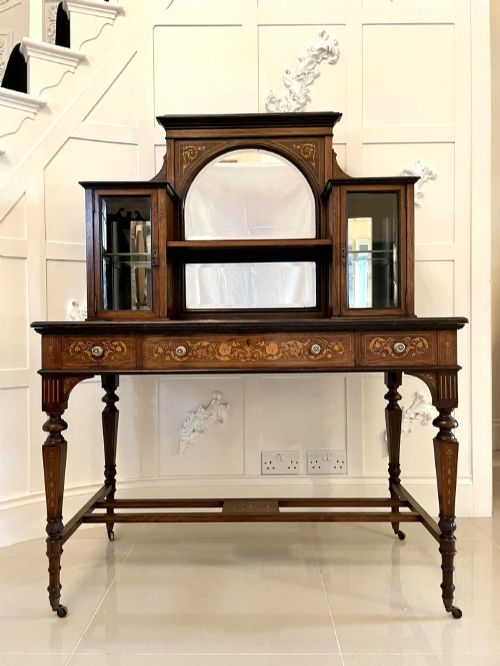
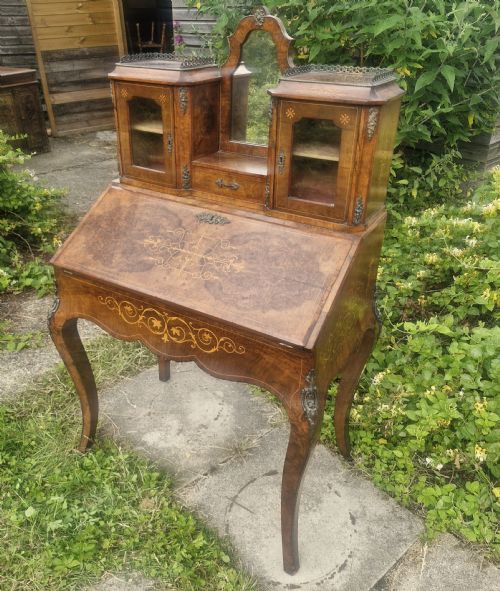
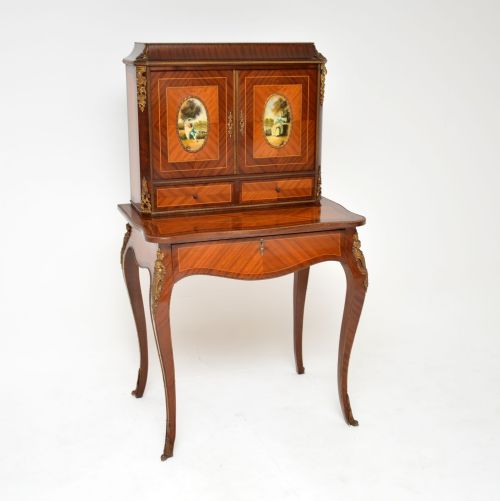
The form you're most likely to meet is the small French-taste ladies' writing piece: the bonheur du jour with its raised superstructure of little drawers, and the bureau de dame. French appears in nearly a third of titles, with bonheur du jour and dame close behind. Grounds are rosewood, walnut, kingwood or satinwood, sometimes with ormolu mounts on the corners and edges.
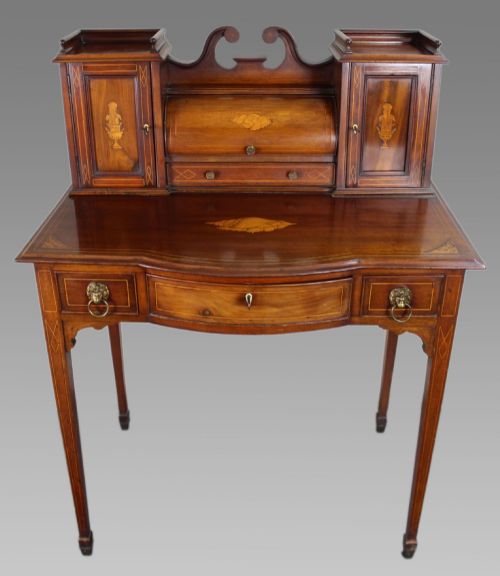
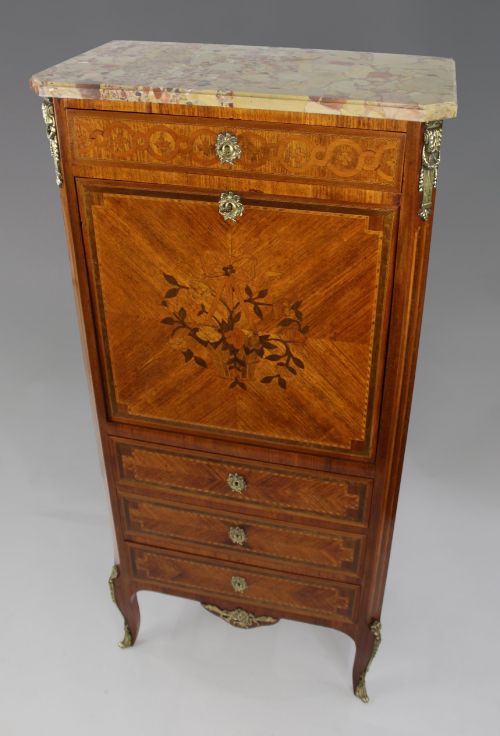
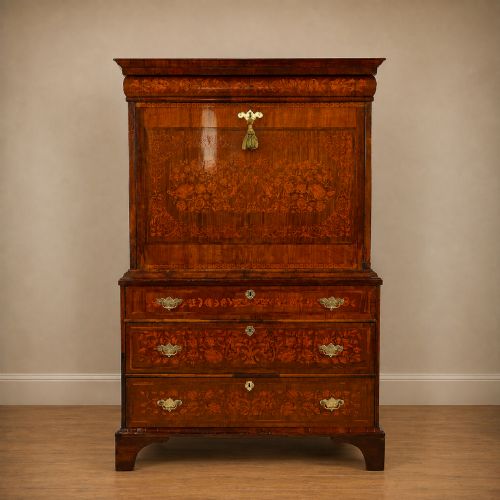
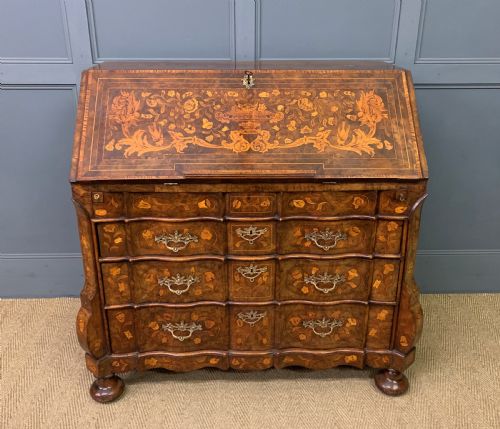
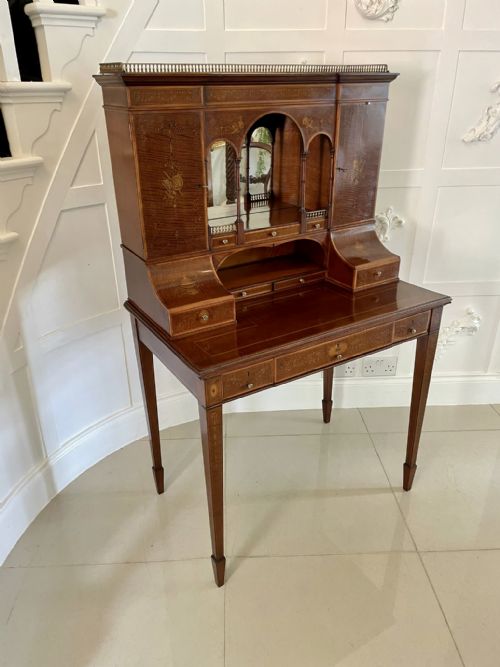
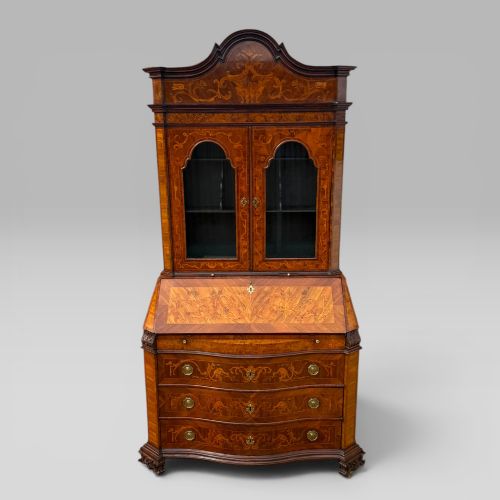
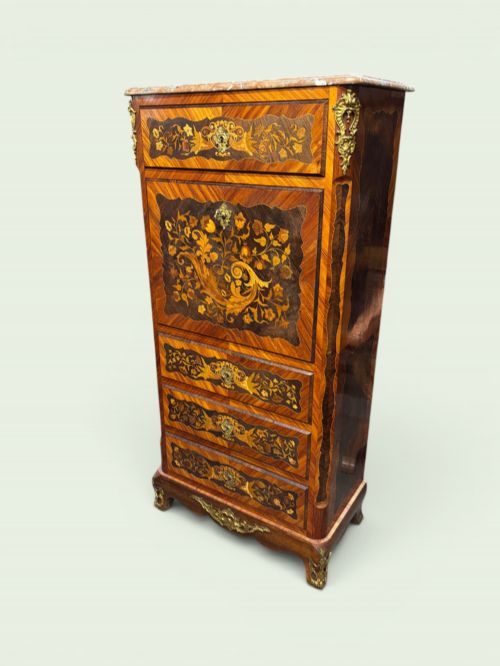
The other main encounter is larger and Continental. Dutch floral marquetry bureaux and bureau bookcases in walnut and burr walnut make up about a sixth of the category, often bombe-fronted, often in two parts. Secretaire abattants and escritoires form another tenth, and English inlaid or Sheraton Revival bureaux, cylinder desks and bureau bookcases a further slice.
Dates supplied by dealers run from 1700 to 1930, but the profile is vague more often than precise: "19th Century", "18th Century" and "Victorian" together outnumber the decade labels. Where decades are given they cluster in the 1860s to 1900s. Any single date is the dealer's own reading rather than a documented one.

Where The Range Splits
Scale and case complexity do most of the work. Bureau bookcases and tall two-part Dutch cases sit at the upper end, while small ladies' desks and the occasional child's bureau sit at the bottom. A glazed or panelled upper case above the fall changes the piece's standing more than any single detail of the inlay.
Shape matters next. Bombe sides, block fronts and double domes recur among the highest-priced pieces on Sellingantiques; flat-sided, plain carcases cluster lower. Timber follows the same line, with burr walnut, satinwood, kingwood and amboyna well up the range and oak, satin walnut and plain mahogany near the bottom. Ormolu mounts and marble tops recur in the mid and upper reaches, often together on bombe secretaire chests.
Then the inlay itself. Dense floral marquetry, and the arabesque or seaweed work found on the 17th-century-labelled escritoires and double-dome bureau bookcases, belongs to the top of the range. Simple line inlay or a run of brass stringing sits low. The earliest labels command the range; the 1920s and 1930 marquetry bureaux and small secretaire abattants sit at the other end.
Retail Price Guide 2026
Typical UK retail prices for marquetry bureau, calculated from the Sellingantiques database of over a million retail prices indexed since 2003. This retail price guide relies exclusively on Sellingantiques data; no external sources or auction records are used, so the figures do not describe the wider market.
Marquetry bureaux have been listed on Sellingantiques since 2010.

The Antique Marquetry Bureau Glossary
- Bonheur du jour
- A small ladies' writing table with a raised superstructure of little drawers or shelves above the writing surface. It appears in around a sixth of titles here.
- Bureau de dame
- A lady's small writing bureau, French in taste. "Dame" turns up in a tenth of titles.
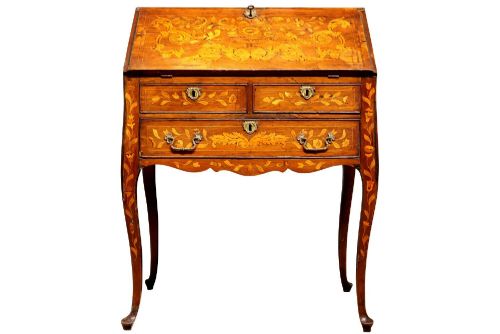
- Secretaire abattant
- An upright secretaire whose fall-front flap drops to form the writing surface. Secretaire appears in a tenth of titles, abattant in half that.
- Escritoire
- An older term for a fall-front or box writing cabinet, sometimes raised on a stand. Used in a twentieth of titles.
- Bombe
- A swelling, outward-curved front or sides, seen most often on Dutch and Italian pieces. It recurs among the higher-priced sampled titles.
- Burr walnut
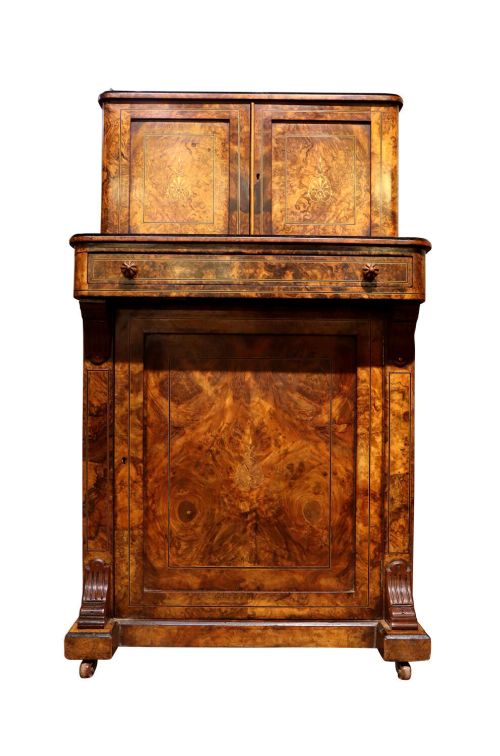
- Veneer cut from a burr growth on the tree, giving a dense figured pattern. Common on the larger Dutch cases.
Frequently Asked Questions
What is a bonheur du jour?
It's a small writing table for a lady, with a raised superstructure of small drawers or shelves standing on the back of the writing surface. Bonheur and jour each appear in around a sixth of the titles in this category.
On Sellingantiques they come in rosewood, kingwood, walnut and satinwood, often with ormolu mounts. Two matched pairs have been offered together.
Which country made most marquetry bureaux?
Dutch is the strongest named origin, carried by around a sixth of titles, and Dutch floral marquetry bureau bookcases account for most of the highest-priced sampled pieces.
French taste dominates the smaller writing pieces. English inlaid and Sheraton Revival bureaux form another group. Italian, Spanish and South German examples turn up once in a blue moon.
How old are these bureaux?
Dealer-supplied dates span 1700 to 1930. Fewer than half the listings carry a clean year; the rest are labelled by century or reign, with "19th Century", "18th Century" and "Victorian" the commonest.
Where decades are given they gather in the 1860s to 1900s. The earliest labels reach the 17th century, and the latest sit at 1920s and 1930.
What woods are used?
Nine or more timber names appear in titles. Walnut, rosewood and mahogany are the everyday ones, with burr walnut common on the larger Dutch cases.
Beyond those come kingwood, satinwood, amboyna, tulipwood, fruitwood and a single Gonçalo Alves. Kingwood is the dark striped Brazilian timber used as a ground for French marquetry.
Are marquetry bureaux usually signed or attributed?
No maker or retailer recurs often enough across this evidence to define the category. These are sold on form, origin and timber rather than on a name.
Around 31 come to market in a year on Sellingantiques, and 82 different dealers have listed one.
Do cylinder desks count as marquetry bureaux?
Yes. Cylinder describes a curved roll-over top that slides back to reveal the writing surface, and it appears in a twentieth of titles.
Most sit with the English inlaid and Sheraton Revival group, alongside bureau bookcases and writing desks in mahogany and satinwood.