
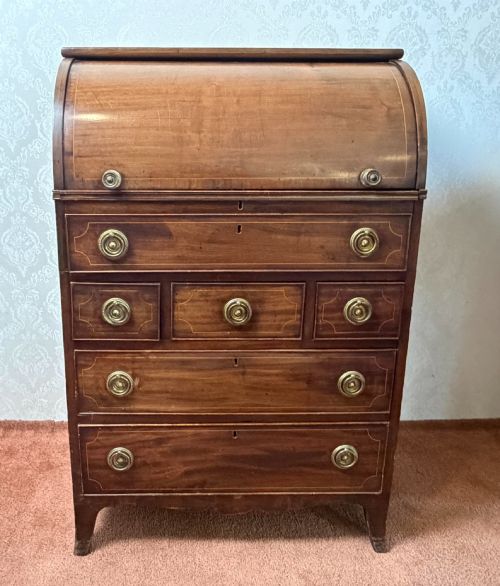
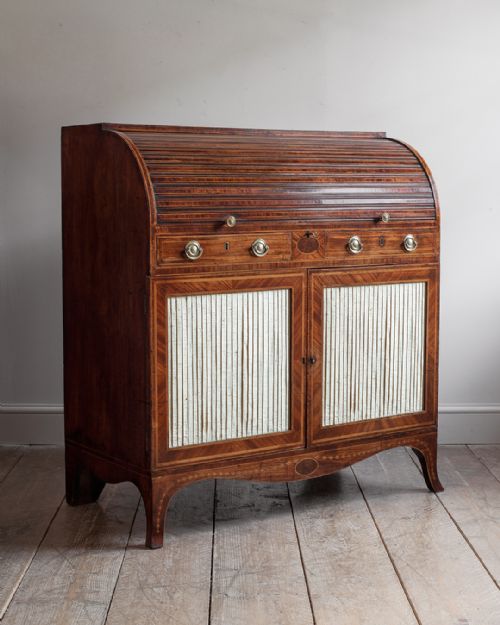


Antique Tambour Bureau
A writing desk closed by a tambour, a flexible shutter of narrow wooden slats glued to canvas, which slides in grooves to shut the writing surface and pigeonholes away without clearing the desk first.
Antique Tambour Bureau
The tambour was taken up for writing furniture in the later 18th century as an alternative to the hinged fall-front. Slats laid on canvas run in curved grooves, so the desk closes without a flap swinging down into the room and without the papers being tidied away. It stayed in use through the 19th century and fed into the Edwardian roll-top desk.
Mahogany is the default timber, named in ten of twenty-seven titles on Sellingantiques, and the word desk appears in twelve. The piece you are most likely to meet is a Georgian or George III mahogany tambour-topped writing table or bureau of domestic scale, small enough for a bedroom or a corner of a drawing room.
Around that centre sit several groups. Bureau bookcases carry a shelved or glazed stage above the tambour, about one in six of the listings. Victorian and Edwardian oak and walnut bureaux, two of them Arts and Crafts, make up roughly another third. Satinwood and inlaid ladies' pieces form a small, consistently high-priced group, and France supplies the only two Continental examples, one with a marble top. One Anglo-Indian campaign padouk writing slope is the outlier.
Dating is loose. Only seven of the twenty-seven listings carry a clean year, and those run 1800 to 1910; the rest sit under broad labels such as 18th Century, Georgian or Victorian. One listing dated 19th Century calls itself George IV in the same breath. Dealers also swap the words tambour, cylinder and roll top freely, sometimes using two of them for a single piece.
Where The Range Splits
Timber does most of the sorting. Satinwood and figured mahogany sit at the top, with the George III mahogany and satinwood writing tables and the satinwood ladies' desks taking the upper end of the range. Late Victorian and Edwardian oak bureaux occupy the bottom. Walnut falls between the two.
Stated period pulls in the same direction. The six listings dated 18th Century cluster in the upper half, and Georgian attributions lift a piece even where the dating is a label rather than a year. Decoration follows: inlaid and marquetry-described surfaces sit higher than plain ones.
Then there is what the maker asked of the form. A plain tambour writing table is one thing; a bookcase stage above it, a desk finished for use from both sides, or a tambour-fronted library desk is another, and those complex pieces take the top of the range. A named firm or an attribution in the title lifts a piece above the middle too, though such names are uncommon in this small archive.
Antique Tambour Bureau Retail Price Guide 2026
Typical UK retail prices for tambour bureau, calculated from the Sellingantiques database of over a million retail prices indexed since 2003. This retail price guide relies exclusively on Sellingantiques data; no external sources or auction records are used, so the figures do not describe the wider market.
Mahogany is the timber named most often in tambour bureau titles on Sellingantiques. Oak, walnut, satinwood and a single padouk make up most of the rest.
The Antique Tambour Bureau Glossary
- Tambour
- A flexible shutter of narrow slats glued to a canvas backing, sliding in grooves to close the desk.
- Cylinder
- A curved quarter-round front closing the writing area, used in these titles almost interchangeably with tambour.
- Roll top
- The same sliding shutter idea under a different name, more usual on later and larger desks.
- Fall-front
- The hinged flap of a conventional bureau, the arrangement the tambour was designed to replace.
- Davenport
- A small sloping-topped desk form, named once in the archive in combination with a tambour top.
- Padouk
- A dense reddish tropical hardwood, seen on the one Anglo-Indian campaign piece and the only non-European timber recorded.
Antique Tambour Bureau: Frequently Asked Questions
How often do tambour bureaux come up for sale?
Only about three a year are listed on Sellingantiques, from a recorded total of twenty-seven listings.
Eighteen different dealers handled those twenty-seven, so almost every dealer who carries one carries a single example rather than a stock of them.
What's the difference between tambour, cylinder and roll top?
In these listings, very little. All three describe a front that slides or curves across to close the writing area, and dealers use the words interchangeably.
Two titles offer both words for the same piece. Roll top tends to appear on later and larger desks, cylinder on the curved quarter-round fronts of Georgian writing tables.
Which woods were used for tambour bureaux?
Mahogany is the default, named in ten of twenty-seven titles. Oak and walnut cover the Victorian and Edwardian end, including two Arts and Crafts examples.
Satinwood turns up on the lighter, more decorative ladies' pieces. One padouk campaign writing slope, Anglo-Indian and dated to around 1840, is the only non-European timber recorded.
Are tambour bureau bookcases a separate thing?
They are the same desk with a stage above it, glazed or shelved. Four titles combine the two, running from a Georgian example to an Edwardian oak roll-top version.
One listing grafts a tambour top onto a davenport instead, which shows how loosely the form was applied.
Why are so many listed simply as 18th Century?
Broad labels do most of the dating in this category. Only seven of twenty-seven listings give a clean year, and those run from 1800 to 1910.
Everything else sits under 18th Century, 19th Century, Georgian or Victorian. A decade in a title is the dealer's estimate rather than a documented date.
Were tambour desks made outside Britain?
Two French examples appear in the archive, one of them a marble-topped lady's writing desk.
The rest are described as English, Georgian or Anglo-Indian, the last being a single campaign writing slope in padouk.