




Antique Bombe Bureau
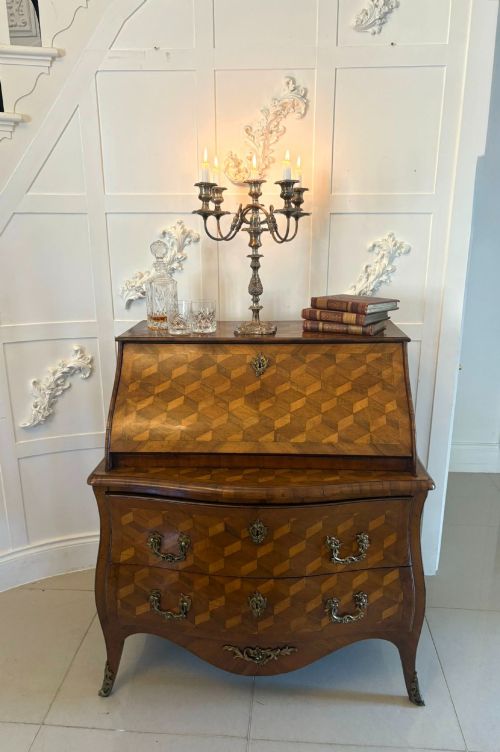
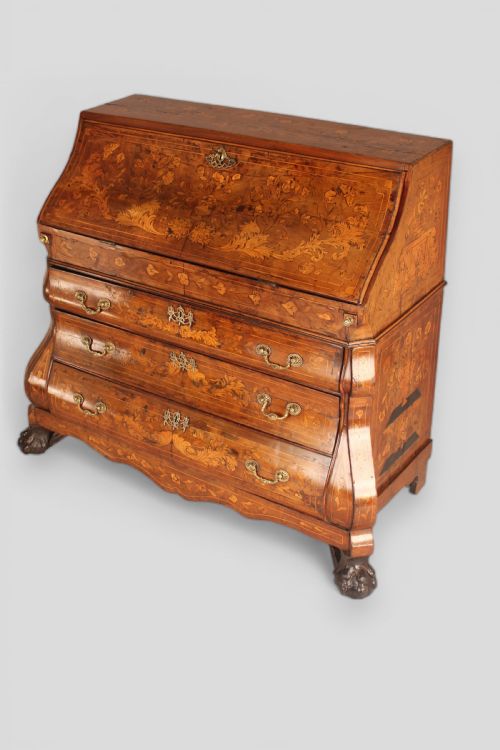
A bombé bureau is a writing desk with a sloping or falling front, its carcase swelling outward in a serpentine curve at the front and sides, with drawers below the writing section.
What Is A Bombé Bureau?
The bombé carcase belongs to the Baroque and Rococo taste of the 18th century, used across Continental Europe wherever a curved, sculptural front was wanted on case furniture. Applied to a bureau, it gave the writing desk a swelling body beneath the fall front. The shape was taken up again in the later 19th century.
On Sellingantiques the form appears overwhelmingly as a Dutch piece in walnut, very often burr walnut with floral marquetry. "Marquetry" is in 25 of 46 titles, "Dutch" in 21, "walnut" in 20, of which "burr walnut" accounts for 11. That combination, dated to the 18th century, is the version you are most likely to meet.
France is the second origin, in 16 titles, and it arrives differently: a smaller secretaire chest faced in rosewood or kingwood marquetry with a marble top, several dated to the 1880s and 1890s. A group of eight titles use "bookcase", meaning a two-part piece with a cabinet above the bureau. Italian marquetry examples turn up twice.
Dating runs from 1750 to 1920, so a bombé bureau is not necessarily an old piece. Twenty of the 46 listings carry a clean year; the rest are dated to a century or a reign, with "18th Century" used 16 times. And the word bombé is not always in the heading, so the shape is often read from the description instead.
Where The Range Sits
Marquetry does most of the work. It is the commonest single term in these titles, and the highest-priced listings are all marquetry-inlaid Dutch pieces, several naming floral marquetry specifically. Burr walnut appears at both ends of the range, so it is the pairing of burr walnut with marquetry, not the veneer alone, that lifts a piece.
Two-part construction counts for a good deal. Several of the highest-priced examples are Dutch marquetry bureau bookcases or a bureau cabinet bookcase, and scale follows the same line: titles using "Large" or "Substantial" sit among the dearer pieces, while the smallest named form, a bombé-fronted bonheur de jour, sits at the bottom.
Date separates the two halves of the category. The 18th-century Dutch pieces occupy the top; the French marble-top secretaires of the 1880s and 1890s and the two listings dated to the 1920s sit lower. Parquetry-faced and solid-timber examples, including one in yew and elm, make up a modest minority below the marquetry work.
Retail Price Guide 2026
Typical UK retail prices for bombe bureau, calculated from the Sellingantiques database of over a million retail prices indexed since 2003. This retail price guide relies exclusively on Sellingantiques data; no external sources or auction records are used, so the figures do not describe the wider market.
Dated bombe bureaux on Sellingantiques run from 1750 to 1920, a spread of 170 years for one shape.
The Antique Bombe Bureau Glossary
- Bombé
- The outward-swelling, bulging curve of the carcase front and sides that names the form. Some titles say "bombé fronted", where only the front swells and not the sides.
- Bureau
- A writing desk with a sloping or falling front enclosing the writing surface and interior fittings.
- Bureau bookcase
- A bureau with a glazed or panelled upper cabinet on top. Eight titles here use the word "bookcase".
- Marquetry
- Pictorial veneer inlay in shaped pieces of wood. Floral marquetry, worked as flowers and foliage, is the pattern tied to the Dutch pieces in these titles.
- Parquetry
- Veneer laid in geometric rather than pictorial patterns, used on several of the French walnut examples.
- Secretaire a abattant
- An upright fall-front writing cabinet, the flap dropping to form the writing surface. One listing in the archive uses the term.
Frequently Asked Questions
How many bombé bureaux come up for sale?
Only about six are listed on Sellingantiques in a year, so the form comes round slowly.
Even so, 23 different dealers have handled one across the archive. Almost every dealer who carries the form has carried a single example rather than a run of them.
Why are so many of them Dutch?
Dutch is by far the commonest origin claimed, in 21 of the 46 listings, and "Dutch marquetry" appears as a phrase in nine titles.
France is second at 16. Italy appears twice and Scotland once, which makes anything other than Dutch or French unusual in this category.
What does a French bombé bureau look like?
The French pieces read as smaller secretaire chests rather than sloping-front desks, faced in rosewood or kingwood marquetry and topped with marble.
Several are dated 1880 to 1890. A cluster of four kingwood marble-top examples dated 1880 sit at an identical figure, and five French walnut parquetry bureaux repeat in the same way.
Are these all 18th-century pieces?
No. The dated field stretches from 1750 to 1920, a 170-year spread for one shape.
"18th Century" is the largest single bracket at 16 listings, with "19th Century" used five times and "Georgian" four. Two listings are dated to the 1920s and one carries no date at all.
Which examples sit at the top of the range?
The top is occupied entirely by 18th-century Dutch marquetry burr walnut bureau bookcases, where the two-part form, the burr veneer and the inlay all come together.
The bottom of the range is a small French bombé-fronted bonheur de jour, a ladies' writing desk.
Do any of these bureaux carry a maker's name?
No maker or workshop attaches to this category in the archive. A scan for maker names returned nothing.
One title attributes a piece to a named retailer, and that is the extent of it. Origin, timber and date are what the listings give you instead.
What unusual forms turn up in this category?
A few appear only once across the whole archive: a bombé-fronted cylinder bureau, closed by a curved roll rather than a flat fall, and a secretaire a abattant.
There is also one bureau in yew and elm rather than the walnut or rosewood that dominates.