20,000  PAGES BROWSED TODAY PAGES TODAY 29  ANTIQUES UPLOADED TODAY NEW ARRIVALS
ID #SA1230110
FOR SALE
£85,000
Email
Save
17th Century Japanese Lacquer Cabinet on French Giltwood Regence Stand
Loveday Antiques
for sale €99,450     $107,950
£85,000
Loveday Antiques

Loveday Antiques

Sellingantiques Verified Since Mar 2012
View Dealers Stock Page
  • About Us
    Specialist furniture dealers 18th-20th century
  • Trade Associations
    Loveday Antiques is a registered member of LAPADA  BADA  CINOA
Id #SA1230110
PDF SHARE
SAVE

17th Century Japanese Lacquer Cabinet on French Giltwood Regence Stand

17th century
For Sale by Loveday Antiques
Description

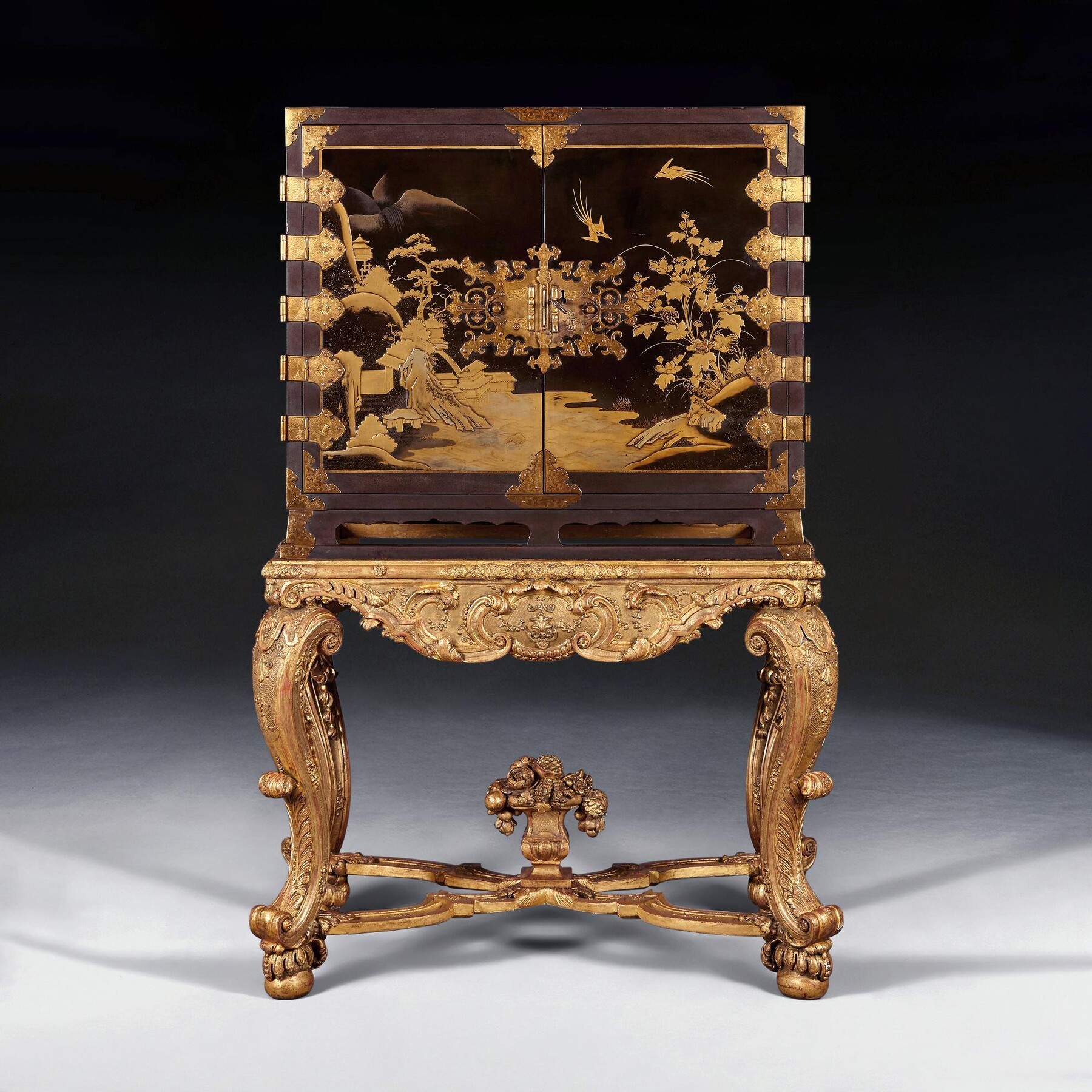
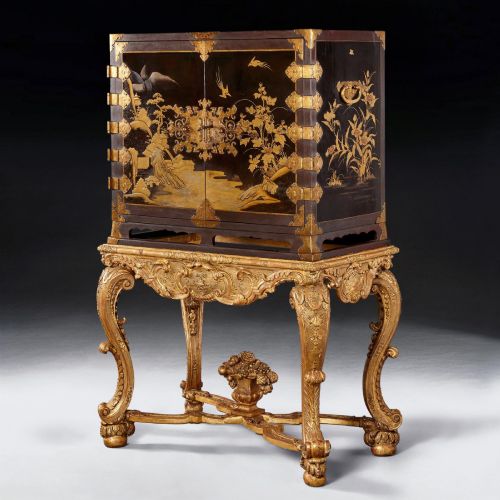
An Extremely Fine and Very Important 17th Century Japanese Lacquer Cabinet on French Giltwood Stand of Regence Period circa 1680-1690

Provenance

Likely acquired by Herman Willem Daendels (1762-1818)

Mr. Herman August Daendels (1918-2000), Amsterdam
Eurasia Antiques, Amsterdam

Biënnale des Antiquairs, Paris, 1998

Private Collection, Belgium
Kollenburg Antiquairs, Oirschot-chosen for the press release for the Art Affair Fair, Amsterdam, in 2020, Also taken to TEFAF Maastricht

A Private European collection

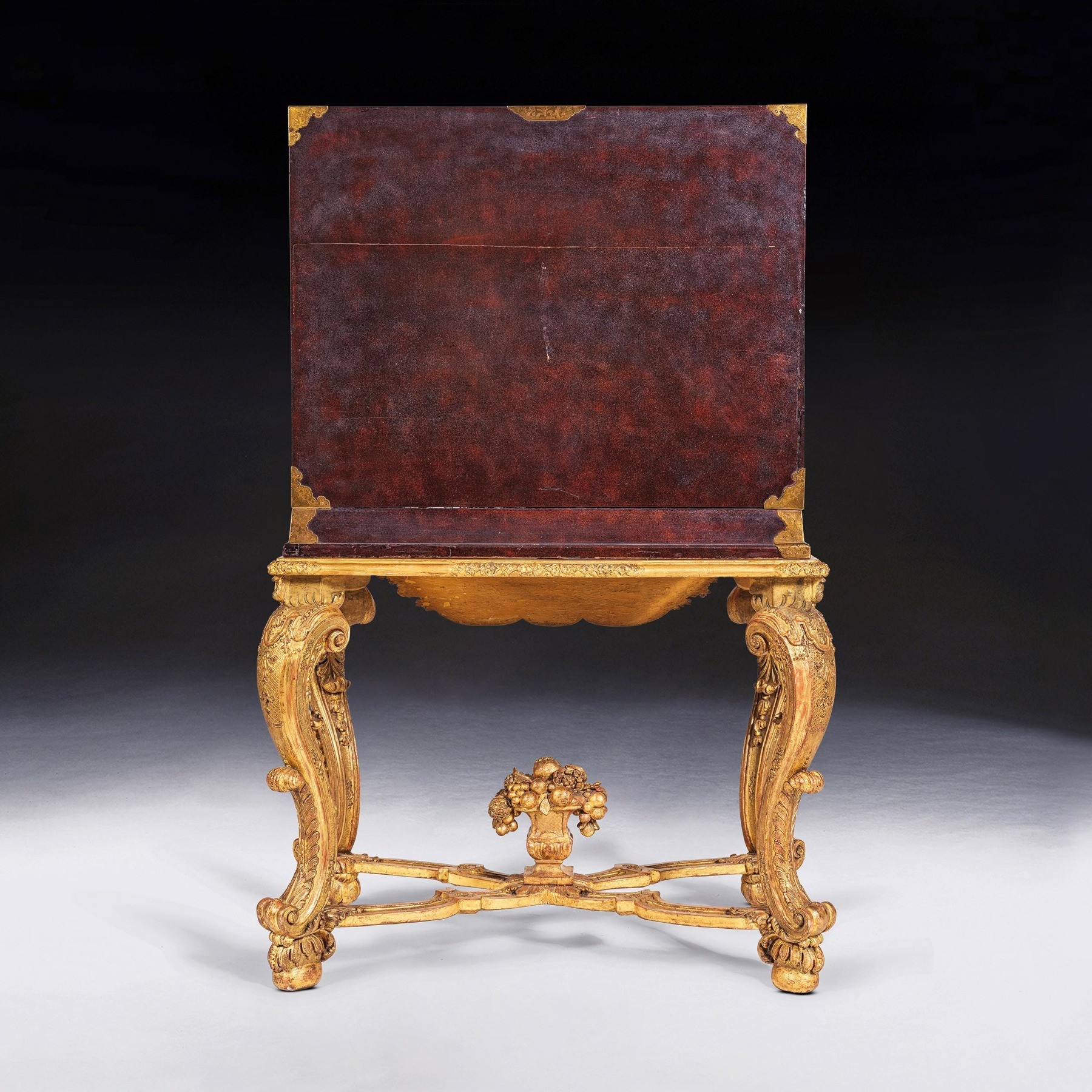
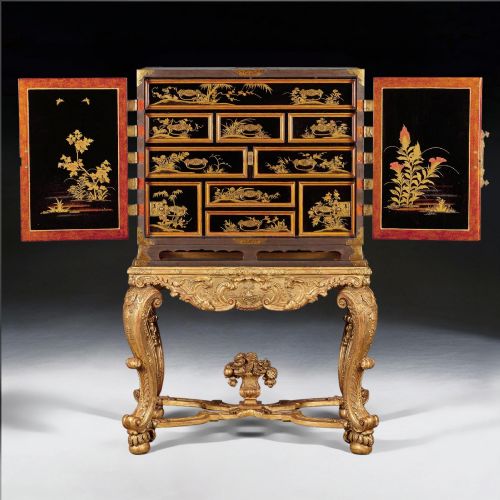
This fine Japanese lacquer cabinet or ‘Cantoor’ was presumably originally acquired by a French connoisseur due to the French Regence period base it sit upon. The craze for lacquer in the west from the 16th century onwards has been extensively documented and it is generally accepted that the finest of all lacquers, technically speaking, were those produced in Japan rather than China. This cabinet is one of the best examples of Japanese export lacquer.
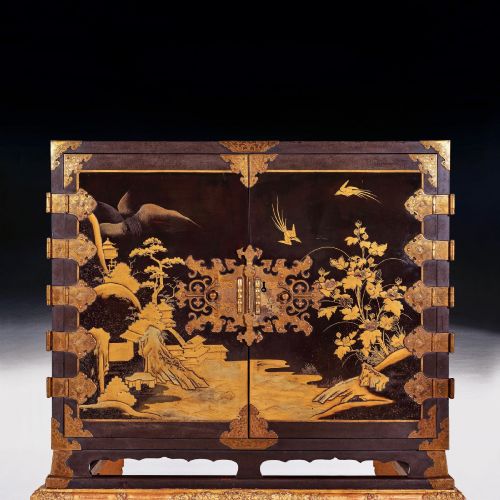
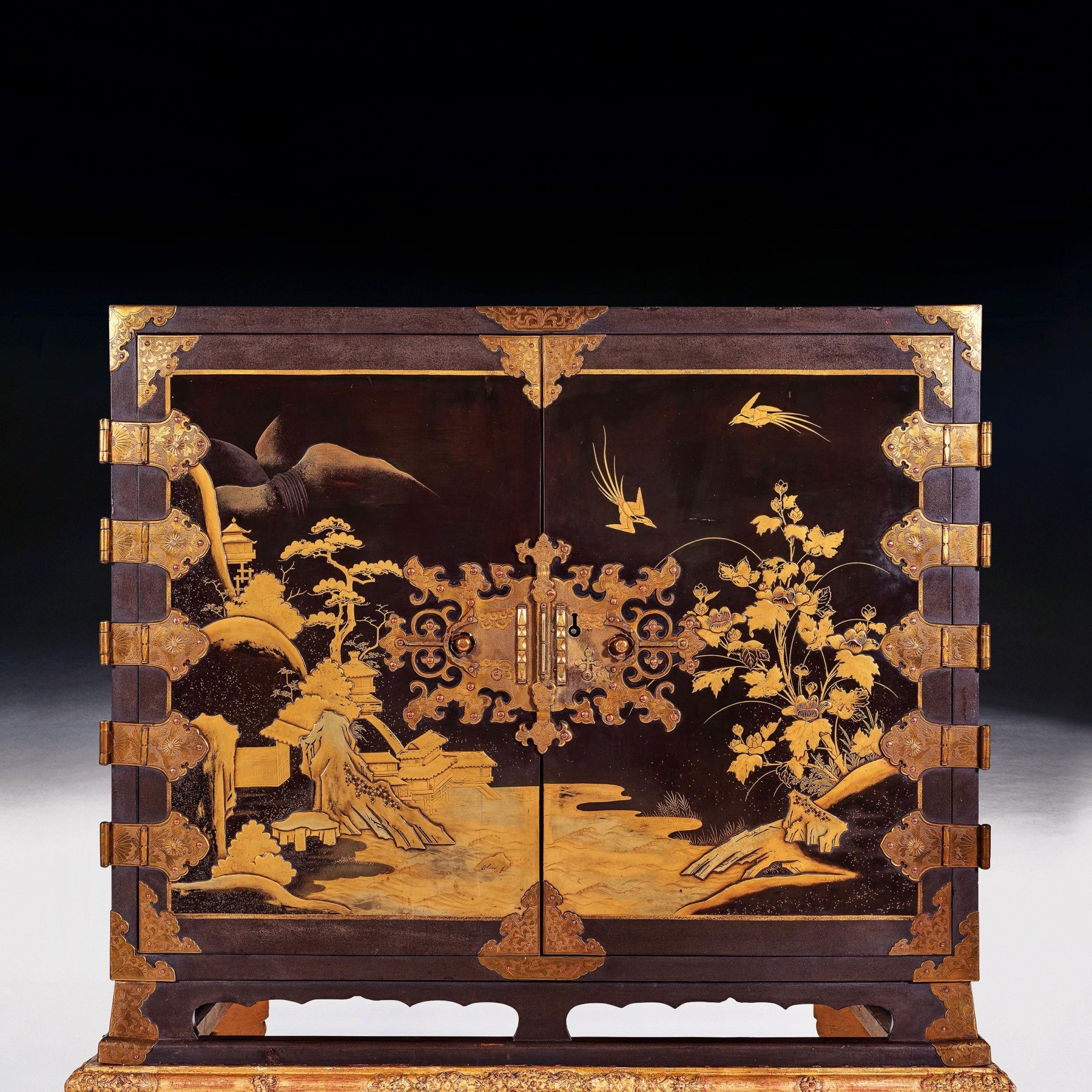
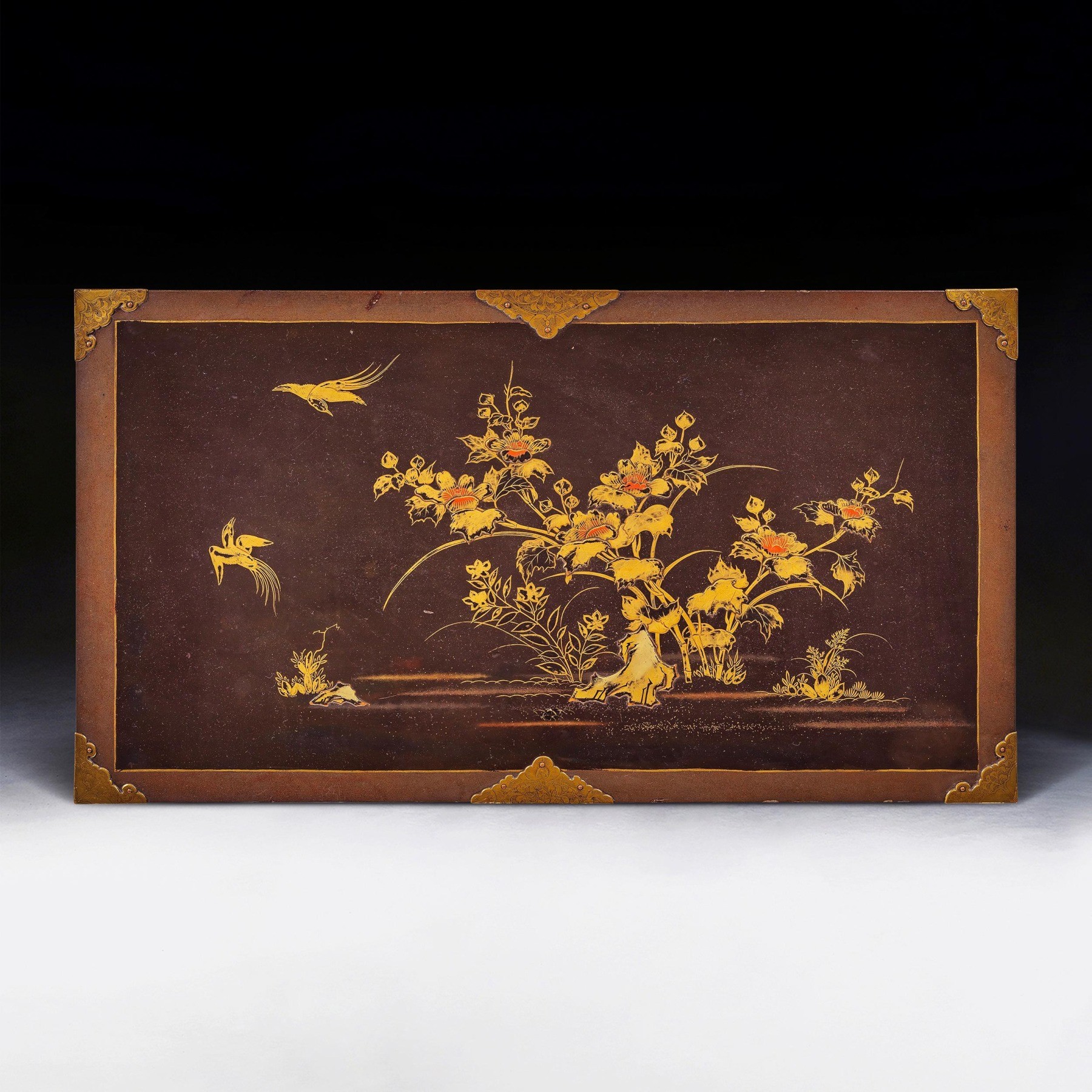
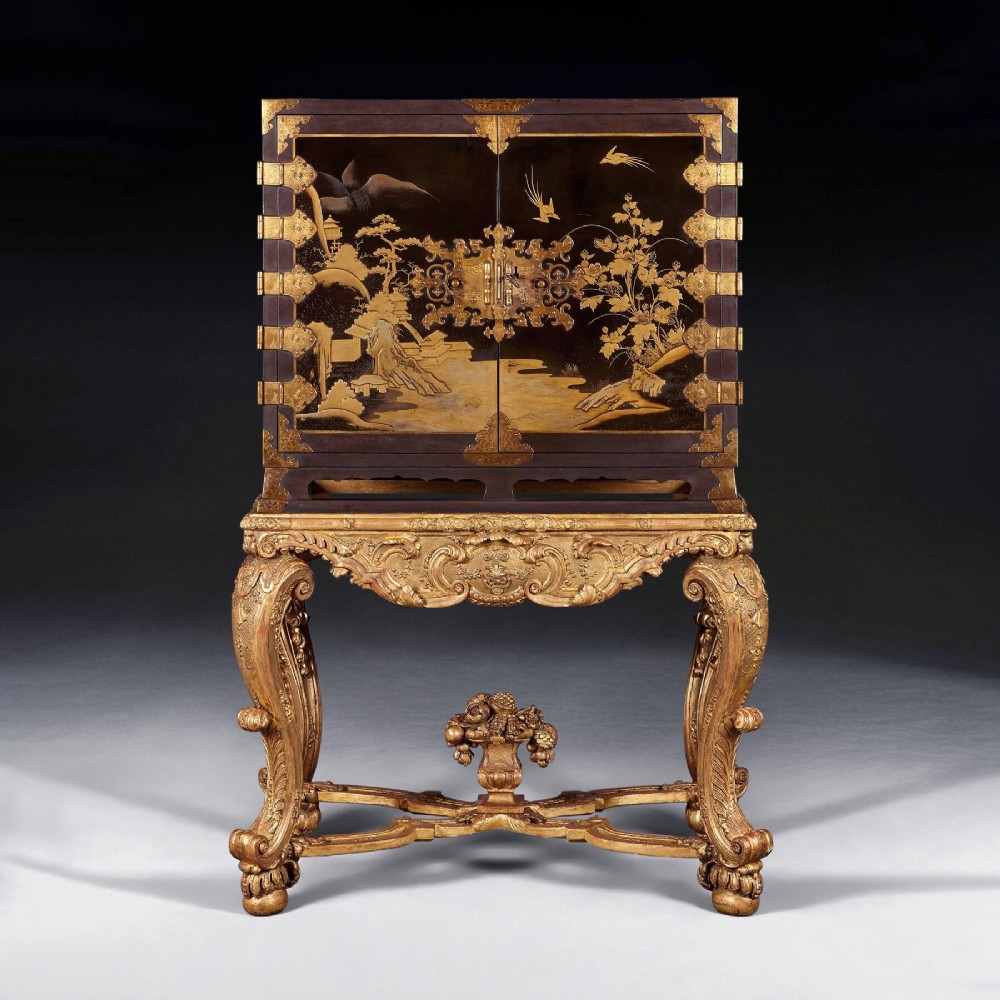
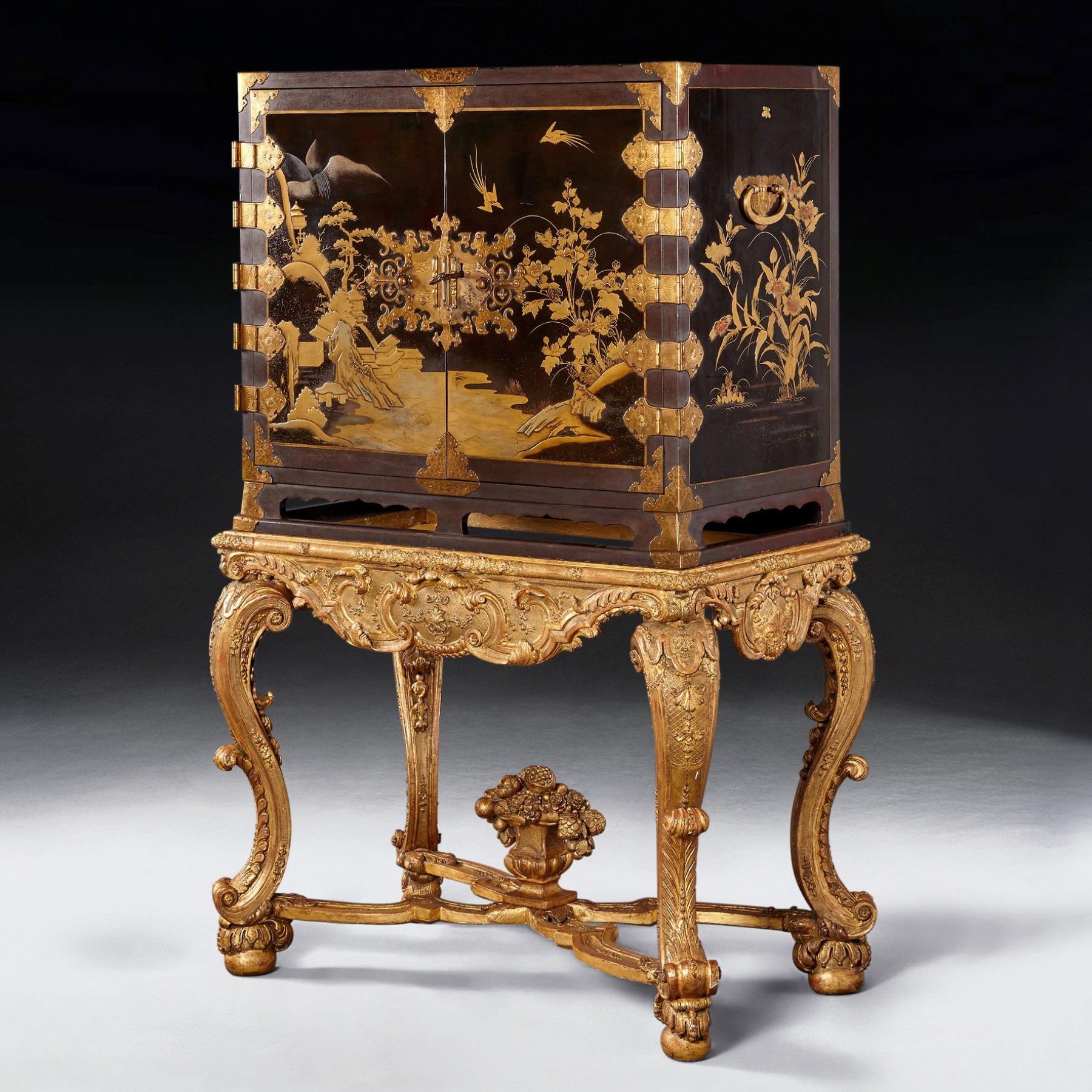
The lacquer work on the cabinet, executed in a variety of techniques including Maki-e, is exquisite and survives in amazing condition. The front depicts a landscape with mountains, temples, trees and a river with flying phoenixes, the lacquered boarders are more of a powdered effect. Each door has five gilt metal engraved brass hinges with further engraved gilt metal mounts to protect the corners of the doors and the outer carcase. There is a two part gilt metal lock plate to the centre of elaborate design that is particularly finely executed.
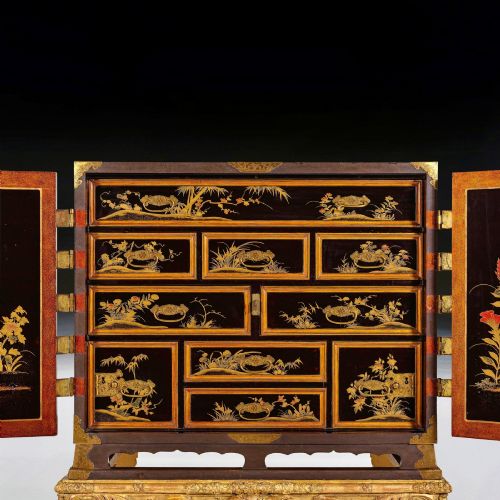
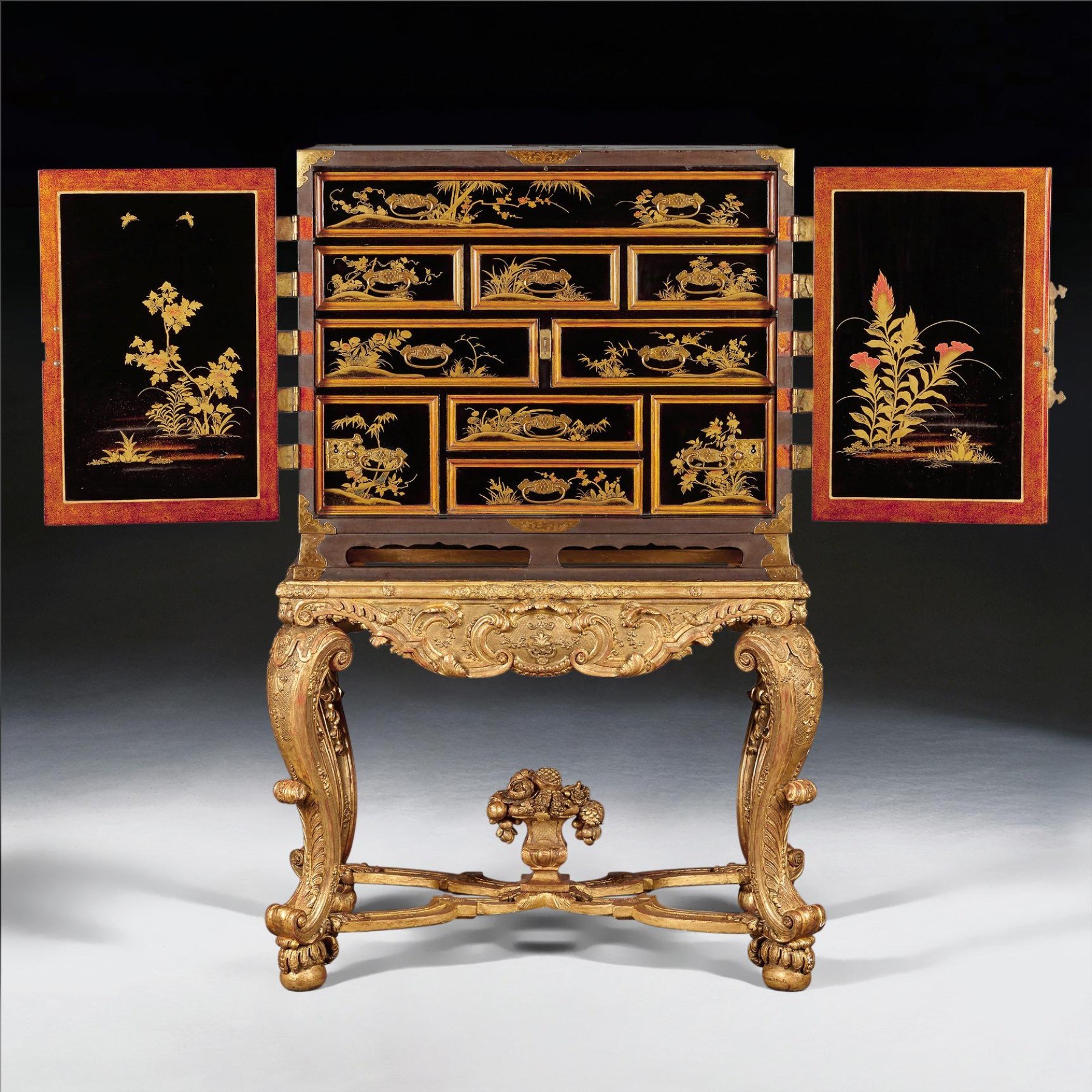
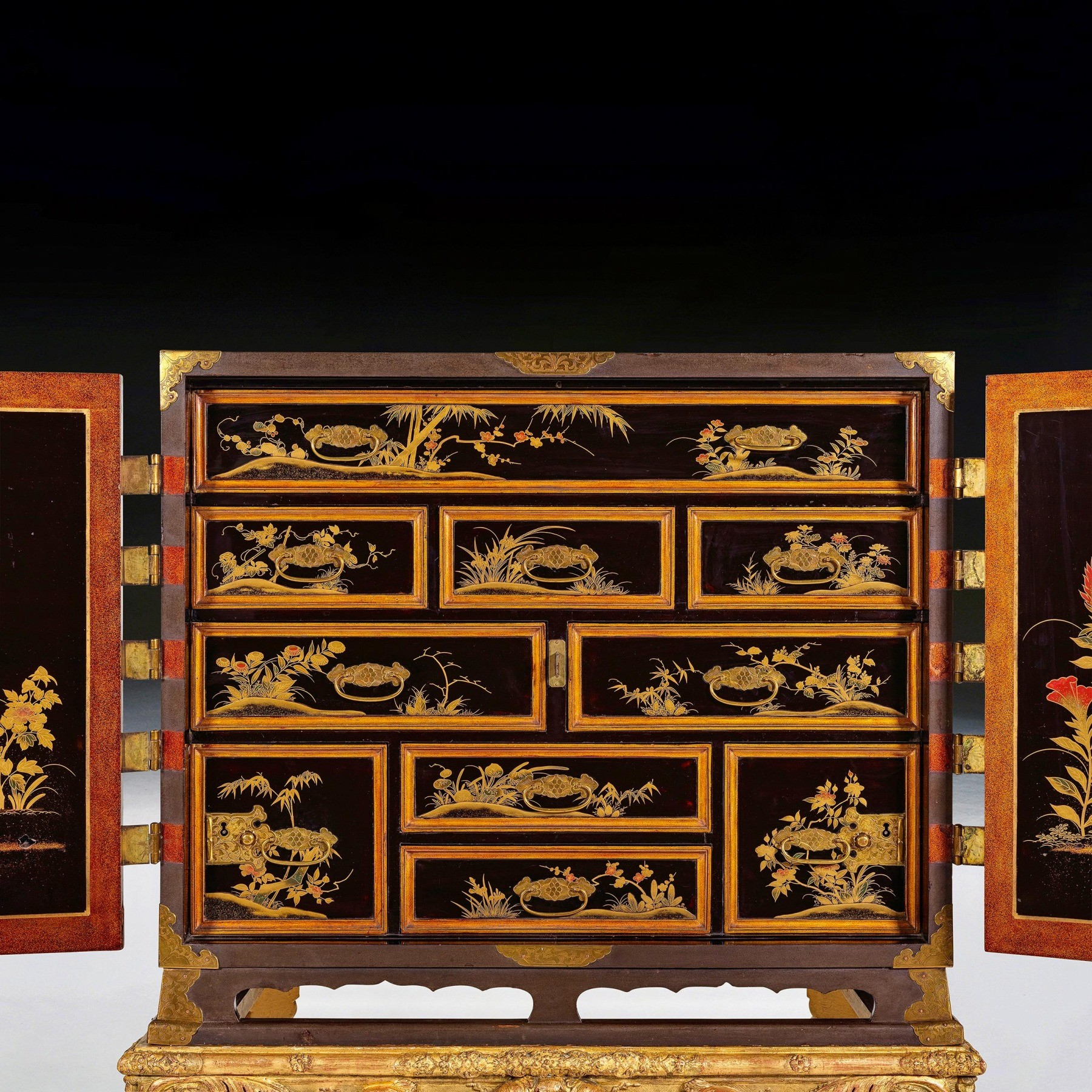
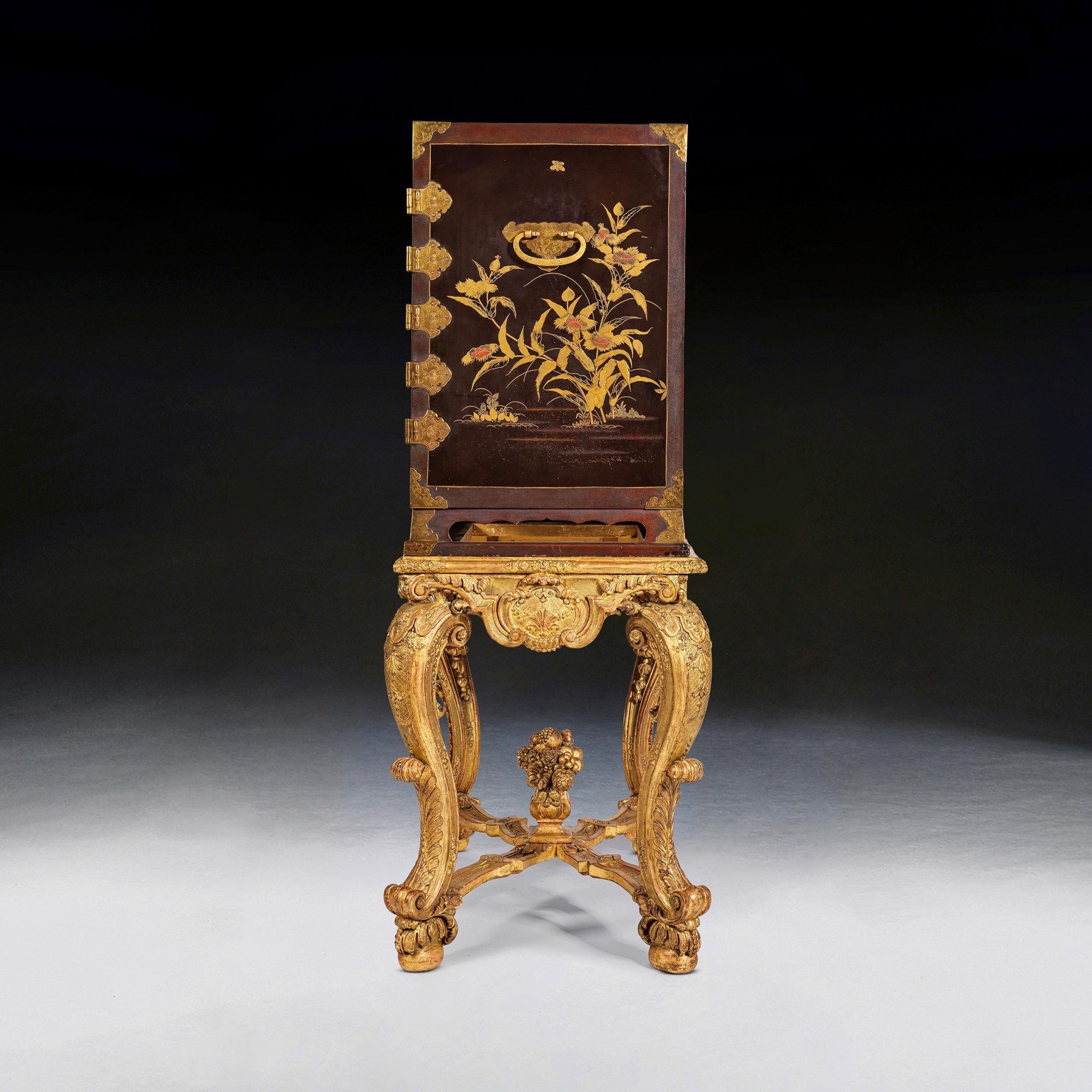
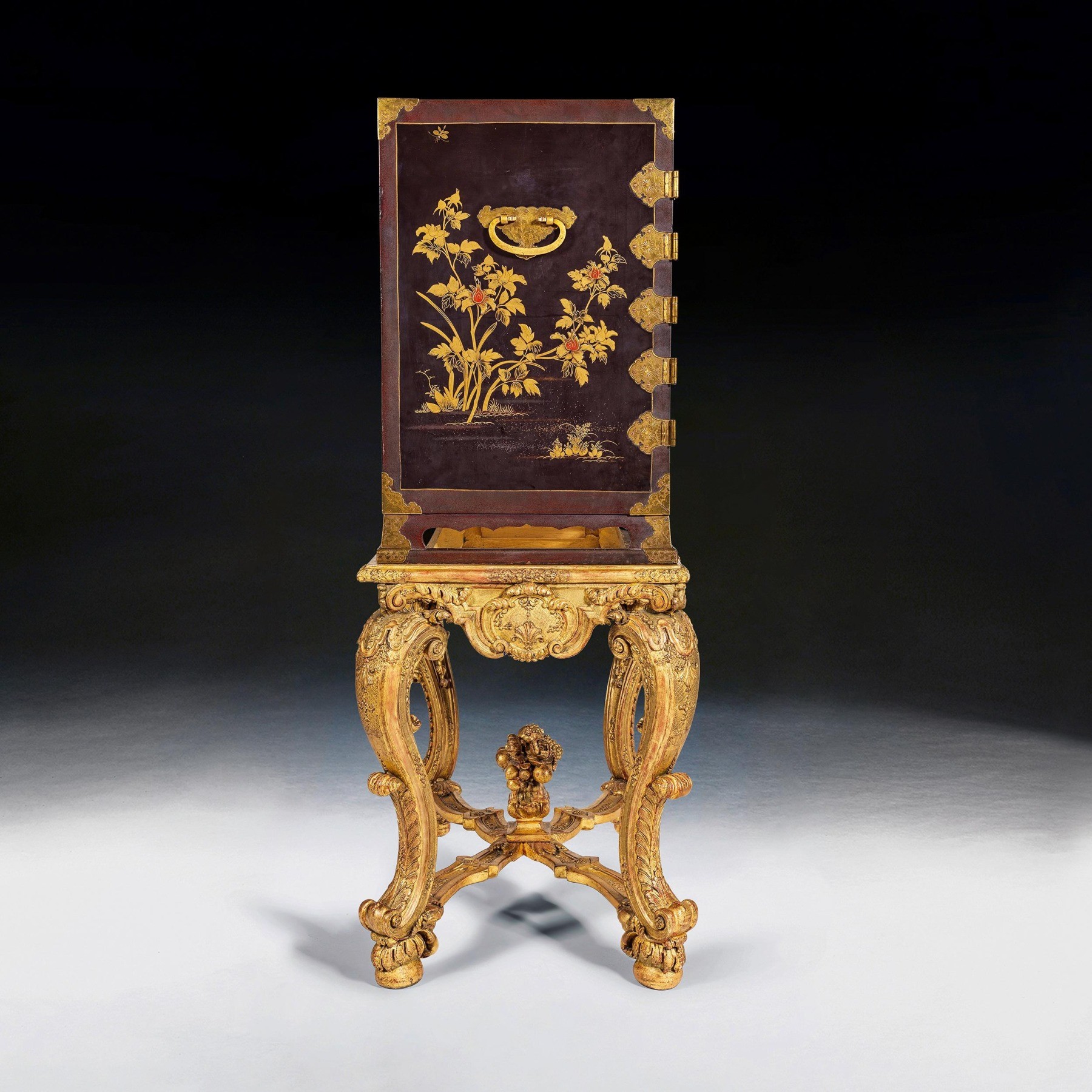
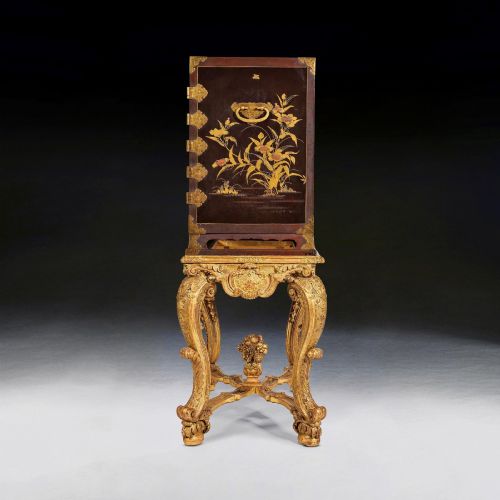
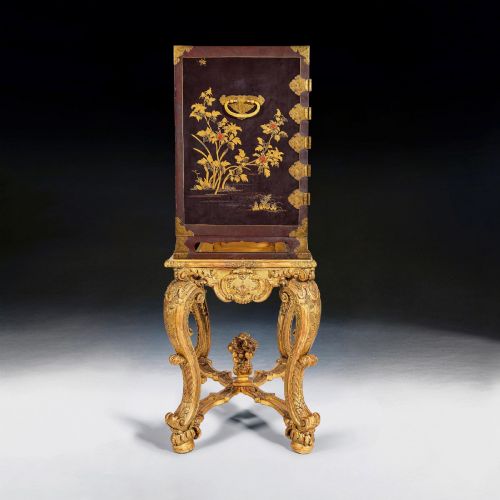
The sides being decorated with feature scenes of flowers and insects, with large and impressive engraved gilt brass handles. Like all of the finest lacquer, the decoration is executed in a variety of levels of relief, making the scene much more three dimensional as a result.
With Japanese export lacquer there was a evolutionary sequence to stylistic change that can be traced back with some accuracy during the 16th and 17th centuries. The Namban lacquer of the late 16th century relied on highly wrought mother of pearl inlay and gold lacquer on a black ground. As the 17th century unfolded, there was progression towards a generally finer lacquer without the use of mother of pearl coupled with this was an increased interest in a more pictorial style with landscapes being used more extensively initially within boarders. Gradually by 1690’s the borders began to disappear from export lacquer work, so the fact that borders are still in evidence on our piece is further proof of being earlier than 1690 in date for the lacquer work.
Most early Japanese lacquer arrived in the west through the Portuguese mercantile companies but this changed by around 1630 when most of the trade between Europe and Japan was conducted through the Dutch East India Company, as is almost certainly the case with the present piece.
The so-called "pictorial style" of Japanese lacquer work was developed around c.1630 specifically to suit the taste of the new Dutch market for such pieces and, as such, this became highly influential throughout the rest of Europe. Lacquer work required painstaking is built up of many layers of the prepared sap of thelacquer tree Rhus vernicifera. After applying each layer, the object is dried in a room with a high humidity and then sanded. The effects of relief are achieved by mixing lime through the lower layers of paint. For the decoration in gold, the maki-e technique is applied, whereby gold powder is strewn or gold foil is placed onto the wet varnish. The gold then sinks somewhat into the lacquer. After the lacquer layer has dried, it can be polished.. As such, pieces like the present cabinet would take a very long time to produce and this was also a factor in the high prices attached to goods of this sort in both the export and domestic Japanese markets.

Physical Dimensions
Height
157cm (61.81")
Width
94cm (37.01")
Depth
52cm (20.47")
Declaration

Loveday Antiques has dated this Japanese Lacquer Cabinet Stand to the 17th Century.

Reference Numbers
Sellingantiques Reference
SA1230110
Dealers Internal Reference
3061
Dealers Notes

Loveday Antiques is a family run business originally established since 1969 in London.

Now in its second generation, Loveday Antiques specialises in an eclectic mix of 18th to 20th Century European furniture and works of art, with a strong emphasis on quality, uniqueness and colour.

As proud members of BADA & LAPADA, the largest association for professional art and antique dealers in the United Kingdom and members of CINOA, the worldwide association for antique dealers you can buy from us with 100% confidence and reassurance as we are committed to upholding and abiding by the strict standards of each association.

Our clients can rest assured that each item is as described and photographed.

All Items are sold with 100% satisfaction 14 day money back guarantee, return delivery will be charged for.

We deliver within the UK for usually between £60-£80 and ship worldwide with professional bespoke crating via air to almost all locations. Please contact us at Loveday Antiques with your full postal address for a very competitive quote.

Delivery within the mainland UK will usually be with 7 to 14 days but please allow up to 28 days. We also ship worldwide with a professional bespoke crating service and large International couriers via air and sea to almost all locations. Please contact us at Loveday Antiques with your full postal address for a very competitive quote.

GOODS

All items listed are in excellent condition having been restored using traditional methods by experienced cabinet makers and polishers keeping the original colour and patina wherever possible.

Please bear in mind you may find the usual markings with antique furniture that are commensurate with age which all add to beauty and uniqueness of the item.

VIEWINGS

We have a reputation for being long established antique dealers in London having had showrooms concurrently running in Islington, Chelsea and Ascot. We have relocated our new showroom, due to London overheads, easily reached between A1 or A10 to just outside of Hertford, Hertfordshire.

We will happily arrange for clients to be collected travelling via train. Local stations being Hertford North, Stevenage and Ware, all being a 10 minute drive from us.

Please contact us for location and appointments.

Telephone: 01438 869 819

Payments accepted are Bank Transfer, Cheque, Major Credit Cards or Cash.

Opening Times

Monday to Saturday 9.00am - 5.30pm Please email or call beforehand to make an appointment.

If outside of these times again please call to make an appointment

We have more than 40 years experience in supplying Antique furniture to the trade, public and interior designers from all parts of the world so please buy with confidence as we have passed the test of time.

Description
An Extremely Fine and Very Important 17th Century Japanese Lacquer Cabinet on French Giltwood Stand of Regence Period circa 1680-1690

Provenance

Likely acquired by Herman Willem Daendels (1762-1818)

Mr. Herman August Daendels (1918-2000), Amsterdam

fig 1. A black Japanese urushi lacquer cabinet decorated with gold landscape scenes and metal corner mounts, supported on a carved French Regence giltwood stand with cabriole legs.
fig 1. 17th Century Japanese Lacquer Cabinet on French Giltwood Regence Stand

Eurasia Antiques, Amsterdam

Biënnale des Antiquairs, Paris, 1998

Private Collection, Belgium

Kollenburg Antiquairs, Oirschot-chosen for the press release for the Art Affair Fair, Amsterdam, in 2020, Also taken to TEFAF Maastricht.
Loveday Antiques
fig 2. A black Japanese urushi lacquer cabinet decorated with gold landscape scenes and metal corner mounts, supported on a carved French Regence giltwood stand with cabriole legs.
fig 2. 17th Century Japanese Lacquer Cabinet on French Giltwood Regence Stand

A Private European collection

This fine Japanese lacquer cabinet or ‘Cantoor’ was presumably originally acquired by a French connoisseur due to the French Regence period base it sit upon. The craze for lacquer in the west from the 16th century onwards has been extensively documented and it is generally accepted that the finest of all lacquers, technically speaking, were those produced in Japan rather than China. This cabinet is one of the best examples of Japanese export lacquer.

fig 3. A black Japanese urushi lacquer cabinet decorated with gold landscape scenes and metal corner mounts, supported on a carved French Regence giltwood stand with cabriole legs.
fig 3. 17th Century Japanese Lacquer Cabinet on French Giltwood Regence Stand

The lacquer work on the cabinet, executed in a variety of techniques including Maki-e, is exquisite and survives in amazing condition. The front depicts a landscape with mountains, temples, trees and a river with flying phoenixes, the lacquered boarders are more of a powdered effect. Each door has five gilt metal engraved brass hinges with further engraved gilt metal mounts to protect the corners of the doors and the outer carcase. There is a two part gilt metal lock plate to the centre of elaborate design that is particularly finely executed.

fig 4. A black Japanese urushi lacquer cabinet decorated with gold landscape scenes and metal corner mounts, supported on a carved French Regence giltwood stand with cabriole legs.
fig 4. 17th Century Japanese Lacquer Cabinet on French Giltwood Regence Stand

The sides being decorated with feature scenes of flowers and insects, with large and impressive engraved gilt brass handles. Like all of the finest lacquer, the decoration is executed in a variety of levels of relief, making the scene much more three dimensional as a result.

fig 5. A black Japanese urushi lacquer cabinet decorated with gold landscape scenes and metal corner mounts, supported on a carved French Regence giltwood stand with cabriole legs.
fig 5. 17th Century Japanese Lacquer Cabinet on French Giltwood Regence Stand

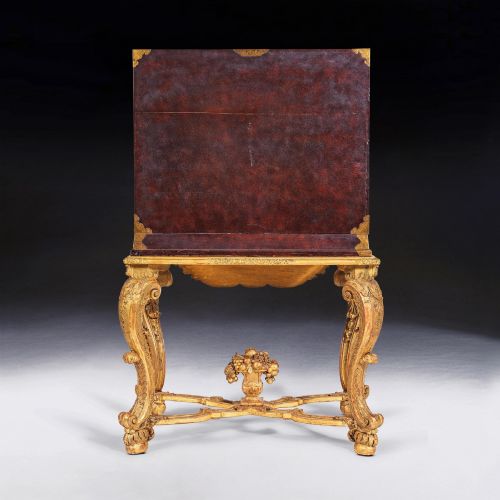
With Japanese export lacquer there was a evolutionary sequence to stylistic change that can be traced back with some accuracy during the 16th and 17th centuries. The Namban lacquer of the late 16th century relied on highly wrought mother of pearl inlay and gold lacquer on a black ground. As the 17th century unfolded, there was progression towards a generally finer lacquer without the use of mother of pearl coupled with this was an increased interest in a more pictorial style with landscapes being used more extensively initially within boarders. Gradually by 1690’s the borders began to disappear from export lacquer work, so the fact that borders are still in evidence on our piece is further proof of being earlier than 1690 in date for the lacquer work.

fig 6. A black Japanese urushi lacquer cabinet decorated with gold landscape scenes and metal corner mounts, supported on a carved French Regence giltwood stand with cabriole legs.
fig 6. 17th Century Japanese Lacquer Cabinet on French Giltwood Regence Stand

Most early Japanese lacquer arrived in the west through the Portuguese mercantile companies but this changed by around 1630 when most of the trade between Europe and Japan was conducted through the Dutch East India Company, as is almost certainly the case with the present piece.

fig 7. A black Japanese urushi lacquer cabinet decorated with gold landscape scenes and metal corner mounts, supported on a carved French Regence giltwood stand with cabriole legs.
fig 7. 17th Century Japanese Lacquer Cabinet on French Giltwood Regence Stand

The so-called "pictorial style" of Japanese lacquer work was developed around c.1630 specifically to suit the taste of the new Dutch market for such pieces and, as such, this became highly influential throughout the rest of Europe. Lacquer work required painstaking is built up of many layers of the prepared sap of thelacquer tree Rhus vernicifera. After applying each layer, the object is dried in a room with a high humidity and then sanded. The effects of relief are achieved by mixing lime through the lower layers of paint. For the decoration in gold, the maki-e technique is applied, whereby gold powder is strewn or gold foil is placed onto the wet varnish. The gold then sinks somewhat into the lacquer. After the lacquer layer has dried, it can be polished.. As such, pieces like the present cabinet would take a very long time to produce and this was also a factor in the high prices attached to goods of this sort in both the export and domestic Japanese markets.

Height
157cm (61.81")
Width
94cm (37.01")
Depth
52cm (20.47")
Date of Manufacture

Loveday Antiques has dated this Japanese Lacquer Cabinet Stand to the 17th Century.

Reference Numbers
Sellingantiques Ref
SA1230110
Dealers Internal Ref
3061
Loveday Antiques
Loveday Antiques
Sellingantiques verified Since Mar 2012

Specialist furniture dealers 18th-20th century

Dealer Profile

You can view the stock and full dealer information on the Loveday Antiques Profile Page

Trade Associations

Loveday Antiques is a registered member of LAPADA  BADA  CINOA
PDF SHARE
SAVE
A black Japanese urushi lacquer cabinet decorated with gold landscape scenes and metal corner mounts, supported on a carved French Regence giltwood stand with cabriole legs.
1 / 9
Archive I A black Japanese urushi lacquer cabinet decorated with gold landscape scenes and metal corner mounts, supported on a carved French Regence giltwood stand with cabriole legs.

17th Century Japanese Lacquer Cabinet on French Giltwood Regence Stand
Archive II A black Japanese urushi lacquer cabinet decorated with gold landscape scenes and metal corner mounts, supported on a carved French Regence giltwood stand with cabriole legs. View II
Archive III A black Japanese urushi lacquer cabinet decorated with gold landscape scenes and metal corner mounts, supported on a carved French Regence giltwood stand with cabriole legs. View III
Archive IV A black Japanese urushi lacquer cabinet decorated with gold landscape scenes and metal corner mounts, supported on a carved French Regence giltwood stand with cabriole legs. View IV
Archive V A black Japanese urushi lacquer cabinet decorated with gold landscape scenes and metal corner mounts, supported on a carved French Regence giltwood stand with cabriole legs. View V
Archive VI A black Japanese urushi lacquer cabinet decorated with gold landscape scenes and metal corner mounts, supported on a carved French Regence giltwood stand with cabriole legs. View VI
Archive VII A black Japanese urushi lacquer cabinet decorated with gold landscape scenes and metal corner mounts, supported on a carved French Regence giltwood stand with cabriole legs. View VII
Archive VIII A black Japanese urushi lacquer cabinet decorated with gold landscape scenes and metal corner mounts, supported on a carved French Regence giltwood stand with cabriole legs. View VIII
Archive IX A black Japanese urushi lacquer cabinet decorated with gold landscape scenes and metal corner mounts, supported on a carved French Regence giltwood stand with cabriole legs. View IX
Enlarged Archival View
Telephone 01438 869819
Location
Benington
Hertfordshire
United Kingdom
Verified Since Mar 2012
Items For Sale 81
Items Sold 943
Loveday Antiques
Loveday Antiques
Verified Since Mar 2012
View Dealer Info
Location: Benington, Hertfordshire, United Kingdom
Verified
Mar 2012
For Sale
81
Sold
943
A black Japanese urushi lacquer cabinet decorated with gold landscape scenes and metal corner mounts, supported on a carved French Regence giltwood stand with cabriole legs.
17th Century Japanese Lacquer Cabinet On French Giltwood Regence Stand
Ref: SA1230110
A black Japanese urushi lacquer cabinet decorated with gold landscape scenes and metal corner mounts, supported on a carved French Regence giltwood stand with cabriole legs.
Detail View 1
Detail View 2
Detail View 3
Detail View 4
Detail View 5
Detail View 6
Detail View 7
Detail View 8
Archival Detail
Every single antique dealer on our platform is individually approved by our internal team. We verify their professional trade history, ethical standards, and photographic quality to ensure a secure, high-standard buying environment. Upon joining, every dealer agrees to a strict 9-point code of conduct. While issues can occasionally arise, our dealers typically resolve them swiftly and directly with the buyer. In fact, since our founding in 2002, Sellingantiques has only had to step in to help resolve an issue on roughly five occasions—a true testament to the quality of our dealers and their dedication to your happiness.
Our dealers are highly experienced in packing and shipping fragile, high-value antiques. Because you are in direct contact with the dealer, you will be able to easily go through all available shipping and insurance options together to ensure your item arrives safely.
Antiques are the ultimate green purchase. By choosing historical pieces over newly manufactured goods, you completely eliminate the carbon footprint of modern mass production while preserving exceptional, timeless craftsmanship.

During the seventeenth century, Japanese export lacquerware was highly prized in Western Europe. To suit European interior fashions and raise the low-profile Asian chests off the floor, aristocrats commissioned local craftsmen to build elaborate carved and gilded stands specifically tailored to display these cabinets.

The cabinets were constructed from wood and coated with sap from the Toxicodendron vernicifluum tree, known as urushi lacquer, decorated using powdered gold and silver dust in maki-e techniques. The accompanying stands were typically carved from European timber, such as pine or beech, and finished with water gilding using gold leaf.

Authentic period pieces exhibit genuine urushi lacquer, which develops microscopic crackling and tone variation over centuries, paired with hand-engraved gilt-metal or brass corner mounts and lockplates. European stands from the era feature traditional joinery, gesso layering beneath gold leaf, and structural wear consistent with aged timber.

A cabinet on stand functions as a striking focal piece within modern or traditional settings, such as a formal drawing room, entrance hall, or dining space. Its rich black and gold finishes contrast effectively against minimalist walls or textured plaster backgrounds.

Maintain stable environmental relative humidity between forty and fifty percent to prevent timber shrinkage and lacquer cracking. Dust gently with a clean microfibre cloth, keeping the cabinet out of direct sunlight and avoiding all liquid cleaners or chemical polishes on urushi surfaces.
items
Add keywords to the filter
Price
£100
£250000
Era
Movements
Material
Origin
Stock Location
Freshness
Online Payments
Categories