




Antique Joint Stools
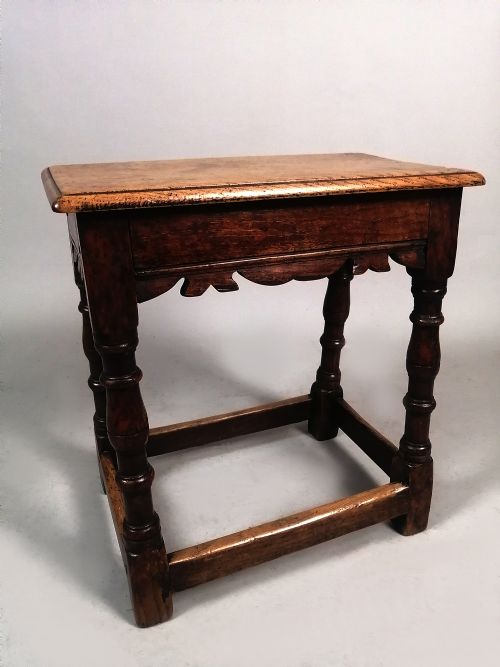
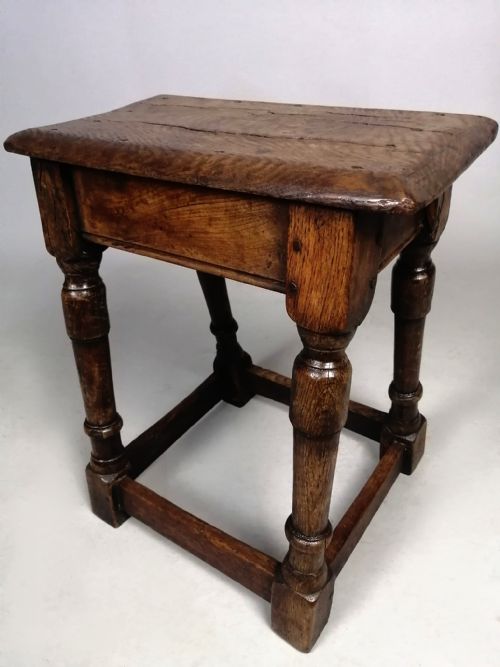
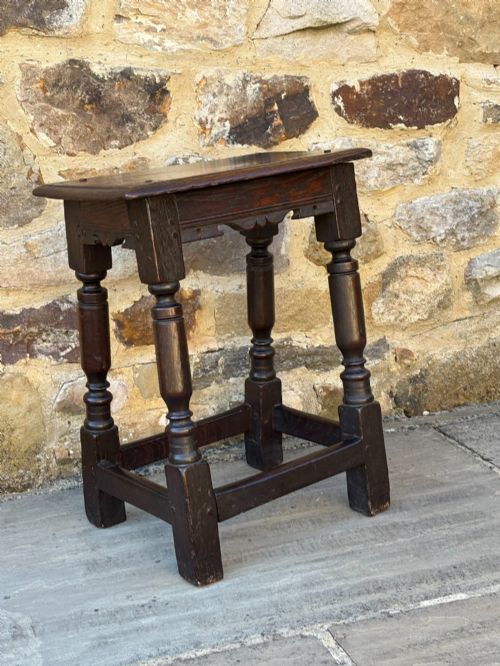
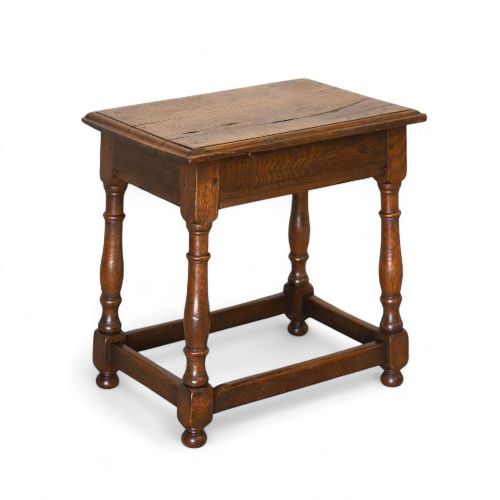
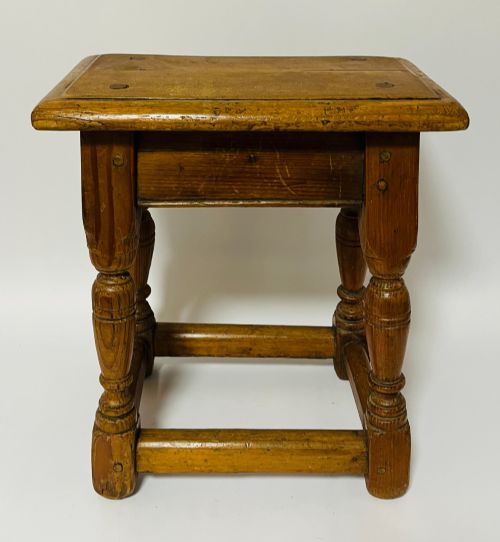
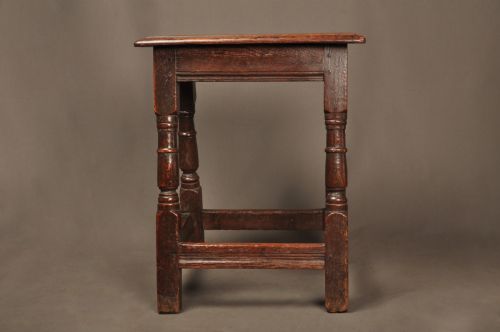
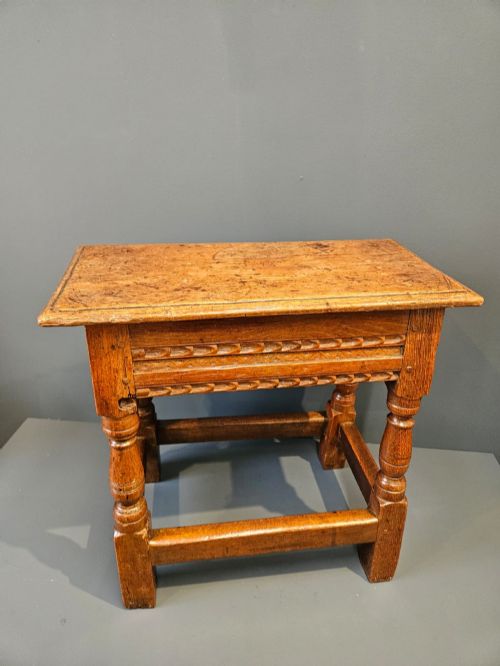
A joint stool is a small four-legged oak stool, pegged together at every joint with a solid plank top, and it was the ordinary seat of an English household at table long before chairs were common.

What Is A Joint Stool?
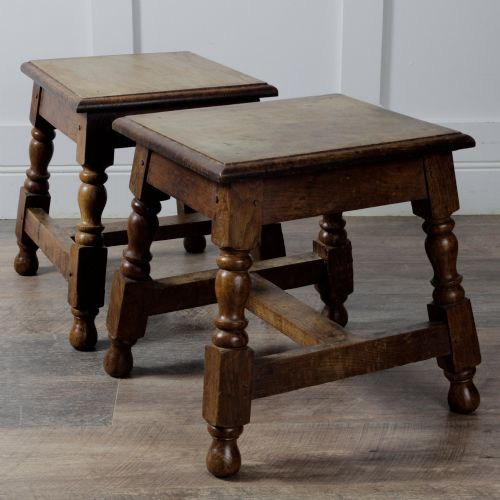
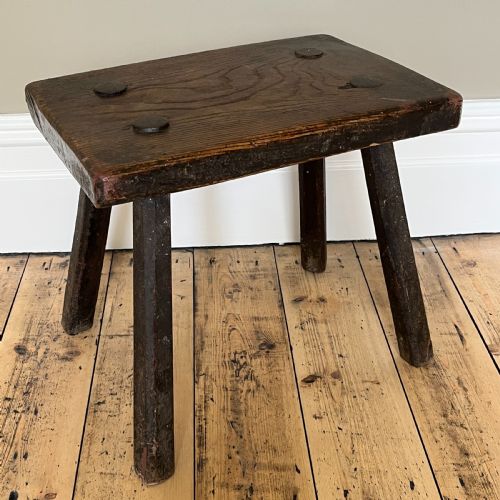
The name comes from joined construction: mortice-and-tenon rails driven through with wooden pins rather than nails or glue. Four legs, turned or plain and slightly splayed, a rail frame and a plank top, at roughly seat height. Oak dominates the titles on Sellingantiques, so oak is what you'll be looking at.
The archive runs from a 17th-century original through Georgian country work to a very large body of later copies made in the same way. Nineteenth-century, Victorian, 1890s and 1920s stools together make up around half of what has passed through, much of it described in titles as "17th century style", "George I Style" or Jacobean Revival. Period 17th-century examples form the largest single date bucket, with Charles I, Charles II, Cromwellian and William and Mary all named.
Dating is often broad rather than precise. Titles hedge with "17th/18th century", "C19th and Earlier" and similar wording, and bucket labels like "Georgian" or "19th Century" carry no year behind them. Where a clean date is given, the range runs 1640 to 1950.
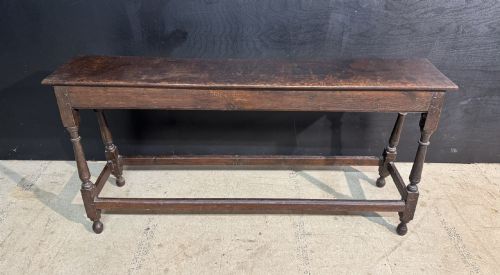
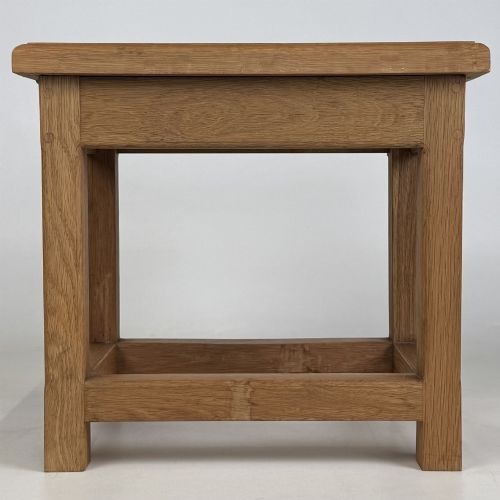
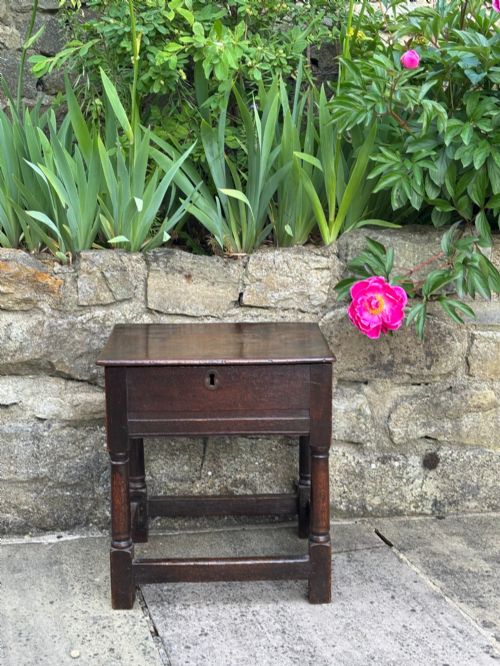
Variants turn up in small numbers. Box stools have a lidded well beneath the top, longer versions are sold as window seats or hall benches, square-topped ones as lamp stands and occasional tables, and a few are boarded from planks rather than framed. Pine, elm, yew, walnut and fruitwood examples appear, but rarely.

Where The Range Splits
Date does most of the work. Seventeenth-century stools occupy almost all of the upper range, while the 1900s to 1930s copies and anything titled "in the 17th century style" fill the bottom. The construction is the same across both ends, which is why the wording of a title matters more here than in most oak categories.
Numbers count next. Twenty-two listings on Sellingantiques are for pairs, and pairs sit well above singles; the highest-priced entry in the sample was a pair of 17th-century stools. Groups of three appear twice and a set of five once, so anything beyond two is unusual.
After that, decoration and timber. Carving lifts a stool above a plain one of the same date, though carved appears in only eleven titles. Yew, fruitwood and elm reach the upper-middle range, pine sits at the very bottom, and unusual forms, the tall, the long, the boarded trestle and the box stool, all cluster above the plain rectangular median.
Retail Price Guide 2026
Typical UK retail prices for joint stools, calculated from the Sellingantiques database of over a million retail prices indexed since 2003. This retail price guide relies exclusively on Sellingantiques data; no external sources or auction records are used, so the figures do not describe the wider market.
The earliest clean year in the Sellingantiques joint stool archive is 1640, given to a Charles I stool. The latest is 1950.
The Antique Joint Stools Glossary
- Joint stool / joined stool
- A stool built from a pegged, framed structure rather than boards. Both spellings turn up in titles and mean the same thing.
- Pegged construction
- Joints held by driven wooden pins. Dealers cite it in titles as the mark of the form.
- In the 17th century style
- Dealer wording for a later copy of the early shape, common through the 1880 to 1930 listings.
- Box stool
- A joint stool with an enclosed well under a lifting top. Locker seat is used for the same idea.
- Coffin stool
- The same form when described as having stood a coffin, used in a few 18th- and 19th-century listings.
- Cracket
- A regional term for a low country stool, recorded once here as "peg cracket".
Frequently Asked Questions
Are joint stools always oak?
Overwhelmingly. Oak runs through the great majority of titles, which makes anything else the oddity of the category.
Pine, elm, yew, walnut, fruitwood and unnamed hardwood all show up in small numbers. Yew, fruitwood and elm sit in the upper-middle of the range; pine sits at the bottom.
How many are genuinely 17th century?
Seventeenth Century is the largest single period bucket, roughly a fifth to a quarter of the archive, with "17th" in forty-eight titles.
The rest divides between Georgian and 18th-century country stools, Victorian and Edwardian revival work, and early 20th-century reproductions. Decade-level dating clusters late, so around half of everything listed is 19th- or 20th-century.
What does Jacobean Revival mean on a listing?
It means Victorian or Edwardian work made in 17th-century taste, using the same pegged joinery as the originals. Jacobean appears in eight titles.
You'll see the same idea written as "17th century style" or "George I Style". These sit at the lower end of the range.
Do joint stools come in pairs?
Sometimes. Twenty-two listings are for pairs, a distinct but minor habit against the single stool.
Anything larger is rare: three oak stools appear twice across the archive and a set of five once.
Are any joint stools marked or signed?
Practically none. Across the whole archive one stool is described as carrying stamped maker's initials, and that is the only mark recorded.
Joint stools were country joinery, so listings identify them by wood and date rather than by any workshop.
Why do some listings call them coffin stools?
It's the same form, described as having stood a coffin. The term appears in a few 18th- and 19th-century listings.
Longer bench-length versions get marketed differently again, as window seats or hall benches, and square-topped ones as lamp stands or occasional tables.