



Antique Fender Stools
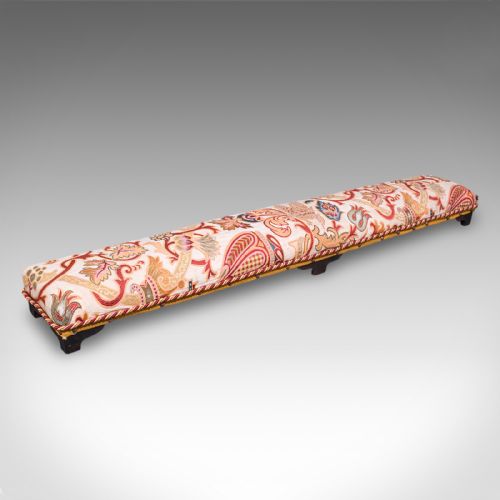
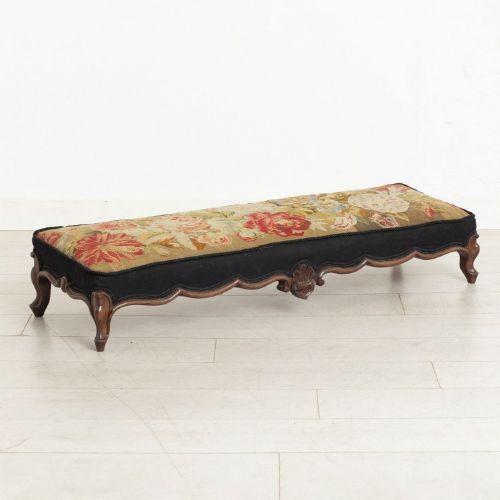
A fender stool is a long, low upholstered seat made to stand at the hearth, against the fender, so you could warm your feet or perch by the fire.
Antique Fender Stools
Timber-framed, upholstered on top, short legs, and much longer than it is deep. That elongated proportion is what defines the form. They belong to the age of the open domestic coal fire, and were made in quantity through the 19th century for exactly that spot in front of the grate.
Walnut and the word Victorian each turn up in nine of the twenty listings on Sellingantiques, and in the samples they mostly arrive together: a long Victorian walnut stool is the version you're most likely to meet. Other timbers appear once each, among them oak, mahogany, rosewood and a solid satinwood stool with gilding.
Worked tops run as a distinct thread. Two have beadwork or beaded seats, and one is titled with needlepoint, crewel and tapestry all at once. A few related low stools sit under the same heading, including carriage footrests and one piece catalogued as a window seat.
Naming is unsettled. The same object is listed as fender stool, long footstool, fireplace fender stool, fireside rest and window seat, so read the description rather than the title. Only eight of twenty listings carry a clean year, running 1860 to 1920, with the 1880s the busiest decade; the rest are placed only to a century or a reign.
Where The Range Splits
Timber does most of the separating. The rosewood and satinwood stools sit at the top of the sampled range, while plainer walnut and oak fill the lower and middle band. Carving lifts a frame out of that middle band too: a carved walnut stool from around 1880 stands well above the mass of plain walnut examples.
Length counts. "Long" recurs in titles both mid-range and at the very top, including the one described as a window seat fender stool, so scale and presence carry real weight in a form that was always about filling the width of a hearth.
Upholstery of interest and early date do the rest. Beadwork, needlepoint and original fabric are all named in titles, the last two among the higher-priced samples. The two top entries are the earliest: a Georgian carriage stool given as 1780, and a rosewood stool titled c1840.
Antique Fender Stools Retail Price Guide 2026
Typical UK retail prices for fender stools, calculated from the Sellingantiques database of over a million retail prices indexed since 2003. This retail price guide relies exclusively on Sellingantiques data; no external sources or auction records are used, so the figures do not describe the wider market.
Only about two fender stools are listed on Sellingantiques each year, and fifteen dealers have listed one since 2010.
The Antique Fender Stools Glossary
- Fender
- The low metal kerb around a hearth. The stool was made to sit against it, which is where the name comes from.
- Long stool
- Trade shorthand for the elongated proportion, much wider than deep, that defines the form. "Long" appears in several titles.
- Footstool or foot rest
- Used interchangeably with fender stool in these titles for the same low upholstered object.
- Beadwork
- A top worked in glass beads, seen on two of the sampled Victorian walnut stools.
- Crewel
- Wool embroidery on linen, named in one title's upholstery alongside needlepoint and tapestry.
- Carriage stool
- A small low footrest, offered under the fender stool heading in two or three listings.
Antique Fender Stools: Frequently Asked Questions
What were fender stools used for?
They stood in front of the fireplace, along or against the fender, giving somewhere to warm the feet or sit close to the fire.
That use explains the shape. Low seat, short legs, and a length that suits the width of a hearth rather than a person.
Which timber is most common?
Walnut. It appears in nine of the twenty listings on Sellingantiques, usually in company with the word Victorian.
Other timbers show up as one-offs: oak, mahogany, rosewood, and one solid satinwood stool with gilding.
How old are the ones that come up?
Periods bunch in the second half of the 19th century. Of the eight listings with a clean year, the dates run 1860 to 1920, and the 1880s is the busiest decade with four.
The other half are labelled only "19th Century" or "Victorian". Two 1920s pieces are the most recent, and a Georgian carriage stool given as 1780 is the single earlier outlier.
Why are they called so many different things?
Dealers don't settle on one name for the form. The same object turns up as fender stool, long footstool, fireplace fender stool, fireside rest and window seat.
A few related low stools are catalogued under the heading as well, mainly carriage footrests.
Are fender stools often signed or stamped?
No maker names come through in this archive at all, whether stamped, labelled or given as an attribution.
The listings identify them by timber, period and upholstery instead.
What sort of upholstery do they carry?
Worked tops are a recurring note. Two sampled stools have beadwork or beaded seats, and one is titled with needlepoint, crewel and tapestry together.
Plainer coverings are the norm elsewhere, with tweed on one carriage stool and "original fabric" named in another title.