



Antique Gout Stools
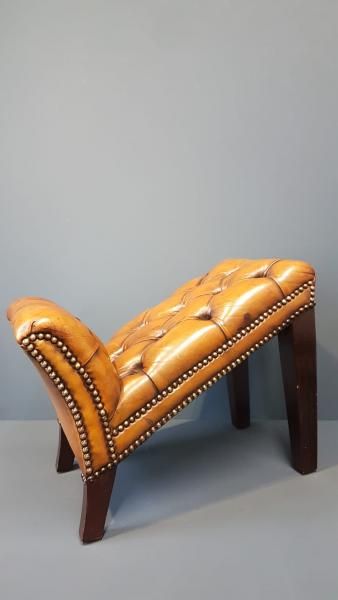
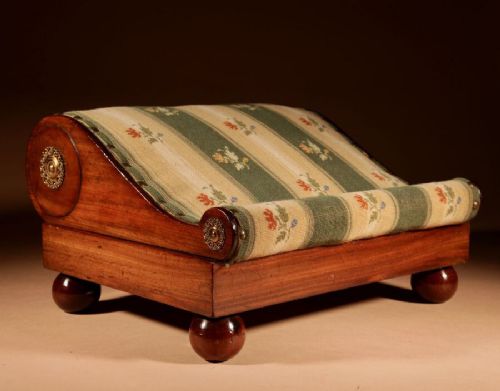
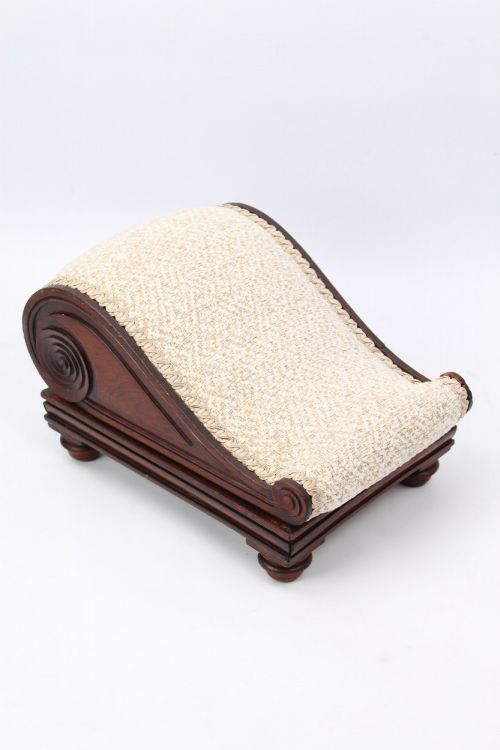
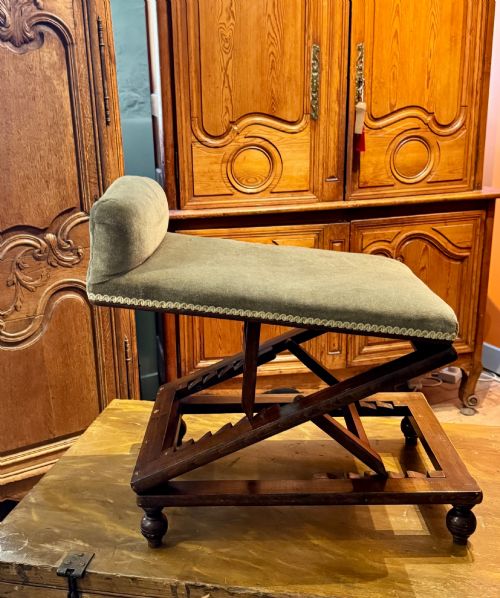
A gout stool is a low upholstered foot rest, often with a sloping or adjustable top, made to raise and cushion a painful foot beside a fireside chair.
Antique Gout Stools
The form grew up in Britain from the later 18th century as ordinary drawing-room furniture rather than medical kit. It stood by a fireside or an armchair, and the sloping or raised top did the work: it held the foot up and angled away from the floor.
What turns up most often is a low mahogany-framed upholstered stool of the Victorian period. Mahogany is named in eleven of twenty-eight titles, "foot" in nearly half of them, and the plain fixed-top small stool is the version you'll meet first. Walnut, rosewood and beech account for most of the rest.
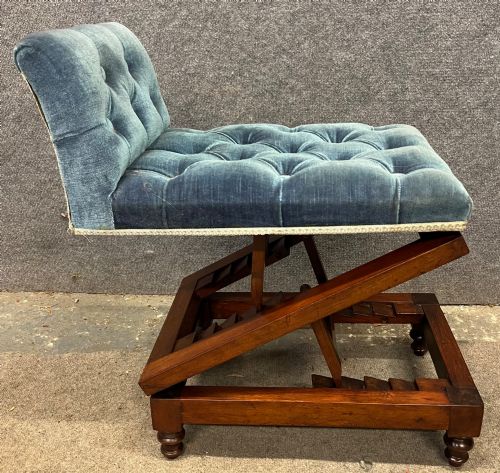
A real if small strand carries a mechanism. Four listings describe a metamorphic stool that folds or converts, three an adjustable or ratcheted top, and three a rocking frame that pivots rather than standing fixed. Together that is about a third of everything recorded. Pairs are rare, at three of twenty-eight.
Dating is loose. The dated field runs from 1800 to 1900, but only ten listings commit to a clean year and the largest single group is simply "19th Century". Dated decades sit mid-to-late, the 1850s and 1860s most of all, with a single Edwardian piece and one dated 1900 at the far edge. Nothing here is dated before 1800.
Where The Range Sits
Mechanism is the clearest divider. The adjustable, metamorphic and rocking stools sit toward the upper part of the range, while the plain low fixed-top stools cluster at the bottom and make up the bulk of the cheaper end. A working angle or a converting frame is what a buyer pays for.
Timber and cover do the rest. Walnut and rosewood, and leather upholstery, appear in the upper half; stained beech and simulated rosewood graining sit low. Needlepoint and tapestry covers land mid-range. Pairs go upward as well, and the two titles carrying a firm's name both sit high.
No cabinetmaker runs through this category. Names appear only on the odd listing, stamped or attributed on a single piece, so timber, mechanism and upholstery carry the weight rather than a signature.
Antique Gout Stools Retail Price Guide 2026
Typical UK retail prices for gout stools, calculated from the Sellingantiques database of over a million retail prices indexed since 2003. This retail price guide relies exclusively on Sellingantiques data; no external sources or auction records are used, so the figures do not describe the wider market.
The top sale of the last year on Sellingantiques was an antique Victorian leather and mahogany metamorphic gout stool, in September 2025.
The Antique Gout Stools Glossary
- Gout stool
- A low foot rest, often angled or adjustable, made to support a raised foot. It appears interchangeably as a gout stool, a gout foot stool or a foot rest, depending on the dealer.
- Adjustable
- The top can be set at different angles or heights, usually on a ratchet. Named in three of the listings.
- Metamorphic
- Folds or converts to change form or function. Named in four listings, the largest of the mechanised groups.
- Rocking
- A frame that pivots rather than standing fixed. Three listings use the word.
- Buttoned leather
- Upholstery drawn down with buttons into dimples. It appears once in the titles, while leather more broadly runs through the upper half of the range.
- Simulated rosewood
- A cheaper timber grained to imitate rosewood. Used once, and at the bottom of the range, as stained beech is.
Antique Gout Stools: Frequently Asked Questions
How many gout stools come up for sale?
About three a year reach this market, spread across sixteen different dealers on Sellingantiques. No single dealer carries them as a line.
That spread is why the naming varies so much from listing to listing.
Why are some called foot rests instead?
The word "foot" carries nearly half the titles in the archive. Dealers write the same object up as a gout stool, a gout foot stool or a low foot rest.
The object underneath is consistent: a small low frame with an upholstered top, often sloped.
What does metamorphic mean on a gout stool?
It means the stool folds or converts to change its form or function. Four of the twenty-eight listings use the word, making it the commonest of the mechanised types.
Metamorphic examples sit toward the upper part of the range, along with the adjustable and rocking frames.
Which wood are they usually made from?
Mahogany is the defining timber, named in eleven of twenty-eight titles. Walnut, rosewood and beech make up most of the remainder.
Walnut and rosewood appear in the upper half of the range. Stained beech and simulated rosewood graining sit at the bottom.
Do gout stools come in pairs?
Rarely. Only three of the twenty-eight listings offer two stools together, and all three sit in the upper half of the range.
Singles are the norm.
Are there any Continental examples?
One bentwood stool with caned bergère work is the only Continental-factory form in the archive, and the only piece dated as late as 1900.
Everything else recorded is English, in mahogany, walnut, rosewood or beech.
One further oddity: a single kneeling fireside foot rest, used knelt against rather than under the feet.