
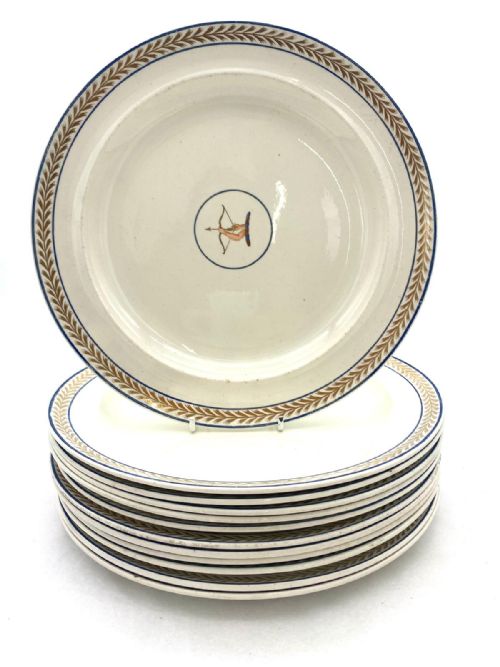


A 2026 Guide by Sellingantiques
Josiah Wedgwood established his first independent pottery works at the Ivy House in Burslem during 1759.
Early output focused on cream-coloured earthenware. Queen Charlotte ordered a tea set in 1765, leading to the famous Queen's Ware designation.
Check the factory marks to date these pieces. The three-letter impressed date code system began in 1860, with the final letter indicating the year.
Jasperware development took thousands of recorded experiments before its commercial introduction in the late eighteenth century.
Many Antique Wedgwood Plates produced throughout the nineteenth century were aimed at the expanding middle-class market across Britain and America.
Josiah Wedgwood ran the firm from 1759 until his death in 1795. He partnered with Thomas Bentley to manage the ornamental wares division.
John Flaxman modelled classical designs for the factory during the late eighteenth century. His figures often appear as applied reliefs on decorative plates.
William Hackwood worked as a chief modeller. He adapted classical cameos and portrait medallions that later featured on flatwares.
The 2026 retail price guide for Antique Wedgwood Plates is drawn from a proprietary archive of over 1.1 million retail prices indexed by Sellingantiques since 2003. This guide relies exclusively on their own internal data; no external sources or auction records are used.
Analysing nearly 25 years of UK antique market history alongside current retail values, the data indicates that typical UK retail prices for Antique Wedgwood Plates range between £100 and £800. Entry-level prices generally fall under £100 and premium examples upwards of £800.
Applied sprigs stand out on jasper pieces. Workers pressed white clay into plaster moulds before attaching the reliefs to the plate surface.
Transfer printing appears frequently on standard dining wares. Copper plates etched with patterns transferred ink to paper, then onto the biscuit ceramic.
Turn the piece over. You will typically find an impressed factory mark cleanly stamped into the base before the initial firing.
Throwers shaped early flatwares on a wheel before finishing them on a lathe. This created sharp edges and a precise profile.
Engine-turning lathes allowed makers to cut geometric patterns directly into the leather-hard clay prior to firing.
Liquid slip casting became common later. Liquid clay poured into plaster moulds formed lighter bodies with consistent dimensions across large services.
"Catherine the Great ordered a massive service known as the Frog Service. Each plate featured a hand-painted British topographical view and a small frog crest."
"Some jasperware plates use a solid coloured body throughout. Others feature a white body with just a thin coloured dip on the surface."
"The factory maintained extensive pattern books. Customers could flip through these volumes and order replacement plates for services decades after the initial purchase."
Based on almost 25 years of Sellingantiques UK antique market data, Antique Wedgwood Plates appeared 115 times (out of 1,100,000 antiques) which gives it a rarity score of 98/100.
This score measures scarcity within the Sellingantiques archive only and is not a survey of the entire antiques market, so these statistics may not be indicative of the general availability of Antique Wedgwood Plates elsewhere.
Wire plate hangers work well for sturdy earthenware. Choose ones with plastic-coated tips to avoid scratching the rim.
For delicate bone china or unglazed jasper, plate stands are much safer. Spring-loaded wire hangers place too much tension on brittle edges and can cause fine hairlines over time.
Keep them out of direct sunlight. While fired ceramics do not fade, prolonged UV exposure will damage any later enamel touch-ups or old adhesive repairs.
Keep them away from the dishwasher. The intense heat and harsh modern detergents will quickly dull the glaze and strip away overglaze enamels.
Wash them by hand in warm soapy water instead. Place a rubber mat in the sink basin first to protect the foot rims from chipping against the hard metal or porcelain surface.
Those dark lines happen when fats and oils seep under the clear glaze through tiny age cracks. It is standard wear for early earthenware.
Do not soak them in domestic bleach. Strong chemicals will break down the ceramic body from the inside and cause the surface to flake away.
Gentle soaking in a mild peroxide solution can lighten the staining. However, most collectors accept some discoloration as part of the history.
Never apply oil to jasperware. Fired ceramic does not dry out or need nourishment like wood or leather.
Oil will simply soak into the unglazed matte surface and attract dust. This creates a sticky, discoloured film that is hard to remove safely without damaging the delicate applied white reliefs.
Please note: This Antique Wedgwood Plates guide and its associated pricing data are provided for general informational purposes only. It does not constitute formal financial, investment, or appraisal advice and should not be relied upon as the sole basis for any commercial activity, purchasing, or sales decisions. Sellingantiques.co.uk accepts no liability for any actions taken in reliance on this information. Always consult with a qualified professional or independent appraiser.
