



Antique Meissen Plates
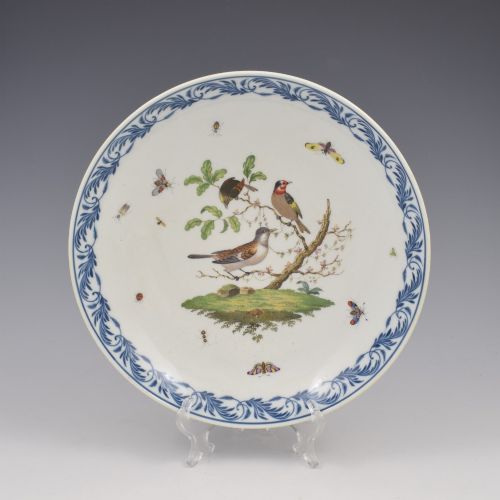
A painted porcelain plate from the Meissen manufactory in Saxony, made for display or the dessert table rather than as part of a dinner service.
Antique Meissen Plates
Meissen was where hard-paste porcelain was first made in Europe, from the early 18th century, and plates came out of the factory both for table use and as decorative cabinet pieces. Pierced borders and flower painting became staples, repeated over long stretches of the factory's output.
What turns up on Sellingantiques is a 19th-century painted plate, offered singly. The word porcelain runs through most of the titles, and the dated field says "19th Century" more often than anything else, with titles adding c.1850, c.1860, c.1870, 1880-1900 or circa 1900. Only three of the eighteen listings commit to a clean year, so the decade named in a title often has no counterpart in the structured date.
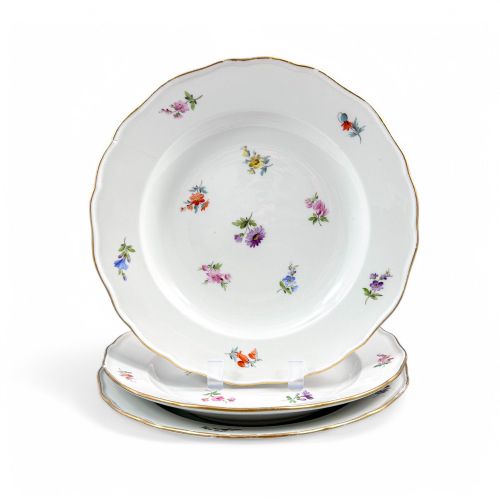
Decoration splits two ways. Birds, insects and flowers make the largest group, taking in scattered-flower Streublumen and one plate in the Kakiemon palette with the Gelber Löwe pattern. Figural and scene painting makes up the rest, including putti at play and a plate after Boucher. A pierced, or reticulated, border shows up on four of them, and rims are commonly scalloped or fluted.
Pairs and sets of three appear four times, which is as far as multiples go. One 18th-century Dot Period plate and one Marcolini-period plate sit at the older end, and a single 1920s floral plate at the other. Note that "Georgian" and "Victorian" appear in the dated field as period shorthand, not as an attribution for German porcelain.
Where The Range Sits
Subject does more than anything else to set a plate apart. Figure painting and copies after the masters hold the top of the range, and the highest-priced titles on Sellingantiques are a putti scene of about 1870 and a plate after Boucher of the same decade. Simple floral plates sit at the bottom.
Pierced work counts for something too. Where a border is reticulated, dealers name it in the title rather than burying it in the description, and those plates run through the archive from c.1850 to the Marcolini period. A plain rim is described in the ordinary way; a pierced one is the feature that gets the billing.
The other lift is specificity. A named pattern or factory period, Gelber Löwe, Streublumen, Dot Period, Marcolini, or the crossed swords mark, does more for a listing than a generic description of flowers. Pairs and sets of three sit in the upper half of the range, and size gets flagged only when there is something to flag.
Antique Meissen Plates Retail Price Guide 2026
Typical UK retail prices for meissen plates, calculated from the Sellingantiques database of over a million retail prices indexed since 2003. This retail price guide relies exclusively on Sellingantiques data; no external sources or auction records are used, so the figures do not describe the wider market.
Meissen plates have been listed on Sellingantiques since 2014.
The Antique Meissen Plates Glossary
- Reticulated
- A border pierced right through with a lattice or basket pattern. Four titles in the archive use the word.
- Cabinet plate
- A plate made or sold to be displayed rather than eaten from, used in two titles.
- Scalloped rim
- A wavy, shell-edged border, sometimes gilt. Fluted is the related term, meaning a rim moulded with radiating ribs or grooves.
- Crossed swords mark
- The Meissen factory mark, named in one title here.
- Streublumen
- German for scattered flowers, small sprigs strewn across the well and rim. Gelber Löwe, or Yellow Lion, is another named Meissen pattern, appearing once in the Kakiemon palette.
- Marcolini
- A period name used for late 18th and early 19th-century Meissen. Dot Period is a term for a phase of 18th-century factory marking.
Antique Meissen Plates: Frequently Asked Questions
What period do most of these plates come from?
The 19th century dominates. Eight of the eighteen listings carry "19th Century" in the dated field, two more say "Victorian", and titles narrow that to c.1850, c.1860, c.1870 or 1880-1900.
The field as a whole runs from 1800 to 1920, with a single 18th-century plate at one end and a 1920s floral plate at the other.
Are Meissen plates sold as full services?
Not on Sellingantiques. Everything in the archive is a single plate, a pair or a set of three.
Multiples appear four times: a pair of blue and white plates, a pair of about 1900, a set of three from the 1880s and three plates of 1850. Those sit in the upper half of the range.
What does reticulated mean on a Meissen plate?
It means the border is pierced through, usually in a lattice or basket pattern, leaving open work around the painted centre.
Four reticulated plates have passed through the archive, dated variously c.1850, c.1860, 1880-1900 and to the Marcolini period. One of them carries the crossed swords mark and exotic bird painting.
Which painted subjects turn up most often?
Birds, insects and flowers form the largest decorative group. Titles specify bird and insect designs, ornithological subjects, exotic birds, Streublumen scattered flowers and plain floral work.
Figural and scene painting makes up the other main group, about a quarter of the listings: a gallant scene with green border, an Old Masters style plate of c.1860, putti at play, and one after Boucher.
How often do these come up for sale?
Roughly two listings a year, spread across eleven different dealers. That is close to one dealer per plate.
No single dealer holds the category, so what appears in any given year depends on what happens to surface.
Why do German words appear in the titles?
Dealers reach for factory vocabulary rather than English description when a plate has a named pattern or period. Streublumen, Gelber Löwe, Marcolini and Dot Period all appear in titles here.
Each of the named patterns turns up only once: Gelber Löwe in the Kakiemon palette, Streublumen on a set of three.