


A 2026 Guide by Sellingantiques
Pair of Lamps Circa 1930, 1930
Priced at £550 from Frank Craig Antiques
Electric lighting was becoming standard in homes during the 1920s. This shift allowed Art Deco lights to hang from the ceiling in entirely new ways.
Notice the shift from naturalism. Earlier styles mimicked plants, while Art Deco lights adopted streamlined shapes inspired by machines and skyscrapers.
Public spaces often drove the demand. Cinemas and hotel lobbies required large statement lighting that eventually filtered down to domestic interiors.
French designers led the luxury market following the 1925 Paris exhibition. Mass-market versions quickly followed across Britain and America.
René Lalique produced pressed glass lighting throughout the 1920s and 1930s. His heavy moulded shades often feature stylised birds.
Marius-Ernest Sabino worked in Paris during the same era. He focused on opalescent glass that casts a warm bluish tint.
Muller Frères operated out of Lunéville. They shifted from earlier organic styles to create robust wrought iron chandeliers.

Art Deco Bakelite Streamline Desk Lamp by E. Cole, C1930, 1930
Priced at £585 from Art Deco World
The 2026 retail price guide for Art Deco Lights is drawn from a proprietary archive of over 1.1 million retail prices indexed by Sellingantiques since 2003. This guide relies exclusively on their own internal data; no external sources or auction records are used.
Analysing nearly 25 years of UK antique market history alongside current retail values, the data indicates that typical UK retail prices for Art Deco Lights range between £300 and £3,000. Entry-level prices generally fall under £300 and premium examples upwards of £3,000.
Stepped profiles appear constantly. You spot these zig-zag forms on everything from the ceiling rose down to the finial.
Wall sconces often take the shape of half-bowls. These push light upwards to bounce off the plaster rather than pointing downwards.
Look for figural elements on table lamps. Spelter women holding spherical glass shades turn up regularly in regional auction houses.
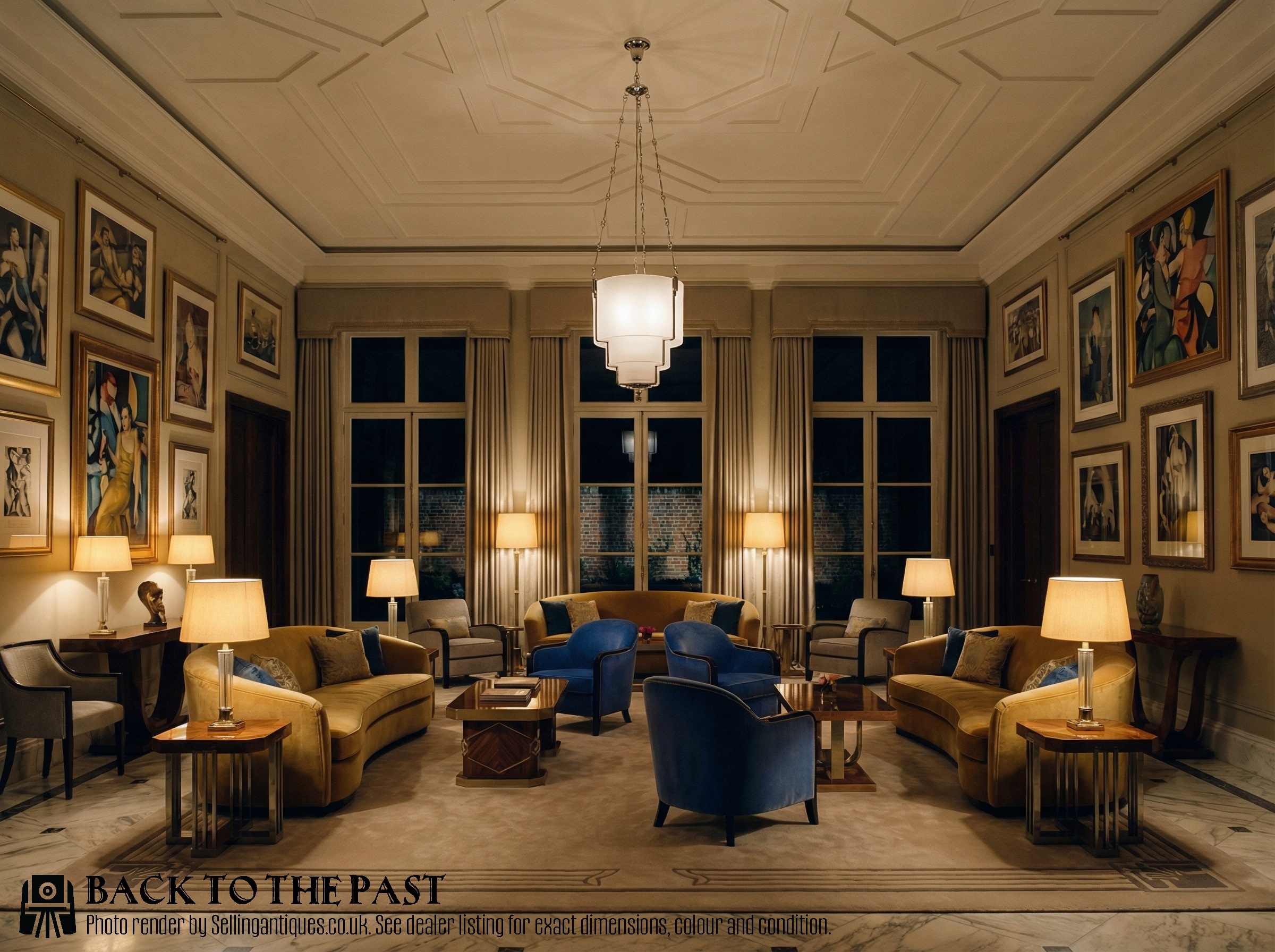
Art Deco Chrome and Glass Ceiling Light, 1930
Priced at £475 from William Rand Antiques
Press-moulding changed how glass was formed. Factories dropped molten glass into heavy metal moulds to achieve crisp reliefs that blowing couldn't manage.
Chrome plating emerged as a durable modern finish. Makers applied it over brass to create a mirror-like surface resistant to tarnishing.
Observe the wrought iron work on French examples. Craftsmen hammered the metal by hand to create rigid frames supporting heavy bowls.
"Some shades were specifically tinted to make skin look healthier. Peach glass cast a warm glow that flattered complexions."
"Stepped designs actually improved light diffusion. The tiered glass panels helped scatter illumination evenly across large spaces."
"Modular components featured heavily. A single geometric glass pattern could appear on chandeliers, wall sconces and table lamps across one house."
Based on almost 25 years of Sellingantiques UK antique market data, Art Deco Lights appeared 40671 times (out of 1,100,000 antiques) which gives it a rarity score of 1/100.
This score measures scarcity within the Sellingantiques archive only and is not a survey of the entire antiques market, so these statistics may not be indicative of the general availability of Art Deco Lights elsewhere.
Warm soapy water handles most dust on frosted glass. Avoid abrasive sponges that scratch the surface.
Dry the glass thoroughly before reattaching it. Trapped moisture corrodes the gallery screws.
You need to have the lamp rewired by a qualified electrician before plugging it in. Original fabric flex from the 1930s is often degraded inside, and early two-pin plugs fail modern safety standards.
The metal frames on these lights usually require proper earthing. An electrician will install modern three-core cable that keeps the period look while ensuring the fixture is safe for daily use.
Gravity and friction do all the work. The glass panels are moulded with specific grooves that slide directly into matching channels on the metal framework.
This design means the shades can rattle if the light gets knocked. You have to handle the main frame carefully when moving the fixture to stop the glass slipping out.
The holes indicate how the bowl was originally suspended. Flycatcher shades rely on three chains hooked through those drilled rims to hang straight from the ceiling hook.
Bowls without holes were designed to sit inside a rigid metal armature. These heavier frames cradle the glass from underneath and are more common on French fixtures.
Please note: This Art Deco Lights guide and its associated pricing data are provided for general informational purposes only. It does not constitute formal financial, investment, or appraisal advice and should not be relied upon as the sole basis for any commercial activity, purchasing, or sales decisions. Sellingantiques.co.uk accepts no liability for any actions taken in reliance on this information. Always consult with a qualified professional or independent appraiser.
