


A 2026 Guide by Sellingantiques
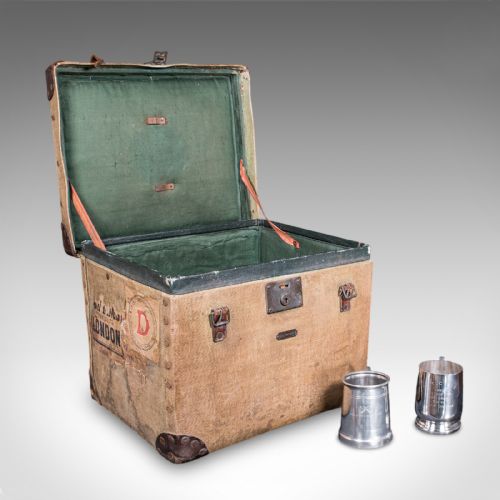
A W Insall Original Small Travelling Campaign Trunk, 19th Century
Priced at £295 from Pareglio & Ayres Antiques Interiors
British army officers often bought these chests privately before setting sail.
The split design meant mules or local porters could carry each half separately over rough terrain.
Check the backboards for old paper transport labels from railway journeys.
Most antique campaign chests date from the middle of the nineteenth century when the British Empire expanded aggressively.
Army & Navy Co-operative Society Limited supplied thousands of chests from the 1870s onwards.
Ross & Co of Dublin built a strong reputation. They're heavily documented and often stamped their name on the drawer edges.
Find Hill & Millard stamps on better London pieces made between the 1850s and 1890s.
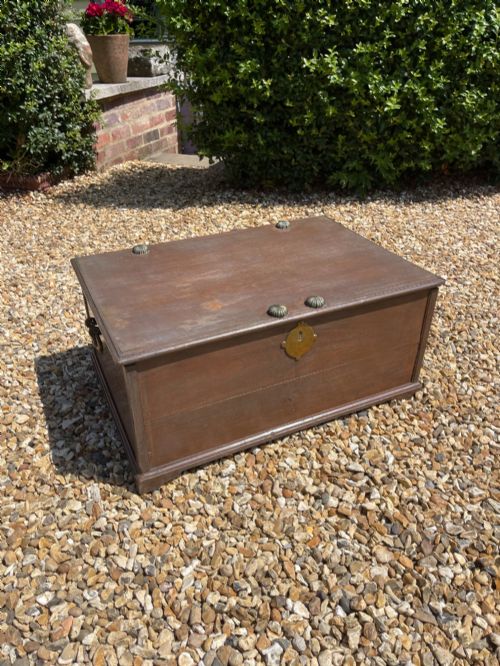
Military Campaign Chest, 1850
Priced at £265 from David Robinson Antiques
The 2026 retail price guide for Antique Campaign Chests is drawn from a proprietary archive of over 1.1 million retail prices indexed by Sellingantiques since 2003. This guide relies exclusively on their own internal data; no external sources or auction records are used.
Analysing nearly 25 years of UK antique market history alongside current retail values, the data indicates that typical UK retail prices for Antique Campaign Chests range between £500 and £2,700. Entry-level prices generally fall under £500 and premium examples upwards of £2,700.
Flush brass drawer pulls sit flat against the wood so nothing catches during transit.
Two separate halves. They locate together using wooden pegs or iron pins dropped into corresponding holes.
Screw-on turned feet detach quickly to sit the bottom section flat on the ground inside a tent.

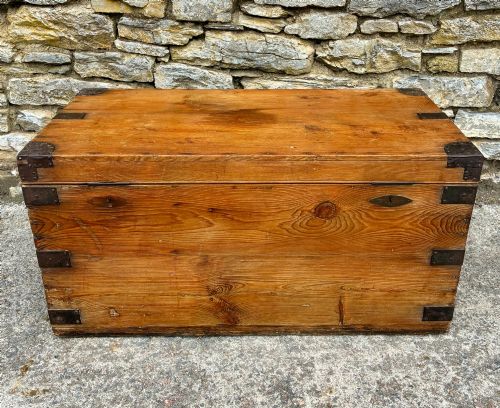
Beautifully Grained Victorian, Solid Camphorwood, Campaign Trunk., 1900
Priced at £625 from The Dorking Desk Shop
Dovetails are hidden under brass straps. Cabinet makers used fine hand-cut joints despite knowing the metal would cover their work.
Earlier chests feature solid timber sides, while later pieces often use thick veneers over a cheaper pine core.
Run your hand along the drawer runners. They were crafted from dense hardwoods to withstand constant pulling under heavy loads.
"Some contained shallow secret compartments behind the main drawer linings to hide gold sovereigns."
"Officers purchased canvas packing cases to slip the halves into. These covers sometimes survive alongside the furniture."
"The layout often included a deep hat drawer specifically proportioned for standard issue military headwear."
Based on almost 25 years of Sellingantiques UK antique market data, Antique Campaign Chests appeared 3996 times (out of 1,100,000 antiques) which gives it a rarity score of 45/100.
This score measures scarcity within the Sellingantiques archive only and is not a survey of the entire antiques market, so these statistics may not be indicative of the general availability of Antique Campaign Chests elsewhere.
The weight varies a lot depending on the timber. A solid mahogany half is heavy enough that one person will struggle to lift it comfortably.
Teak examples are even denser. You'll usually need two people to move the bottom section safely once the drawers are full.
Yes, it could. While the classic antique campaign chest features brass strapwork, many officers bought plainer versions to save money or weight. Naval officers in particular often used unbound chests because ships offered smoother transport than rough land routes.
You'll want to look at the handles instead. If the drawer pulls sit flush to the wood and the piece splits in two, it belongs to the travel furniture family regardless of corner bindings.
Those are locating dowels. They slot into matching holes on the bottom half to stop the top section sliding around.
Some makers used iron pins instead of wooden pegs. A restorer can easily turn new ones if yours are missing.
That deeper bottom drawer had a very specific function. It was proportioned to hold bulky items like uniforms, boots and saddle gear that simply would not fit into the standard top drawers.
Cabinet makers understood that soldiers lived out of these pieces. They arranged the drawer depths to mirror the kit an officer had to carry, keeping the heavy gear low down for stability.
Please note: This Antique Campaign Chests guide and its associated pricing data are provided for general informational purposes only. It does not constitute formal financial, investment, or appraisal advice and should not be relied upon as the sole basis for any commercial activity, purchasing, or sales decisions. Sellingantiques.co.uk accepts no liability for any actions taken in reliance on this information. Always consult with a qualified professional or independent appraiser.
