



A 2026 Guide by Sellingantiques

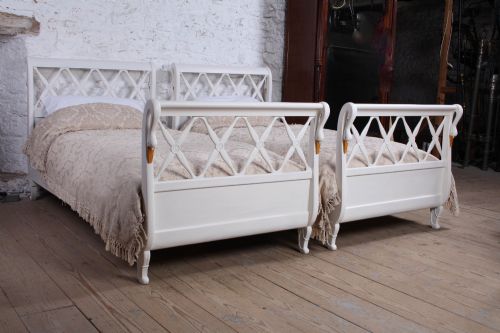
Pair of English Country House Gilt Single Beds., 19th Century
Priced at £480 from Rupert Hitchcox Antiques
Originating in France during the early nineteenth century under the Empire style.
The design heavily referenced Greek and Roman forms found on ancient domestic seating.
Look for the American Empire adaptations that emerged slightly later. They took the French concept and scaled it up considerably for colonial bedrooms.
Victorian makers eventually absorbed the shape into their catalogues. You find them with heavier proportions by the mid-nineteenth century.
Cabinetmaker François Baudry built prominent examples in France during the Empire period. His workshop shaped the early lit bateau forms.
The workshop of François-Honoré-Georges Jacob-Desmalter supplied elaborate mahogany versions to French palaces. He helped popularise the rolling scroll ends.
American production relied on large regional workshops. Duncan Phyfe manufactured heavy scrolled frames for the domestic market in New York.
The 2026 retail price guide for Antique Sleigh Beds is drawn from a proprietary archive of over 1.1 million retail prices indexed by Sellingantiques since 2003. This guide relies exclusively on their own internal data; no external sources or auction records are used.
Analysing nearly 25 years of UK antique market history alongside current retail values, the data indicates that typical UK retail prices for Antique Sleigh Beds range between £400 and £2,800. Entry-level prices generally fall under £400 and premium examples upwards of £2,800.
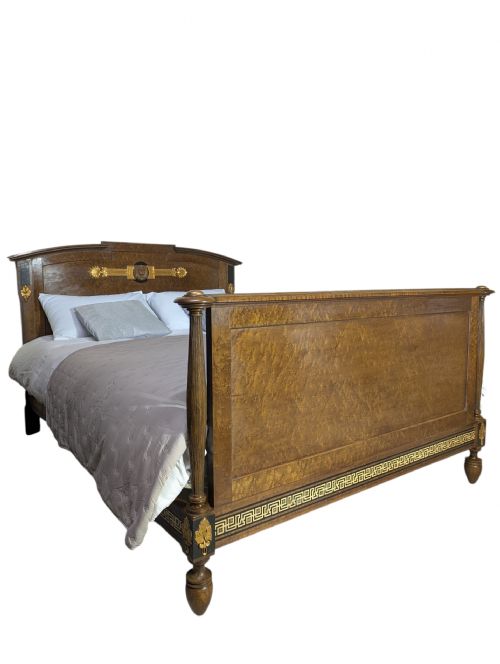
Rolling headboards curve outwards away from the mattress. The footboard mirrors this shape, though sometimes sits slightly lower to the ground.
Deep side rails connect the two ends. They form a solid wooden barrier rather than an open gap, creating an enclosed sleeping area.
Sitting close to the floor is typical. Short bracket feet or heavy turned legs support the thick wooden carcase.
Steam bending allowed cabinetmakers to achieve the dramatic curves. Thick lengths of wood were heated and forced over wooden moulds.
Massive iron bed bolts pull the side rails tight against the headboard posts. You need a specialised wrench to loosen these fixings.
Applying veneer to the curved surfaces required high skill. Craftsmen used hot hide glue and shaped cauls to press the fragile sheets down evenly.
"Placing them sideways against the wall was the standard arrangement. This freed up floor space and allowed the curved ends to frame the occupant."
"Some early versions featured built-in bookshelves concealed in the hollow space behind the curved headboard."
"The solid wooden side rails effectively block under-bed draughts. This creates a warmer sleeping environment during colder months."
Based on almost 25 years of Sellingantiques UK antique market data, Antique Sleigh Beds appeared 159 times (out of 1,100,000 antiques) which gives it a rarity score of 97/100.
This score measures scarcity within the Sellingantiques archive only and is not a survey of the entire antiques market, so these statistics may not be indicative of the general availability of Antique Sleigh Beds elsewhere.
Fitting a new mattress into an antique frame often requires compromise. Nineteenth-century beds were built to custom dimensions rather than modern sizes. You'll usually need to measure the internal width and length between the side panels.
Many buyers order a custom foam or sprung mattress to drop inside the antique carcase. Another option involves resting a modern box spring on top of the side rails, though this hides the wooden flanks and alters the proportions.
The curved ends on an antique sleigh bed don't dismantle. The headboard and footboard are solid glued units. You'll have to navigate the whole scroll-ended panel up the stairs in one piece.
The side rails unbolt and lift away. This reduces the weight, but the height and depth of the main curved sections remain fixed. Measure the clearance on your landing carefully before committing to a large Empire frame.
Wooden slats span the gap between the side rails. Dealers often cut modern pine boards to rest on the internal ledges.
Some heavy frames retain their original rope pegs. Knobs carved along the inner rails held ropes pulled tight to form a suspended web.
Cabinetmakers didn't always finish the back of the headboard. These frames were designed to stand against a wall, so polishing the rear side wasted expensive veneer. You'll often find exposed pine carcase wood or rough tool marks on the reverse.
Later Victorian models sometimes feature finished backs as room layouts changed. If you plan to float an early antique sleigh bed in the centre of a room, you might need a restorer to polish the raw boards.
Please note: This Antique Sleigh Beds guide and its associated pricing data are provided for general informational purposes only. It does not constitute formal financial, investment, or appraisal advice and should not be relied upon as the sole basis for any commercial activity, purchasing, or sales decisions. Sellingantiques.co.uk accepts no liability for any actions taken in reliance on this information. Always consult with a qualified professional or independent appraiser.
