


Antique Corbeille Beds
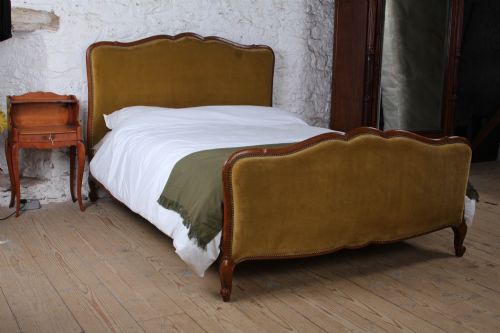
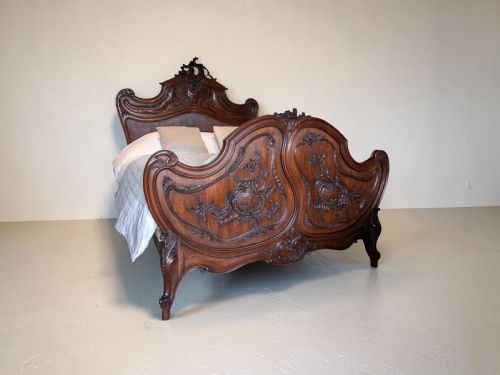
A corbeille bed is a French bedstead whose head and foot boards curve outward in a basket-like sweep, with an upholstered or caned panel set into a shaped show-wood frame, made for domestic bedrooms.
Antique Corbeille Beds
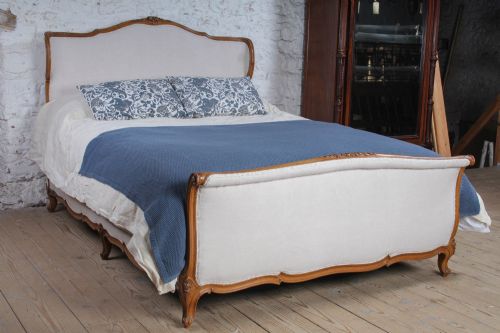
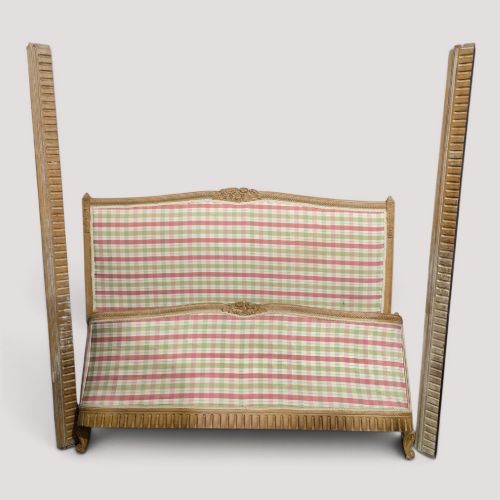
Corbeille is French for basket, and the name describes the shape: the head and foot boards curve out and back in a rounded sweep. The panel inside that curve is either stuffed and covered in fabric or filled with woven cane, and the polished frame around it is left showing.
On Sellingantiques they arrive overwhelmingly as French pieces, with 50 of 67 titles saying so. The dating is narrow. Sixty listings carry a clean year and they run from 1880 to 1930, with the 1920s alone accounting for 32 of them, more than the other five decades together. Nothing is documented on either side of that fifty-year window.
The version you are most likely to meet is upholstered rather than caned, and sized for a modern mattress. Thirty-five titles cite king or king size, which means half the category is described by width first and period second. Ten titles say the bed has been newly upholstered, and that word always sits immediately before 'upholstered': it's the covering dealers flag as recent, not the frame.
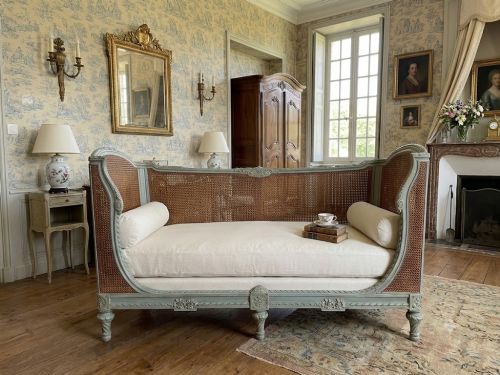
Beyond that main run there are smaller groups. Caned or bergère beds turn up around one in eight. Painted or gilded frames appear in about one in seven. Demi-corbeille, with the sweep at one end only, and double corbeille, with both ends matching, account for six titles between them. Pairs of matching singles surface three times, and a day-bed version, the canapé corbeille, once.
What Sets Them Apart
Width does more work than anything else. The bottom of the range is a plain double or a bed with no size stated at all; the top is where 'super' appears, along with 6ft+, 2m x 2m and a single Emperor size, that last one on a burr walnut double corbeille. A form made for French bedrooms has been re-framed for UK mattresses, and the wider conversions carry the money.
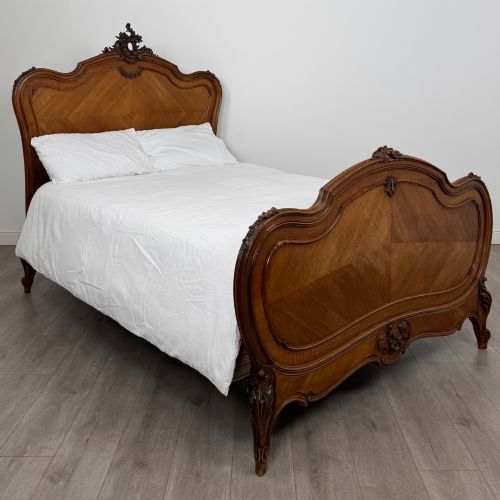
Then the panels and the timber. Caned and bergère beds sit almost entirely in the upper half, where the plain upholstered panel is the everyday version. Titles that name a wood, walnut, burr walnut, rosewood, mahogany, cherry, marquetry, sit above those that name none, and the rosewood, burr walnut and marquetry examples go highest.
Shape and company matter too. A double corbeille, shaped at head and foot, sits above a demi-corbeille worked at one end. Beds that come with matching bedside cabinets or matching chairs sit at the very top, and a pair of singles sits above the median for a single bed.
Antique Corbeille Beds Retail Price Guide 2026
Typical UK retail prices for corbeille beds, calculated from the Sellingantiques database of over a million retail prices indexed since 2003. This retail price guide relies exclusively on Sellingantiques data; no external sources or auction records are used, so the figures do not describe the wider market.
The word newly turns up in ten corbeille bed titles on Sellingantiques, and every time it sits just before upholstered.
The Antique Corbeille Beds Glossary
- Corbeille
- French for basket, and the name of the form: head and foot boards curving outward in a rounded sweep.
- Show wood
- The polished frame left visible around an upholstered panel, and the part that carries the timber named in the title.
- Newly upholstered
- Re-covered by the dealer or a recent owner. Ten titles say so outright, always of the covering rather than the frame.
- King size / super king
- Modern UK mattress widths of 5ft and 6ft. Thirty-five titles cite one or the other, so the size often leads the description.
- Double corbeille
- Both ends shaped, head and foot matching, against a demi-corbeille which is swept at one end only.
- Bergère
- Used of a bed with enclosed sides, upholstered or caned, in the manner of a bergère chair.
Antique Corbeille Beds: Frequently Asked Questions
Why do so many say king size?
Because the form was made for French bedrooms and French mattresses. Half the titles on Sellingantiques cite king or king size, and 11 say super, so the beds have commonly been widened or re-framed to UK measurements.
The widest are given as 6ft+, 2m x 2m, or in one case Emperor size, which appears exactly once, on a burr walnut double corbeille.
What period do corbeille beds come from?
Sixty of the 67 listings carry a clean year and they fall between 1880 and 1930. The 1920s account for 32 of those, more than the other decades put together.
One 1880s listing is the earliest dated piece, and three carry an 1890s date. The dated field is the dealer's own and often a round decade marker, 1900, 1910, 1920, rather than a researched year.
Are corbeille beds caned or upholstered?
Both, and upholstered is the commoner of the two. Twenty-three titles say upholstered against nine that are caned or described as bergère.
The caned examples sit almost entirely in the upper half of the range.
Which makers made these beds?
None are named. Across all 67 listings no maker's name appears anywhere, and none carry a stamp or label recorded in the description.
One title alone names a place of manufacture, describing a Paris maker. Otherwise these are anonymous French bedsteads, sold on form, timber and width.
What does demi-corbeille mean on a listing?
The basket sweep is worked at one end only, usually the head. Three titles use the term.
Double corbeille is the opposite: both ends shaped and matching, used in six titles, and those sit high in the range.
How often do these come up for sale?
Around five corbeille beds come to market on Sellingantiques in a year, spread across 17 different dealers, so no one dealer holds the form.
Within that, single beds and day beds are the exception. Pairs of matching singles surface three times in the archive, and the canapé corbeille, the settee version, once.