
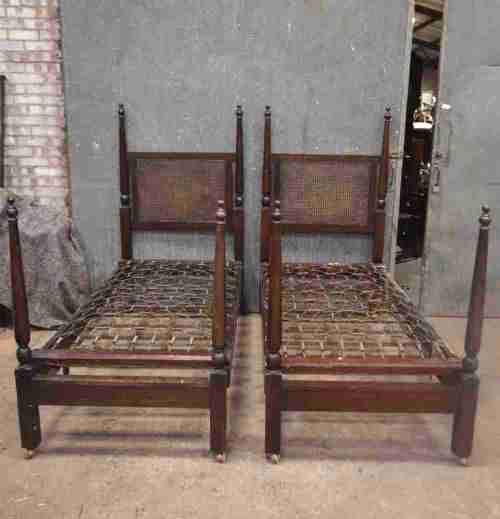
Antique Bergere Beds
A bergère bed is a French bedstead with woven cane panels set into carved or painted head and foot frames, built as a lighter alternative to solid panelled or upholstered beds.
Antique Bergere Beds
The name comes from the caned French armchair, and the idea carries straight over to the bedstead: hand-woven cane fills the head and foot panels, held in a wooden frame of walnut, beech or sometimes oak. Caning is the defining feature, named outright in 31 of the 43 listings on Sellingantiques and implied by the rest.
The version you're most likely to meet is a French caned bergère widened or built to UK king size. "King size" or "kingsize" appears in 25 titles, "french" in 26, and the three terms usually run together in the same description. A smaller run covers singles, pairs of metre-wide beds that can be joined, and one walnut daybed.
Painted frames account for 8 titles, with eau de nil quoted twice and an aged blue grey once. The corbeille or basket end, a bowed shape at the head or foot, turns up four times. Louis XV, Louis XVI and Empire styling each appear three times as qualifiers on the framing.
Every listing carries a year, and they all sit between 1890 and 1920, with the 1920s the busiest decade. The dates land on round decade markers that recur exactly, so read them as approximate placements in the late 19th to early 20th century rather than documented attributions. Seven dealers have handled the form, and only about two examples reach the market in a year.
What Separates Them
Carving does most of the work. Frames described as carved, whether carved walnut, carved and caned or carved with roses, sit in the upper half of the range, while plainer mouldings around the same cane panels sit below. Where a timber is named at all, walnut and oak are the ones called out, and those six titles cluster high.
Surface is the other lever. Original paint, aged paint and named colours like blue grey place a bed above the middle, and the finish being old rather than fresh is what the wording is pointing at. Size pushes the same way: big king size, oversize kingsize, super king size and 5ft all occur towards the top.
What comes with the bed matters more than any single feature. Beds sold with a matching bedside, matching cabinets or as a full bedroom suite occupy the highest positions in the archive, and the top of the range is a complete bergère suite sold with its kingsize bed, mattress and base rather than a bedstead on its own.
Antique Bergere Beds Retail Price Guide 2026
Typical UK retail prices for bergere beds, calculated from the Sellingantiques database of over a million retail prices indexed since 2003. This retail price guide relies exclusively on Sellingantiques data; no external sources or auction records are used, so the figures do not describe the wider market.
The widest bergere beds on Sellingantiques are described as oversize kingsize, super king size and big king size, with five feet quoted twice.
The Antique Bergere Beds Glossary
- Bergère
- A bed with woven cane panels set into the head and foot frames, borrowing its name from the caned armchair.
- Caned
- The hand-woven cane infill, and the single most common word across these titles.
- King size
- Sized to a UK king mattress, often the result of widening an original French frame.
- Corbeille
- A bowed, basket-shaped end; one title spells it "corbielle".
- Low end
- A footboard noticeably lower than the head, named in two titles.
- Eau de nil
- A pale green paint finish, quoted in two titles.
- Metre wide
- A French single width, usually mentioned where a pair can be joined into one bed.
Antique Bergere Beds: Frequently Asked Questions
Are bergere beds always king size?
No, but king size dominates. Twenty-five of the 43 titles say "king size" or "kingsize", and two quote 5ft, with one super king size.
The rest are singles, pairs and one daybed. French singles at a metre wide turn up where a pair can be joined.
What wood are the frames made from?
Walnut and beech are the usual carcass timbers, with oak appearing on some. Only six titles name the timber at all.
Where it is named, walnut and oak are what get called out, and those listings sit high in the range.
How old are most of these beds?
Every listing on Sellingantiques carries a year, and all 43 fall between 1890 and 1920. The 1920s account for 18, the 1900s for 13.
Those years repeat as round decade markers, so they read as approximate placements in the late 19th to early 20th century rather than precise dating.
Do painted bergere beds come up often?
Painted finishes are named in 8 titles. Eau de nil is quoted twice, an aged blue grey once.
Wording that specifies original paint, beautiful original paint or aged paint places a bed above the middle of the range.
Which makers signed these beds?
None are recorded. A scan of the whole archive turned up no maker or workshop name on any of the 43 listings.
Only one title names a retailer at all. These beds are described by style, timber and size rather than by a firm.
What does corbeille mean on a bed?
It describes a bowed, basket-shaped end to the head or foot, rather than a flat panel.
It appears four times in the archive, once spelled "corbielle", and once on a pair of singles rather than a double.