
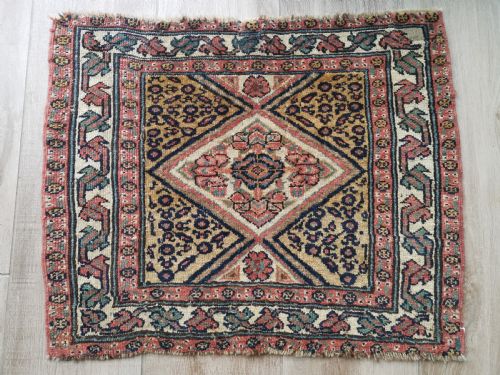


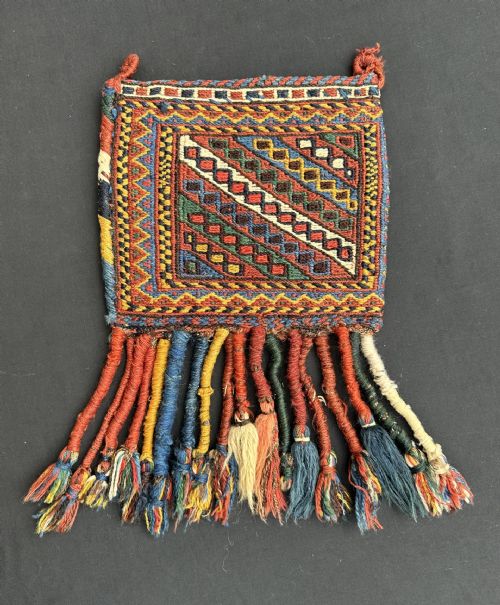


Antique Oriental Rug Fragment
These antique oriental rug fragment selections encompass woven bag faces, trapping remnants, and textile pieces created by nomadic and tribal groups across Central Asia, Persia, and the Caucasus.
Antique Oriental Rug Fragment
When you search for an antique oriental rug fragment, you are looking at remnants and individual panels from larger nomadic and tribal trappings, such as saddle bags, torbas, and chuvals. These pieces preserve the intricate weaving traditions of groups including the Turkmen, Baluch, Shahsavan, and Afshar tribes from the nineteenth century.
You are most likely to meet bag faces, mat remnants, and mounted textile sections on this page, dating from the eighteen-seventies through to the early twentieth century. These survivals offer a concentrated view of tribal motifs, such as guls, botehs, and tile patterns, rendered in wool, cotton, and silk.
The objects stem from regions spanning from the Trans-Caspian steppes to northwest Persia and the Caucasus. Each remnant reflects the utilitarian origins of domestic nomadic weavings, repurposed or preserved as decorative textile art.
How they were made
The makers utilised hand-spun wool and cotton foundation structures, occasionally incorporating silk and metallic thread for specific highlights and structural contrast. Natural dyes provided the deep crimson, ivory, and polychrome palettes observed across the tribal pieces.
Construction techniques include hand-knotted pile work alongside flatwoven Soumak structures and embroidered textile surfaces. These methods ensured the durability required for everyday nomadic items like storage bags and animal trappings.
Antique Oriental Rug Fragment Retail Price Guide 2026
Typical asking prices for oriental rug fragment among the pieces listed under this phrase on Sellingantiques today, from the lower quarter to the upper quarter. They describe what is for sale here now, not the wider market.
Some Yomut bag faces spent their early days serving as spindle bags before finding a second life as wall art.
What varies in quality
Quality rests primarily in the precision of the drawing and the clarity of tribal motifs such as gul designs, botehs, and bird or dragon forms. Tighter knots and finer weaves separate delicate dowry pieces and smaller torba faces from coarser utilitarian bag fragments.
The vibrancy and depth of the natural dyes significantly influence the visual impact of a piece, alongside the preservation of the original format. Finely executed drawing combined with a balanced, saturated palette marks the higher echelon of these survivals.
The Antique Oriental Rug Fragment Glossary
- Torba
- A small horizontal wall-pocket or storage bag produced by Turkmen tribes. These pieces typically hung inside a tent to store small possessions.
- Chuval
- A large Turkmen tent bag used for household storage. They frequently feature multiple primary guls arranged across the face.
- Khorjin
- A traditional paired saddlebag used by nomadic tribes for transport and storage. Surviving examples are often separated into individual bag faces.
- Gul
- A primary octagonal medallion or motif repeated across Turkmen and Central Asian carpets and bag faces. Each design often identifies a specific tribal group.
- Soumak
- A flatweave technique utilising a wrapping process over the warp threads to create a textured, durable surface. Shahsavan weavers frequently employed this method.
Antique Oriental Rug Fragment: Frequently Asked Questions
What is a bag face?
A bag face is the decorative front panel of a nomadic storage sack or saddlebag that survived after the plain back panel deteriorated or was cut away. These panels preserved the most intricate weaving and tribal iconography.
Nomads utilised these bags inside tents or on pack animals, meaning only the decorated face was displayed publicly.
How do I identify a Turkmen fragment?
Turkmen pieces often feature deep crimson grounds and repeating octagonal gul motifs associated with specific tribes like the Tekke, Yomut, or Ersari. Their structures typically employ wool with precise knotting.
Examining the specific drawing style and secondary ornaments helps distinguish between the various tribal substrains.
Were these always fragments?
Many items listed as fragments or half-faces were originally complete utilitarian objects like saddlebags, tent bands, or larger trappings. Wear, damage, or the division of household goods over time resulted in these sections being cut down.
Once separated, the remaining decorative panels were preserved independently as textile art.
How should I display a textile fragment?
Smaller bag faces and remnants are frequently mounted on fabric or framed behind glass to protect the fragile wool, cotton, and silk structures. Proper mounting prevents sagging and relieves tension on old foundation threads.
Keep mounted pieces away from direct sunlight to preserve the stability of natural dyes.