


A 2026 Guide by Sellingantiques
Salt was a high-status commodity before modern mining practices.
Large ceremonial cellars gradually gave way to smaller, individual antique glass salts placed near each diner.
English glasshouses started turning out matched sets for the table around the early eighteenth century.
By the Victorian era, dining etiquette required a vessel at every place setting.
Waterford produced heavy cut glass versions in Ireland during the late eighteenth and early nineteenth centuries.
Apsley Pellatt made high-quality cameo-encrusted salts at the Falcon Glass Works in London.
Continental makers like Baccarat turned out pressed and cut examples in massive volumes.
The 2026 retail price guide for Antique Glass Salts is drawn from a proprietary archive of over 1.1 million retail prices indexed by Sellingantiques since 2003. This guide relies exclusively on their own internal data; no external sources or auction records are used.
Analysing nearly 25 years of UK antique market history alongside current retail values, the data indicates that typical UK retail prices for Antique Glass Salts range between £100 and £500. Entry-level prices generally fall under £100 and premium examples upwards of £500.
Wide rims make it easy to dip a small spoon into the bowl.
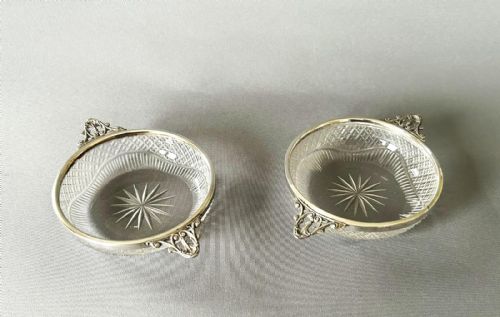
Many rest on a stepped foot or a star-cut base to provide stability on a busy table.
Facet cutting frequently covers the outer walls, catching the candlelight during dinner.
Blowing glass into a rigid metal mould allowed makers to create identical sets for large dinner services.
Wheel engraving replaced simple diamond-point scratching as lathes became more sophisticated.
The press-glass technique eventually stamped out elaborate patterns in seconds without needing a cutter.
"Cobalt blue linings were specifically chosen to contrast with white salt and make it look brighter."
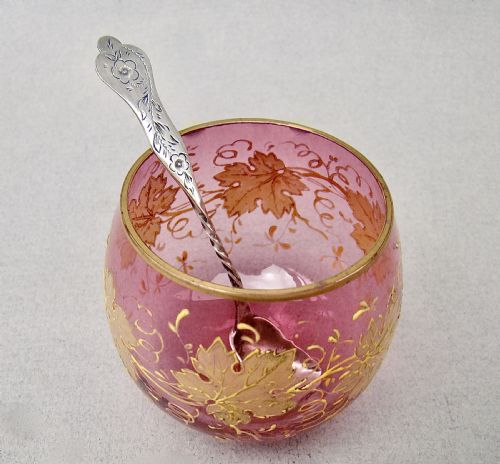
"Matching spoons occasionally survive alongside the main vessel."
"The heavy bases help prevent spills if someone reaches across the dining table."
Based on almost 25 years of Sellingantiques UK antique market data, Antique Glass Salts appeared 398 times (out of 1,100,000 antiques) which gives it a rarity score of 92/100.
This score measures scarcity within the Sellingantiques archive only and is not a survey of the entire antiques market, so these statistics may not be indicative of the general availability of Antique Glass Salts elsewhere.
That is the pontil mark. It happens when the glassblower breaks the hot iron rod away from the base of the finished vessel.
Early makers left this scar rough and jagged. Later factories ground it out, leaving a smooth, polished depression in the centre of the base.
Salt is highly corrosive. Over decades it eats into the structure of the glass itself.
That milky film is a chemical change. It cannot be washed off. Some people rub mineral oil inside to hide the cloudiness.
The dark colour provides a sharp visual contrast against the contents. Before modern processing, table salt often looked grey or lumpy.
Serving it in a rich cobalt or ruby vessel made the salt look whiter and more refined. It also helped diners see exactly how much they were pinching out.
You are describing a trencher salt. This form sits squarely on the table linen without a pedestal or legs to raise it up.
They were popular in the eighteenth century. Diners would place them next to their wooden or pewter trencher plate. The low centre of gravity meant they rarely tipped over during a busy meal.
Glassmakers usually formed them by blowing into a mould and then cutting facets onto the thick sides.
Please note: This Antique Glass Salts guide and its associated pricing data are provided for general informational purposes only. It does not constitute formal financial, investment, or appraisal advice and should not be relied upon as the sole basis for any commercial activity, purchasing, or sales decisions. Sellingantiques.co.uk accepts no liability for any actions taken in reliance on this information. Always consult with a qualified professional or independent appraiser.
