


A 2026 Guide by Sellingantiques
The antique tambour bureau emerged in late eighteenth-century France before spreading to British and American cabinetmakers.
Designed as a practical solution for dusty Georgian rooms, allowing writers to hide messy papers away quickly.
Look at the timeline of domestic correspondence, which surged just as these desks became popular.
By the early nineteenth century, changing tastes saw production slow in favour of standard cylinder and fall-front forms.
George Hepplewhite included several influential designs for these desks in his 1788 working guide.
Boston cabinetmaker John Seymour produced variations during the Federal period, often combining mahogany with contrasting maple interiors.
Gillows of Lancaster documented similar forms in their late eighteenth-century estimate sketchbooks for provincial clients.
The 2026 retail price guide for Antique Tambour Bureau is drawn from a proprietary archive of over 1.1 million retail prices indexed by Sellingantiques since 2003. This guide relies exclusively on their own internal data; no external sources or auction records are used.
Analysing nearly 25 years of UK antique market history alongside current retail values, the data indicates that typical UK retail prices for Antique Tambour Bureau range between £800 and £5,000. Entry-level prices generally fall under £800 and premium examples upwards of £5,000.
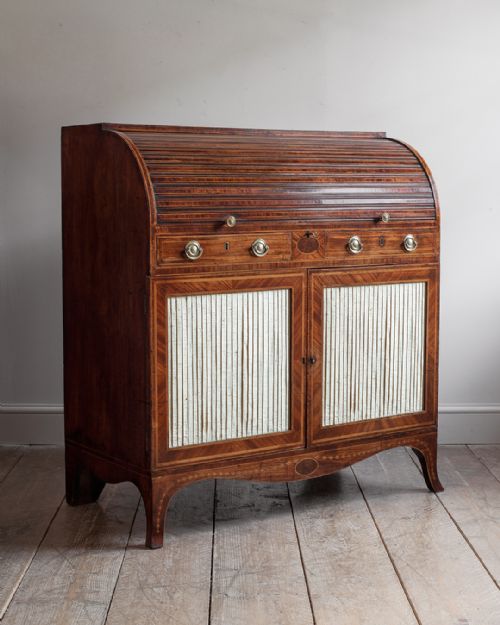
A flexible sliding cover of vertical wooden slats forms the main closure, rolling back into the cabinet sides.
Pulling the writing surface forward sometimes engages a mechanical linkage that opens the shutter automatically.
Small internal compartments neatly arrange letters and inkwells behind the working area.
Hand-cut dovetails secure the main carcase, maintaining rigidity under the shifting weight of the internal mechanism.
Makers shaped each slat with a slight bevel so the curtain could flex smoothly around tight corners.
Turn the drawers over to inspect the bottom boards, which are usually chamfered and set into grooved sides.
"Some early examples house hidden mechanical locks that secure the internal drawers when the main lid is shut."
"The narrow slat construction allowed cabinetmakers to use up smaller offcuts of expensive exotic woods."
"Inspect the tiny brass pulls closely, as many original fittings retain delicate hand-filed threads."
Based on almost 25 years of Sellingantiques UK antique market data, Antique Tambour Bureau appeared 113 times (out of 1,100,000 antiques) which gives it a rarity score of 98/100.
This score measures scarcity within the Sellingantiques archive only and is not a survey of the entire antiques market, so these statistics may not be indicative of the general availability of Antique Tambour Bureau elsewhere.
Do not force the slats backwards. The canvas backing is old and pulling hard will tear the fabric or snap the dry glue lines holding the timber.
Look for obstructions in the lower runnels first. Sometimes a stray letter or paperclip slips behind the drawer bank and blocks the track. Clearing the hidden pathway usually frees the mechanism.
A slight slope is common. The brass hinges and wooden supports that hold the writing surface take a lot of downward pressure from heavy arms over the decades. Wear in these areas alters the resting angle.
You can check the hinges for loose screws. Tightening them often corrects a minor droop. If the timber supports below are worn down, they might need building back up by a restorer.
A simple beeswax works well for lubricating the runnels. Avoid silicone sprays or modern liquid oils.
Apply a thin layer of solid wax directly to the wooden channels using a cotton swab. The goal is to reduce friction without creating a sticky paste that attracts household dust.
Timber expands and contracts with changes in seasonal humidity. If the desk recently moved into a damper environment, the drawer sides have likely swelled tight against the carcase divisions.
Let the desk settle into its new climate for a few months. Often the drawers will shrink back down and slide freely once the moisture content equalises.
If they still bind after a season, check the runners for built-up dirt. Old wax and dust can harden into ridges that catch the drawer bottoms.
Please note: This Antique Tambour Bureau guide and its associated pricing data are provided for general informational purposes only. It does not constitute formal financial, investment, or appraisal advice and should not be relied upon as the sole basis for any commercial activity, purchasing, or sales decisions. Sellingantiques.co.uk accepts no liability for any actions taken in reliance on this information. Always consult with a qualified professional or independent appraiser.
