




Victorian Pottery Spill Holders
Victorian pottery spill holders are charming ceramic vessels designed to hold thin tapers for lighting fires, bringing character to any mantelpiece.
Victorian Pottery Spill Holders
Victorian pottery spill holders are earthenware vessels produced during the nineteenth century, often modelled into animal groups, figures, and architectural motifs. These pieces served the practical domestic purpose of storing wooden spill tapers near the hearth for lighting candles and fires.
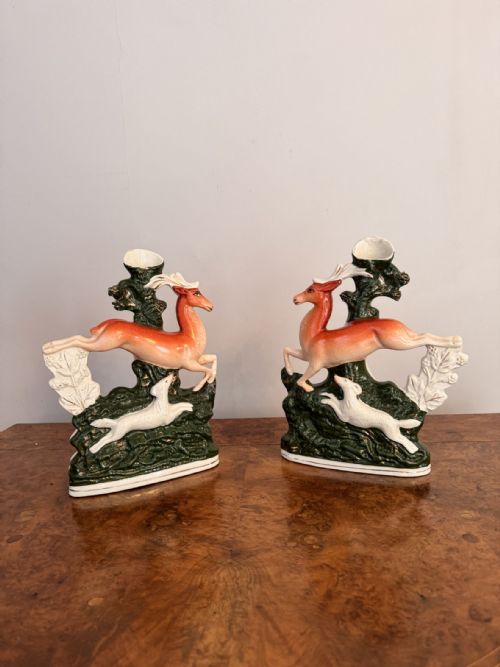
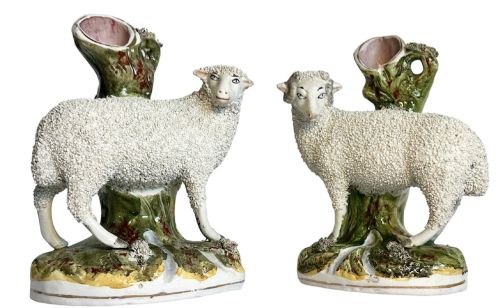
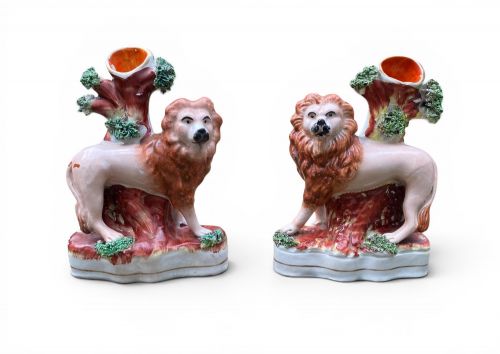
The most common versions met on this page are Victorian Staffordshire figures and pairs of animals such as deer, sheep, lions, dogs, and swans. Makers frequently combined the figurine form with a hollow cylindrical vase behind the subject to hold the tapers.
Dated examples and pieces from the wider Victorian era span from approximately 1850 to 1900, showing flatback construction designed to sit neatly against a wall. Collectors encounter both single figures and symmetrical pairs that originally flanked a fireplace or dresser centrepiece.
How They Were Made
Potters shaped these spill holders using earthenware clay, frequently forming the bodies in moulds before finishing the details by hand. The resulting ceramic figures were then given a lead glaze or general glaze to seal the porous body.
Makers applied enamel and enamel paint over the glaze to colour the animals, clothing, and landscape bases. This surface painting created the vivid polychrome palette typical of nineteenth-century Staffordshire works.
Babes in the wood figures remind modern buyers of dark folklore sitting quietly beside fireplace tapers.
What Varies in Quality
Scale and complexity also separate ordinary production from superior pieces, particularly in large pairs depicting complicated subjects like Scots harvesters or multiple animals. The crispness of the glaze and the preservation of the enamel paint over the ceramic body further distinguish better specimens.
The Victorian Pottery Spill Holders Glossary
- Spill Vase
- A hollow ceramic container designed to hold wooden spills for lighting fires. These vessels form the upright cylindrical section attached behind figures or animals.
- Flatback
- A Staffordshire figure construction method where the reverse is left unglazed and flat so the piece rests flush against a wall. This technique saved time and materials during manufacture.
- Earthenware
- A porous ceramic body fired at lower temperatures than stoneware or porcelain. It forms the structural base for the vast majority of nineteenth-century Staffordshire pottery.
- Enamel Paint
- Vitreous coloured pigments applied over a fired glaze and heated again to fuse with the surface. It provides the bright hues found on Victorian figures.
Victorian Pottery Spill Holders: Frequently Asked Questions
What are Victorian pottery spill holders?
These ceramic vessels are nineteenth-century earthenware figures and animal groups featuring integrated cylindrical holders designed to store wooden tapers.
Households used them near hearths to easily transfer flames to candles and fires before matches became common.
How were spill holders used?
They sat upon mantelpieces and tabletops holding thin wooden spills ready for everyday domestic tasks.
When a fire or candle needed lighting, a single spill was pulled from the vase and touched to the embers.
What subjects appear on these pieces?
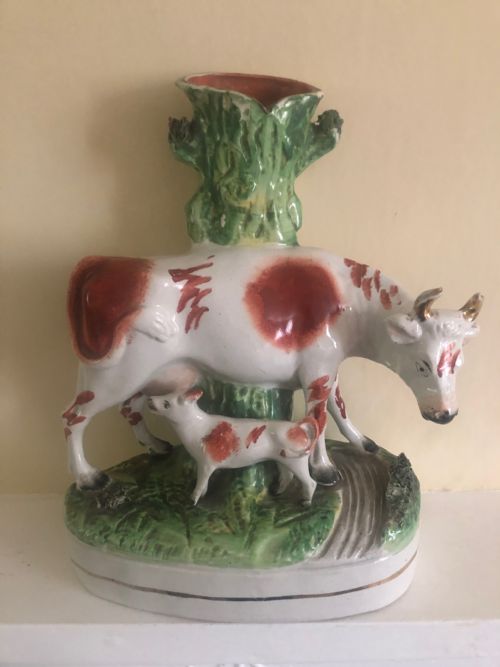
Potters modelled animals such as deer, sheep, lions, dogs, swans, and cows, alongside human figures and literary scenes.
Many examples depict pairs of animals standing beside the hollow trunk that serves as the taper holder.
How do you date Victorian Staffordshire spill holders?
Dating relies on stylistic clues, flatback construction methods, and characteristic nineteenth-century enamel painting.
Pieces originating from the middle to late Victorian period often display specific glaze formulas and moulding traits tied to Staffordshire potteries.