



Victorian Ebonised Games Table
A victorian ebonised games table brings dark sophistication to a room, offering a clever surface that transforms for cards or chess.
Victorian Ebonised Games Table
When you search for a victorian ebonised games table, you encounter nineteenth-century furniture designed for leisure, featuring dark simulated or blackened wood surfaces. These pieces appear across various nineteenth-century decades, including the eighteen-seventies and eighteen-eighties, often adopting card or gaming formats.
The selections span distinct stylistic influences from the period, ranging from English aesthetic movement pieces to French Napoleon III and Louis XV revival designs. Alongside traditional card tables, the records show handkerchief folds, sewing combinations, and console variants.
Origin points encompass English workshops and French cabinets, frequently incorporating contrasting timbers or metallic inlay. Buyers select these tables for dual-purpose entertaining and distinct dark-toned period aesthetics.
Materials and Construction Methods
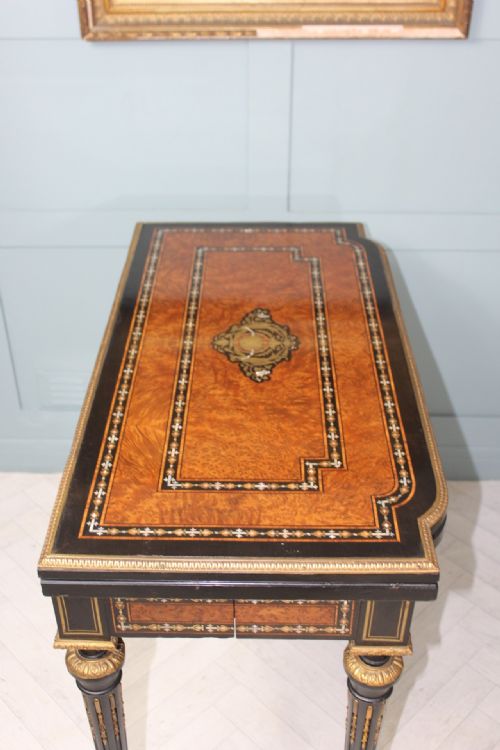
Cabinet makers utilised ebonised wood as a primary base, achieving the dense black finish through staining or painting fruitwood and other timbers to imitate costly ebony. This dark ground served as a canvas for contrasting inlay materials.
Craftsmen embedded brass, mother-of-pearl, and parcel gilt detailing into the surfaces, alongside marquetry work in amboyna, burr walnut, and mahogany. Ormolu mounts and porcelain plaques occasionally embellished French revival examples.
Internal engineering relied on hinged, swivel, or trifold mechanisms that allowed top surfaces to pivot and open, revealing concealed wells or baize-lined playing surfaces supported by oak or walnut framing.
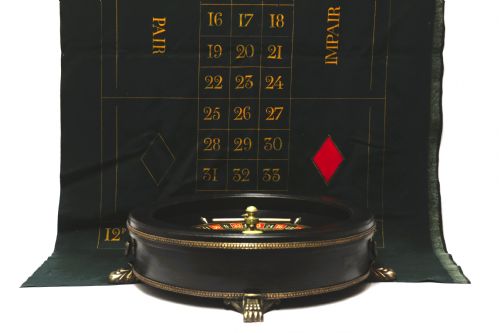
A French roulette wheel from 1880 sneaks into the gaming antiques, proving Victorians loved a spin long before casino nights.
Markers of Superior Craftsmanship
The distinction between standard production and exhibition quality lies in the precision of the marquetry and the crispness of the applied brass and mother-of-pearl work. Superior examples demonstrate meticulous hand-cut inlay rather than simple surface decoration.
Structural integrity of the folding and swivelling mechanism dictates much of the functional merit, with finer pieces operating smoothly without slack in the joints. The choice of secondary timbers like oak for internal framing also signals higher workshop standards.
Attribution to documented makers or retail houses elevates a piece, as demonstrated by stamped or labelled works from known firms. The harmony between the ebonised finish and secondary exotic veneers like amboyna determines visual success.
Edwards & Roberts·Lamb of Manchester·S&H Jewell
The Victorian Ebonised Games Table Glossary
- Ebonised wood
- Timber treated to resemble expensive ebony, creating a dense black finish popular in nineteenth-century design. This technique provided a dramatic dark backdrop for metallic and mother-of-pearl inlay.
- Baize
- A coarse woollen fabric used traditionally to line the playing surfaces of card tables. It offers a soft, durable texture for handling playing cards.
- Marquetry
- Decorative patterns formed by inserting pieces of contrasting wood, veneer, or shell into a wood veneer base. It requires high precision to achieve intricate floral or geometric designs.
- Ormolu
- Gilded bronze mounts applied to furniture for decorative enrichment, frequently seen on French revival pieces. The technique adds metallic lustre against dark ebonised surfaces.
- Trifold
- A tabletop design that folds out multiple times to expand the surface area for gaming or dining. This mechanism maximises versatility in smaller parlour spaces.
Victorian Ebonised Games Table: Frequently Asked Questions
How do I maintain the ebonised finish?
Dust regularly with a soft, dry cloth to prevent abrasion on the dark surfaces. Avoid harsh chemical cleaners that can strip or dull the black polish.
Apply a microcrystalline wax occasionally to protect the wood from humidity and minor scuffs. Keep the table away from direct sunlight to prevent fading of the ebonised tone.
How do I date these tables?
Examine the secondary timbers, screws, and hinges underneath the tabletop for manufacturing clues. Machine-cut screws generally point towards later Victorian production.
Stylistic markers also help narrow the decade, such as the geometric lines of the aesthetic movement versus the elaborate curves of French revival pieces.
Can these tables be used daily?
These tables function well for everyday use provided the folding mechanisms are handled with care. The baize surfaces or inlaid tops benefit from coasters and gentle treatment.
Placing them away from direct heat sources prevents the timber and veneers from warping or cracking over time.