


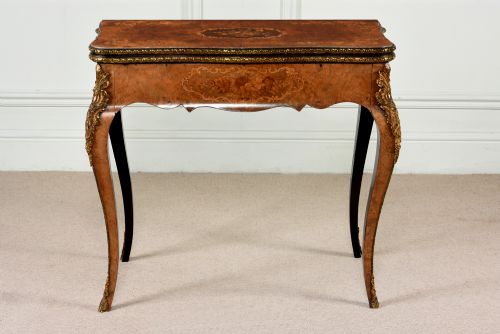

Late Victorian Card Table
A late victorian card table brings domestic entertainment to life through folding mahogany, rosewood and walnut surfaces designed for evening games.
Late Victorian Card Table
A late victorian card table serves as a dual-purpose piece of furniture that opens from a compact console or occasional table into a baize-lined surface for cards and board games. These pieces emerge from the nineteenth century in various configurations, ranging from square envelope folds to serpentine demi-lune shapes.
Mahogany, rosewood and burr walnut dominate the examples found here, often enhanced with satinwood inlay or marquetry. Alongside standard card tables, the selection includes centre tables, games tables and occasional tables sharing the same period aesthetic.
The aesthetic movement and revival styles heavily influence these designs, incorporating oak, ebonised wood and brass details. Buyers encounter everything from simple folding oak models to elaborately banded and inlaid conversation tables.
Materials and Construction
Cabinet makers utilise dense hardwoods like mahogany, walnut and rosewood as the structural foundation, often applying intricate satinwood inlay, marquetry or parcel gilt highlights to the exterior. Ebonised finishes and oak also appear, particularly within pieces influenced by the aesthetic movement or reformed gothic styles.
Working surfaces typically receive an inset of green baize or tooled Moroccan leather to provide a suitable texture for playing cards. Folding mechanisms, swivel tops and pivoting leaves rely on brass hinges and internal wells designed to conceal gaming pieces.
Late Victorian Card Table Retail Price Guide 2026
Typical asking prices for late victorian card table among the pieces listed under this phrase on Sellingantiques today, from the lower quarter to the upper quarter. They describe what is for sale here now, not the wider market.
Several tables retain hidden wells originally built to catch stray counters during spirited late-night card sessions.
Assessing Quality and Execution
Quality rests upon the selection of timber veneers, such as figured burr walnut, fiddleback mahogany or amboyna, matched carefully across the folding leaves. Superior examples demonstrate precise satinwood stringing and delicate marquetry rather than stamped or heavy-handed surface decoration.
The integrity of the pivoting or folding mechanism dictates daily usability, requiring tight joints and stable support legs that bear weight evenly when opened. Original fitted elements, such as internal gaming wells and matching brass hardware, elevate the standing of an individual piece.
Lamb of Manchester·Gillows
The Late Victorian Card Table Glossary
- Envelope table
- A card table with a square folding top that opens diagonally in four triangular flaps resembling an envelope to reveal a baize-lined interior.
- Demi-lune
- A half-moon shape commonly seen in the profile of console and card tables designed to sit flush against a wall when closed.
- Baize
- A coarse woollen fabric, traditionally green, used to line the playing surfaces of card and games tables.
- Marquetry
- Decorative veneer work forming intricate patterns or pictures using various coloured woods, ivories or metals.
- Serpentine
- A curved shape featuring a convex centre flanked by concave curves, frequently defining the front edge of a table top.
Late Victorian Card Table: Frequently Asked Questions
What games were played on these tables?
These tables accommodated popular nineteenth-century parlor pastimes, including whist, cribbage and various card games requiring a stable, baize-covered surface. The felt or baize lining prevented cards from sliding and muffled the sound of play.
Many examples include small corner wells or compartments for storing counters, markers and packs of cards between sessions.
Where should I place a card table at home?
A demi-lune or console card table sits neatly against a living room wall when closed, functioning as a side table for lamps or decorative boxes. Placing it in a study or drawing room allows it to serve as a focal point.
Opening the table requires adequate clearance around the piece so guests can access the seating and unfold the leaves without obstruction.
How do I identify the aesthetic movement style?
Aesthetic movement pieces from the late nineteenth century favour ebonised wood, geometric lines and restrained decoration often inspired by Japanese design. Brass hardware and contrasting timber inlays frequently accent these dark finishes.
Such tables stand apart from heavy rococo or classical revivals through their emphasis on simplicity, craftsmanship and structural honesty.