
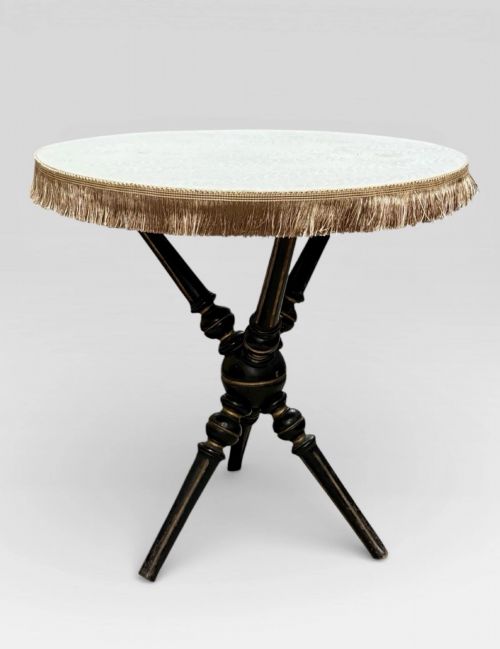


Aesthetic Movement Card Table
An aesthetic movement card table brings clever folding mechanisms and Japonisme-inspired design into the nineteenth-century parlour.
Aesthetic Movement Card Table
An aesthetic movement card table provides a folding or drop-leaf surface designed for parlour games and card playing during the nineteenth century. These pieces emerge primarily from the Victorian period, spanning the 1870s, 1880s, and 1890s, alongside occasional Edwardian examples.
The forms seen here include specialised games tables, occasional tables, side tables, and trifold handkerchief tables. A buyer is most likely to encounter ebonised wood structures, walnut, and oak frames configured as compact folding surfaces.
Makers such as Lamb of Manchester and Gillows appear in the record, alongside pieces attributed to the Manchester School. Surviving variants incorporate exotic woods, brass details, and decorative elements like Wedgwood plaques.
How they were made
Makers utilised ebonised wood, oak, walnut, and burr walnut as primary structural materials, often enriched with amboyna and other exotic veneers. Brass hardware and gilt accents punctuate the darker wood surfaces.
Construction techniques include trifold drop-leaf mechanisms, lacquer work, bamboo framing, and decoupage. Some examples incorporate passementerie fringe and specialised fabric inlays for the gaming surface.
Listings feature oak, burr walnut, and ebonised wood alongside bamboo and lacquered surfaces.
What varies in quality
The standard of execution depends on the complexity of the timber selection and the precision of the folding mechanism. Tables featuring amboyna veneers, Wedgwood plaques, and intricate marquetry represent the upper tier of production.
Attribution to known workshops like Lamb of Manchester or Gillows elevates the standing of a piece. Simpler ebonised or bamboo occasional variants show more straightforward construction.
Lamb of Manchester·Gillows
The Aesthetic Movement Card Table Glossary
- Ebonised
- Wood treated to imitate ebony, giving a dense black finish popular in nineteenth-century furniture design. This treatment was standard for many aesthetic movement pieces.
- Amboyna
- A highly prized, richly figured exotic wood used for veneers and decorative highlights on cabinet work. Its speckled grain adds distinct visual depth.
- Trifold
- A tabletop design that unfolds in three sections to reveal a larger playing surface supported by pivoting legs. This mechanism saves space when the table is closed.
- Passementerie
- Decorative trimming such as fringes, cords, or tassels applied to the edges of fabric surfaces. It often adorns the skirts of nineteenth-century tables.
- Japonisme
- The influence of Japanese art on Western design, characterised by asymmetry and natural motifs. This aesthetic defined the visual language of these tables.
Aesthetic Movement Card Table: Frequently Asked Questions
What is an aesthetic movement card table?
An aesthetic movement card table is a nineteenth-century folding or multi-surface table designed for parlour games. These pieces reflect the artistic reforms of the period through ebonised finishes, exotic woods, and Japanned decoration.
They function as compact occasional tables that expand when needed for card playing or social gatherings.
How do I date an aesthetic movement table?
Dating relies on stylistic markers, construction methods, and recorded workshop attributions from the 1870s to the 1890s. Pieces from this era frequently employ ebonised wood, bamboo, and specific brass hardware.
Makers' stamps or labels, when present, provide the most precise chronological indicator for these Victorian items.
What woods were used in these tables?
Cabinetmakers utilised ebonised wood, oak, walnut, burr walnut, and mahogany as primary structural timbers. Exotic woods like amboyna were frequently selected for decorative veneers.
Some lighter variations incorporated bamboo structures combined with lacquer or decoupage panels.
How were these tables used originally?
These tables served a dual purpose as decorative parlour furniture and functional surfaces for card games and social activities. The folding or trifold tops allowed households to save space when entertainment was finished.
They sat against walls or in corners as side tables until required for evening recreation.
Are these tables suitable for daily use?
These tables adapt well to modern living as occasional surfaces, provided the folding mechanisms and hinges receive careful handling. The delicate veneers and ebonised finishes require standard care to prevent surface marking.
Placing them away from direct heat sources helps preserve the nineteenth-century timber and joinery.