
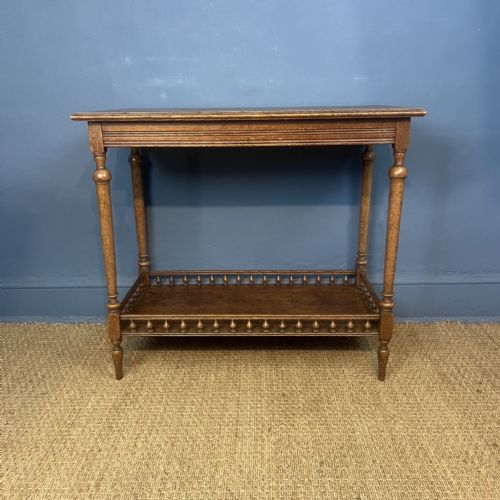
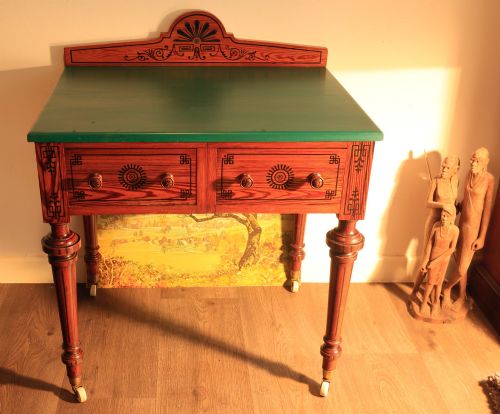


Aesthetic Movement Console Table
An aesthetic movement console table brings distinct late nineteenth-century reform design into a hall or sitting room with clean lines and striking surfaces.
Aesthetic Movement Console Table
An aesthetic movement console table represents the reform design spirit of the Victorian era, combining functional form with artistic surface decoration. Buyers searching for an aesthetic movement console table will encounter pieces originating predominantly from the nineteenth century, spanning decades from eighteen-seventy through to nineteen-twenty.
The selection includes specific console formats alongside related side tables, card tables, writing tables, and hall stands. Ebonised wood and bamboo predominate, frequently accompanied by oak, walnut, pitch pine, and brass highlights.
How they were made
Cabinet makers utilised ebonised wood to mimic expensive exotic hardwoods, often applying parcel gilt or combining the dark finish with bamboo frames. Structural integrity relied on traditional joinery applied to oak, walnut, and pitch pine carcases.
Surfaces incorporated ceramic tiles, such as those from Minton, or featured burr thuya and ebony veneers. Brass mounts and handles provided functional contrast to the dark wood and natural bamboo structures.
Object forms include side tables, card tables, writing desks, and hall stands.
What varies in quality
The distinction between standard commercial output and finer workshop production lies in the selection of timber and the execution of surface details. Pieces featuring burr thuya veneer, parcel gilt, or integrated ceramic tiles demonstrate higher ambition than plain ebonised softwood carcases.
Makers associated with specific schools or documented firms introduce greater refinement in joinery and structural proportion. The retention of original brass hardware and undamaged ceramic inserts elevates a piece above those with replaced elements.
Jenks & Woods·Ellen E. Houghton of Minton
The Aesthetic Movement Console Table Glossary
- Ebonised wood
- Timber treated to resemble ebony through staining or painting. This finish was widely utilised in the nineteenth century to achieve a dense black surface.
- Parcel gilt
- The practice of applying gold leaf selectively to specific carved details or raised portions of furniture. It highlights decorative motifs against a dark background.
- Card table
- A folding or pivoting table designed specifically for playing card games. Many Victorian examples feature baize-lined surfaces and folding leaves.
- Etagere
- A set of open shelves for displaying small decorative objects. These tiered structures often form part of a console table design.
- Burr thuya
- A highly figured wood veneer taken from the burl of the thuya tree. It provides a rich, mottled grain pattern prized on luxury writing and side tables.
Aesthetic Movement Console Table: Frequently Asked Questions
What is an aesthetic movement console table?
An aesthetic movement console table is a nineteenth-century furnishing piece influenced by the art-for-art's-sake philosophy, favouring stylised natural motifs, ebonised finishes, and bamboo structures.
These tables were designed to decorate domestic hallways and reception rooms rather than serve purely utilitarian storage functions.
How do I identify this style?
Key indicators include ebonised wood surfaces, bamboo frames, Japanese-inspired motifs, and contrasting brass hardware or ceramic tile insets.
Construction dates generally cluster in the late Victorian period, spanning the eighteen-seventies to the turn of the twentieth century.
Where were these tables placed?
Original placement was typically against a wall in a hallway, drawing room, or entrance vestibule where decorative impact mattered most.
Many incorporated lower tiers or etagere shelving to hold cards, small ceramics, or visiting trays.
How do I care for ebonised wood?
Ebonised surfaces require gentle dusting with a soft, dry cloth and protection from direct sunlight to prevent fading or surface cracking.
Avoid commercial silicone polishes that can build up a greasy residue over the black finish.