
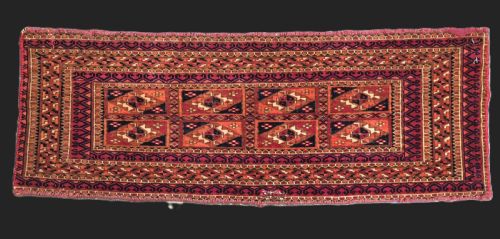
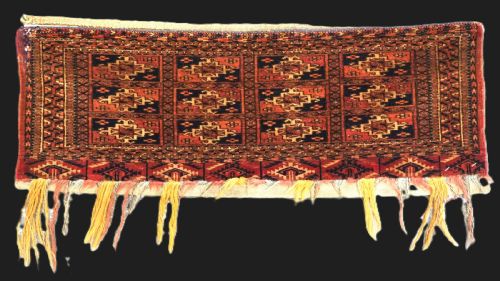


Tekke Turkmen Gul Rug
A tekke turkmen gul rug delivers tribal geometry and saturated madder tones, prized for intricate octagonal motifs woven by Central Asian nomads.
Tekke Turkmen Gul Rug
A tekke turkmen gul rug centres on repeated octagonal medallions known as guls, woven by nomadic weavers across Central Asia during the nineteenth and early twentieth centuries. These pieces appear as full room-sized carpets, floor rugs, and smaller utility sacks including torbas and chuvals.
The most common formats on this page are chuval faces and torba panels, often surviving from the middle to late nineteenth century with geometric field patterns. Dowry rugs and main carpets also feature frequently, displaying specific gul variations such as the aina gul or salor gul.
Weavers constructed these textiles for practical domestic use within tribal life, ranging from tent storage bags to floor coverings for family gatherings. Surviving examples demonstrate the traditional output of Turkmen tribes working with wool and natural dye palettes.
How They Were Made
Weavers utilised hand-spun wool for the dense pile, dyed with natural substances to produce deep reds, browns, and contrasting ivory accents. Selected pieces incorporate fine silk highlights to accentuate specific details within the repeating gul motifs.
The technique relies on symmetrical knotting executed on wool foundations, yielding a dense, velvet-like texture that withstands heavy daily wear. Many bag faces retain their original plain-weave backs and hanging loops, showing the complete construction methods of nineteenth-century nomadic workshops.
Several surviving torba faces still retain their original hanging loops, ready to be mounted exactly as nomadic families hung them centuries ago.
What Varies in Quality
Knot density and structural fineness define the upper tiers of these textiles, requiring exceptional dexterity from the weaver to render complex geometric drawing with precision. Pieces exhibiting extremely tight weaves and crisp lines represent superior technical execution.
Colour saturation and the clarity of natural dye formulas determine visual distinction, where deep madder tones and unvaried hues elevate an example. The retention of original backs, complete formats, and supplementary silk highlights further distinguish high-grade specimens from standard utilitarian items.
The Tekke Turkmen Gul Rug Glossary
- Gul
- A repeating octagonal medallion motif used across Turkmen tribal rugs to signify specific clan lineages and heritage. These principal design elements structure the field of the textile.
- Chuval
- A large utility bag woven by nomadic groups for household storage inside the yurt. Chuval faces often survive as individual decorative rug panels.
- Torba
- A smaller wall-hanging storage bag utilised for domestic items within traditional nomadic tents. They share the intricate gul designs seen on larger carpets.
- Aina gul
- A specific mirrored or diamond-shaped variation of the standard tribal medallion. This uncommon motif appears primarily on dowry and wedding textiles.
- Madder
- A natural red dye derived from the roots of the rubia plant, providing the foundational colour for traditional Turkmen wool piles. It yields rich, enduring terracotta and crimson shades.
Tekke Turkmen Gul Rug: Frequently Asked Questions
What is a gul rug?
A gul rug is a traditional woven textile featuring repeating octagonal medallions, originating from Central Asian nomadic tribes.
These geometric motifs identify specific tribal groups and form the primary decorative structure across the field of the carpet.
How were chuval bags used?
Chuvals served as large storage sacks inside traditional nomadic dwellings for holding bedding, clothing, and household goods.
Nomads hung them against the lattice walls of tents, which explains why many survive today as decorative face panels rather than complete bags.
How do I date an antique rug?
Dating relies on assessing the natural dye palette, the fineness of the wool weave, and structural characteristics typical of nineteenth-century production.
Earlier examples from the first half of the nineteenth century generally display more saturated madder colours and extremely dense knotting.
Where were these rugs made?
Nomadic and settled Turkmen tribes produced these textiles across Central Asia, including regions associated with the Emirate of Bukhara.
Weavers worked within tribal communities using locally sourced materials and traditional geometric designs passed down through generations.
How do I care for wool pile?
Wool pile textiles require regular gentle vacuuming without rotary brushes to prevent fibre damage and dust accumulation.
Professional cleaning by specialists familiar with antique vegetable-dyed carpets ensures the longevity of the natural fibres.