


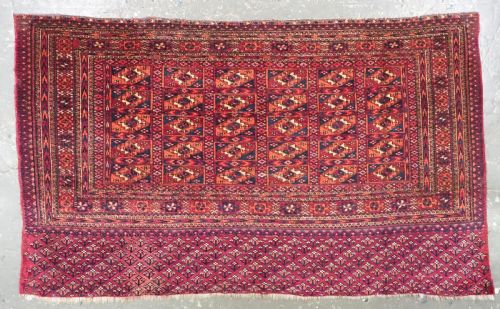


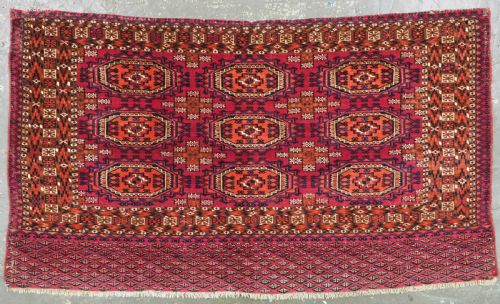


Hand Knotted Chuval Face
A hand knotted chuval face brings tribal textile art into a room, offering patterned wool fronts of nomadic tent bags.
Hand Knotted Chuval Face
A hand knotted chuval face represents the front panel of a traditional Turkmen storage bag, woven by nomadic weavers across Central Asia. When you search for this phrase, you encounter regional tribal styles including Tekke, Yomut, and Ersari, often displaying specific gul motifs and elem panels.
Most examples found here date from the nineteenth century, ranging from around 1750 to 1900. These pieces typically take the form of small rugs, textile fragments, or complete bag faces designed originally for household storage inside a yurt.
Materials and construction
These textiles utilise wool dyed with natural colours, creating the rich saturated palette characteristic of nineteenth-century Turkmen tribal weaving. The dense knotting provides a durable pile suited to the utilitarian function of nomadic furnishings.
Weavers constructed these pieces with structural precision, integrating complex geometric patterns such as the Salor gul and aina gul designs directly into the foundation.
Nomadic weavers packed these bags with blankets and bedding, meaning your wall art once doubled as a tent's wardrobe.
Assessing quality in tribal weavings
Quality rests upon the fineness of the knotting and the crispness of the geometric design work. Pieces displaying complex arrangements of guls and detailed elem borders demonstrate superior technical skill from the weaver.
The choice and preservation of natural dyes dictate visual depth, while completeness of survival marks the distinction between intact faces and fragmentary examples.
The Hand Knotted Chuval Face Glossary
- Chuval
- A large tent bag used by Turkmen nomads for household storage. The face represents the decorative front panel preserved after the utilitarian back was removed.
- Gul
- A primary medallion motif repeated across Turkmen carpets and bag faces. Different tribes utilised distinct gul designs to signal identity and lineage.
- Elem
- The decorative lower panel of a rug or bag face, often filled with floral or geometric motifs beneath the main field of guls.
- Torba
- A smaller storage bag produced by Turkmen tribes, structurally related to the larger chuval.
Hand Knotted Chuval Face: Frequently Asked Questions
What is a chuval face?
A chuval face is the decorative front panel of a nomadic storage bag produced by Turkmen and other Central Asian tribes. These textiles served both a practical storage function inside the tent and a decorative purpose.
Over time, many of these bag fronts were separated from their plain utility backs to be preserved and collected as standalone textile art.
How do I hang a textile fragment?
Hanging a textile fragment requires careful support to distribute the weight evenly across the wool fabric without causing stress to the ancient structure. A professional conservator can attach a cotton sleeve to the reverse for a concealed rod mounting.
Alternatively, conservation-grade Velcro systems allow flat mounting against a wall surface, keeping the piece secure and visible.
How do I tell Tekke from Yomut?
Distinguishing between Tekke and Yomut pieces involves examining the specific gul medallions and the secondary motifs used within the field. Tekke designs frequently feature structured octagonal guls with clean symmetry.
Yomut examples tend to incorporate hook motifs, diamond-shaped patterns, and distinct border arrangements that reflect a different tribal heritage.
What are natural dyes in rugs?
Natural dyes are colourants derived from plant, insect, and mineral sources utilised before the introduction of synthetic aniline dyes in the nineteenth century. These materials produce complex tones that age gracefully.
Colours created with natural dyes often exhibit subtle variations known as abrash, adding visual depth across the wool surface.