


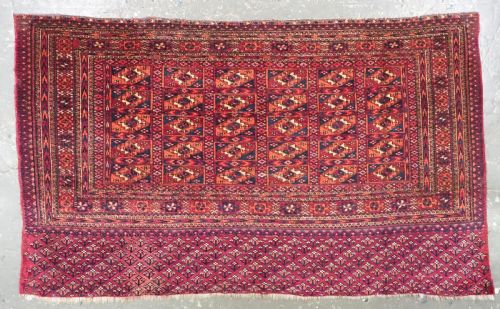


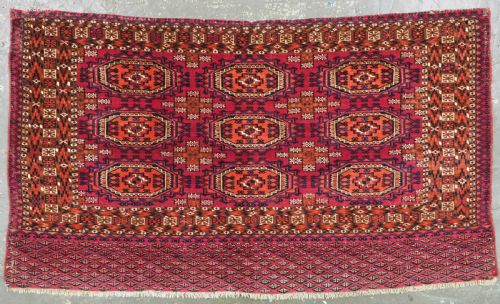


19th Century Chuval
When you examine a 19th century chuval, you encounter a woven Turkmen storage bag face made for nomadic life and prized today for its intricate tribal artistry.

19th Century Chuval
A 19th century chuval is a large bag face woven by Central Asian tribal groups such as the Tekke, Yomut, Ersari, Saryk, and Kizil Ayak. These pieces served practical domestic functions within nomadic tents, often used for storing household goods and bedding during migrations.
Most examples found today are individual bag faces rather than complete sacks, preserved as panels or wall hangings due to their striking geometric patterns. The format typically displays repeating rows of primary medallions known as guls, accompanied by minor ornaments and detailed border systems.
Materials and construction
These textiles rely on a foundation of wool and cotton, utilising hand-spun materials dyed with natural colorants to achieve deep reds, browns, and ivory tones. Certain examples incorporate supplementary flat-woven details or occasional silk highlights to accentuate specific design elements within the field.
The density of the weaving varies significantly, with finer specimens demonstrating meticulous knotting techniques that create crisp geometric definitions. Many surviving pieces retain portions of their plain weave backs, hanging loops, or finished borders from their original construction.
The inventory spans the mid to late nineteenth century, recording nomadic weaving traditions from Central Asian tribal workshops.
Judging quality and character
Quality in these nomadic textiles rests upon the precision of the weave, the saturation and depth of the natural dyes, and the clarity of the primary gul drawing. Pieces exhibiting unusual design variants, balanced proportions, or complete structural integrity command closer attention from collectors.
The distinction between standard production and exceptional work lies in the handle of the wool and the complexity of the secondary ornaments. Examples featuring scarce medallion layouts or paired formats demonstrate the higher tier of tribal craftsmanship.
Tekke Turkmen·Yomut Turkmen·Ersari Turkmen·Saryk Turkmen·Kizil Ayak
The 19th Century Chuval Glossary
- Chuval
- A large nomadic storage bag or bag face produced by Turkmen tribes in Central Asia.
- Gul
- A primary repeating medallion motif characteristic of Turkmen tribal rug and textile design.
- Torba
- A smaller horizontal storage bag face created for domestic use within the nomadic tent.
- Aina gul
- A specific mirror-like secondary medallion form found within certain tribal compositions.
- Elem
- The decorative lower panel of a bag face, positioned beneath the main field of guls.
19th Century Chuval: Frequently Asked Questions
What is a chuval used for?
Nomadic families utilised these large bags inside their dwellings to store clothing, bedding, and valued personal possessions during seasonal travels.
Over time, many of these storage sacks were separated into individual bag faces, turning practical containers into decorative panels suited for domestic display.
How do you hang a textile safely?
Mounting a textile requires distributing the weight evenly across the entire upper edge rather than supporting it at isolated points. Using a cotton sleeve stitched to the reverse or a padded wooden batten protects the delicate wool structure from undue strain.
Keeping the piece away from direct sunlight preserves the stability of the natural dyes used across the surface.
How are different tribes identified?
Distinguishing between tribal origins depends on analysing the specific geometry of the primary guls, the structure of the borders, and the prevailing background palette. Tekke examples often display closely packed octagonal medallions, while Yomut and Ersari pieces introduce distinct structural proportions and secondary motifs.
Comparing the weave density and foundation materials further clarifies the specific Central Asian group responsible for the work.
Are complete bags common?
Surviving examples that retain both the decorated face and the plain weave back are less common than isolated bag faces. Many pieces were divided historically when the functional sacks wore out along the base or sides.
Complete pieces offer a clearer view of the original utilitarian construction and often feature intact flat-woven details.