



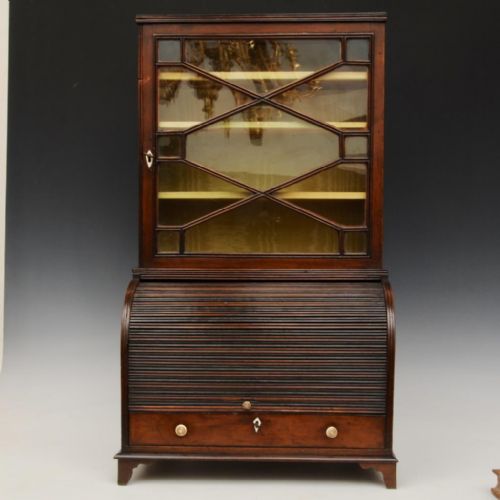


Regency Apprentice Piece
A regency apprentice piece is a scaled-down masterwork made by a craftsman to prove his skill, offering exquisite detail in miniature form.
Regency Apprentice Piece
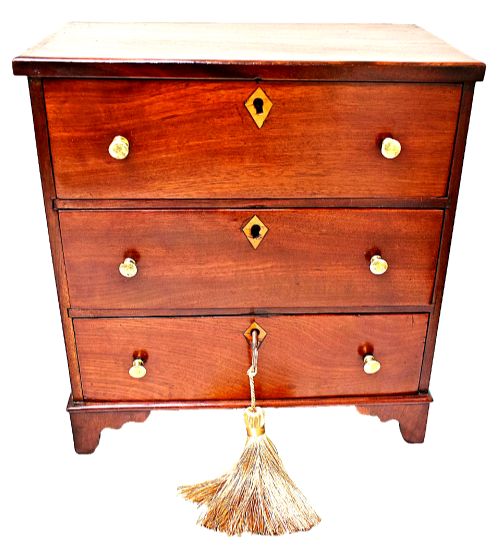
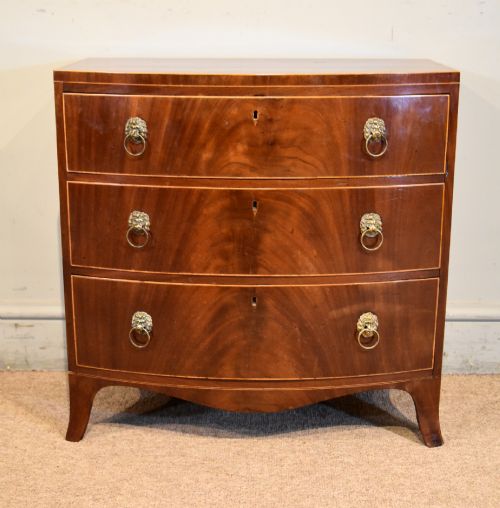
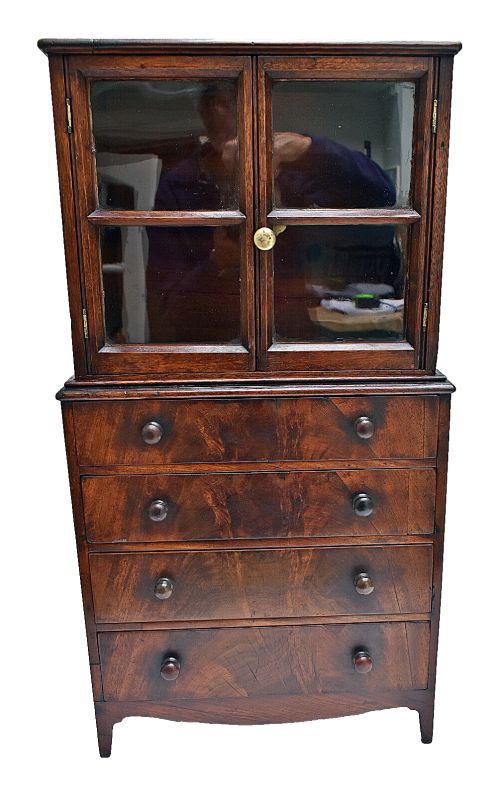
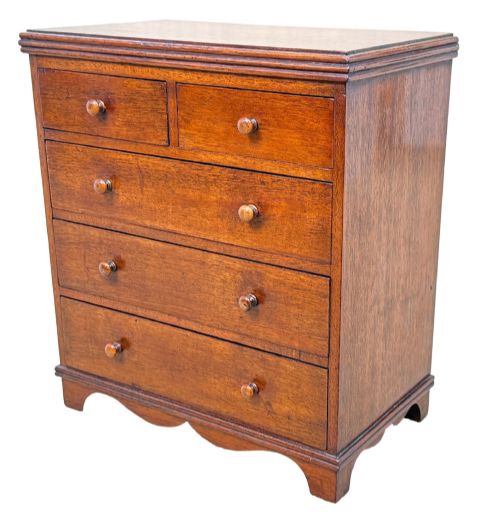
Miniature chests of drawers dominate the selection, appearing with bowfronts, straight fronts, and various wood veneers. Alongside these small chests, buyers encounter miniature breakfast tables, sideboards, tea caddies, and tabletop cabinets.
The origins span the 18th Century through to 1880, with a strong concentration of pieces hailing from the Regency and George III periods. Each surviving example provides a window into the rigorous standards demanded of period woodworkers.
Materials and construction methods
Makers utilised dense hardwoods such as mahogany and rosewood, often paired with finer decorative veneers like burr yew and amboyna. These timbers provided the stable ground required for intricate joinery on such a reduced scale.
Brass fittings, boxwood stringing, and delicate bone details frequently accent the primary woods, reflecting full-size cabinet-making practices of the era. Dovetail joints and turned feet mirror the structural integrity of domestic furniture built during the Georgian and Regency years.
Regency Apprentice Piece Retail Price Guide 2026
Typical asking prices for regency apprentice piece among the pieces listed under this phrase on Sellingantiques today, from the lower quarter to the upper quarter. They describe what is for sale here now, not the wider market.
Even the tiny drawers retain hand-cut dovetails, proving that the apprentice had nowhere to hide his mistakes.
Assessing quality in miniature furniture
Proportion and scale distinguish finer works from simpler efforts, as maintaining the exact geometry of a full-size chest of drawers or breakfast table requires exceptional dexterity. The handling of secondary timbers inside drawers and back panels reveals the maker's underlying discipline.
The choice of veneer grain and the crispness of inlay work separate standard examples from those of superior execution. Attention paid to hardware placement and functional drawer movement completes the assessment of a high-grade piece.
The Regency Apprentice Piece Glossary
- Bowfront
- A convex curved cabinet front that swells outward in the centre. This shape requires advanced woodworking skill to fit drawers accurately.
- Veneer
- A thin layer of figured wood applied to a secondary timber base. It adds visual richness through varied grain patterns like burr yew or amboyna.
- Stringing
- A narrow strip of contrasting wood inlaid into the surface of a cabinet. It creates delicate geometric borders around drawer fronts and tops.
- Secondary timber
- The internal wood used for drawer linings and carcases where it remains hidden. Oak and pine frequently serve this structural purpose.
- Dovetail
- A traditional interlocking joint used to connect drawer corners. Fine, tight pins demonstrate superior craftsmanship in miniature scale.
Regency Apprentice Piece: Frequently Asked Questions
What is a regency apprentice piece?
A regency apprentice piece is a miniature furniture model constructed by a woodworker to demonstrate mastery of the craft. These items were typically produced during the late Georgian and Regency eras.
Craftsmen scaled down full-size forms like chests of drawers, tables, and cabinets while retaining authentic joinery techniques and proportions.
How were these miniature items used?
These small items served primarily as qualification pieces for admission to trade guilds or as travelling sample pieces for salesmen. They allowed patrons to inspect the maker's skill without transporting full-scale furniture.
Over time, collectors and homeowners placed them on tabletops or larger furniture surfaces as decorative display objects.
How do I identify a period piece?
Period identification relies on examining timber species, construction methods, and hardware styles consistent with the 18th and 19th centuries. Mahogany and rosewood construction combined with hand-cut dovetails point toward authentic Georgian or Regency manufacture.
Secondary woods and wear patterns inside the drawers offer further clues regarding the age and origin of the object.
Are all miniature chests apprentice pieces?
Not all miniature furniture served an apprentice function, as many small items were also made as dollhouse furnishings or children's toys. True apprentice or journeyman pieces generally display the exact construction rigour of full-size furniture.
Makers invested the same attention to detail in miniature chests and cabinets as they did in domestic household goods.