
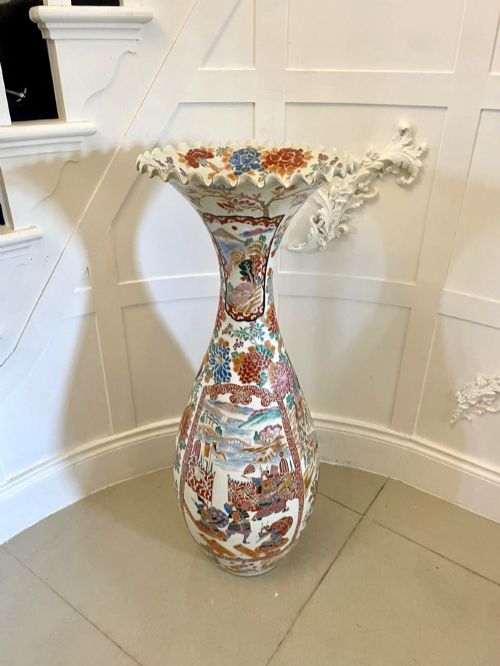
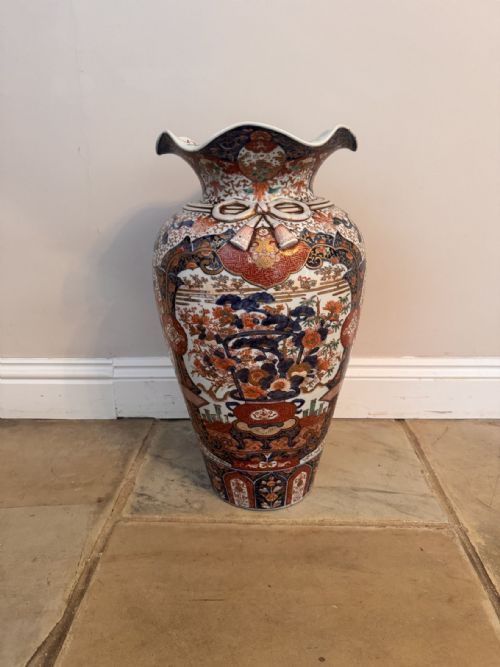
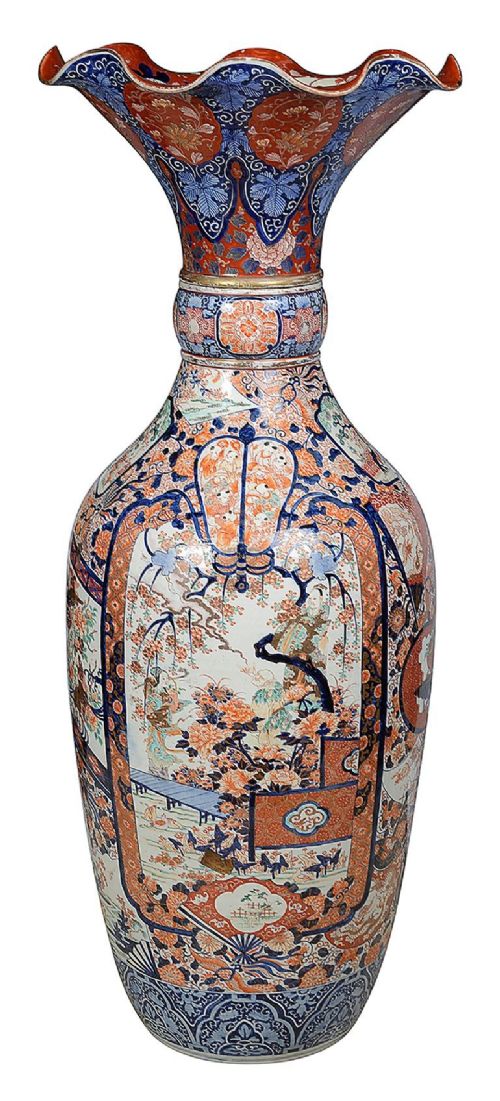
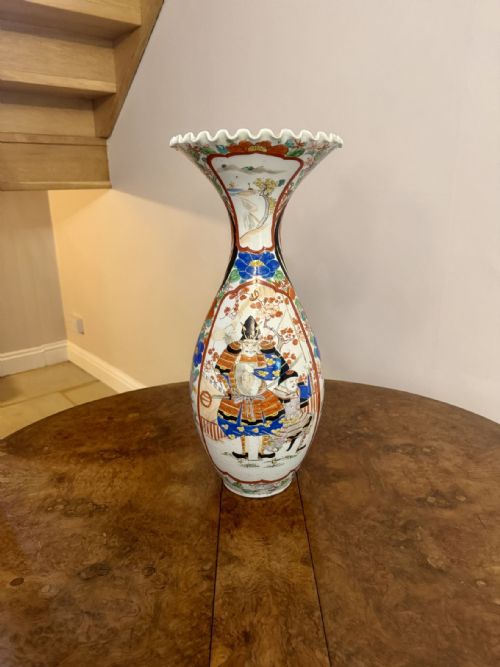


Large Imari Urn
A large imari urn delivers striking scale and rich colour, bringing traditional Japanese design and Victorian decorative taste into a room.

Large Imari Urn
When you search for a large imari urn, you are looking at substantial ceramic vessels created in Japan or produced in the Imari style during the nineteenth century. These pieces encompass floor-standing vases, lidded jars, and jardinières that often span significant heights, including monumental pairs and standalone display items.
The version you are most likely to meet on this page dates from the nineteenth century, specifically the Meiji period, alongside examples incorporating wood and ormolu mounts. They arrive either as single statement floor vases or in matched pairs designed for grand interior placement.
How they were made
These pieces rely on porcelain as a primary body, shaped into large-scale vases and urns before undergoing high-temperature firing. Artisans then applied characteristic cobalt blue and iron red pigments alongside enamel and gold leaf, building up complex floral and panelled decorative schemes.
Many examples received supplementary gilt and gilding highlights to catch the light, while select vessels integrated carved wood stands or ormolu mounts to support their height and weight.
The material record encompasses porcelain, enamel, gold leaf, glaze, gilt, gilding, wood, and ormolu across various vase and urn forms.
What varies in quality
The calibre of a piece rests heavily on the crispness of the hand-painted palette and the complexity of the cobalt and iron red panels. Superior examples display dense, meticulously executed floral and geometric motifs that cover the porcelain surface with exceptional precision.
Scale and proportion also dictate standing power, where monumental pairs or tall floor-standing vases maintain structural balance alongside intricate enamel work. The inclusion of original covers, matching pairs, and complementary materials such as ormolu mounts elevates the distinction of the work.
Arita Imari·Samson
The Large Imari Urn Glossary
- Imari
- A style of Japanese porcelain decorated in underglaze blue, iron red, and gold, named after the port from which it was shipped to Europe. This distinctive palette defines the visual character of these large vases and urns.
- Meiji Period
- The era of Japanese history lasting from 1868 to 1912, associated with a surge in export ceramics destined for Western markets. Many large floor vases and lidded jars date from this prolific manufacturing period.
- Ormolu
- Gilt-bronze mounts applied to decorative objects to enhance their presence and support their structure. Certain large vases integrate these metal additions for display on stands.
- Jardiniere
- A large decorative pot or vessel designed to hold plants or flowers rather than cut stems. These heavy porcelain pieces often match the decorative schemes of contemporary lidded vases.
Large Imari Urn: Frequently Asked Questions
What is a large imari urn?
A large imari urn is a substantial nineteenth-century porcelain vessel decorated in the traditional Japanese Imari palette of blue, red, and gold. These pieces were produced for export and grand interior display.
They take the form of tall floor vases, lidded jars, and jardinières, often standing well over a metre in height and occasionally created as matched pairs.
How were these large urns used?
These vessels served primarily as decorative focal points in nineteenth-century drawing rooms, hallways, and formal reception spaces. Their imposing scale allowed them to stand directly on the floor or upon dedicated wooden stands.
Lidded versions could contain dry potpourri or simply display intricate panel painting from every angle, while open jardinières accommodated large plants.
How do I live with a large imari urn?
Position your urn where its substantial height and rich colour palette can command the space without obstructing movement. Floor-standing examples work particularly well in empty corners, wide landings, or flanking grand fireplaces.
Keep the porcelain away from heavy foot traffic to protect the body and any associated wooden stands or ormolu mounts from accidental knocks.
How do I tell periods apart?
Nineteenth-century pieces, particularly those from the Meiji period and the 1880s to 1900s, display robust porcelain bodies with dense enamel and gold leaf decoration. Earlier seventeenth-century traditions influenced these later nineteenth-century revival and export wares.
Pay attention to the weight of the porcelain, the depth of the underglaze blue, and the presence of period-specific Samson copies or Japanese export markings.