


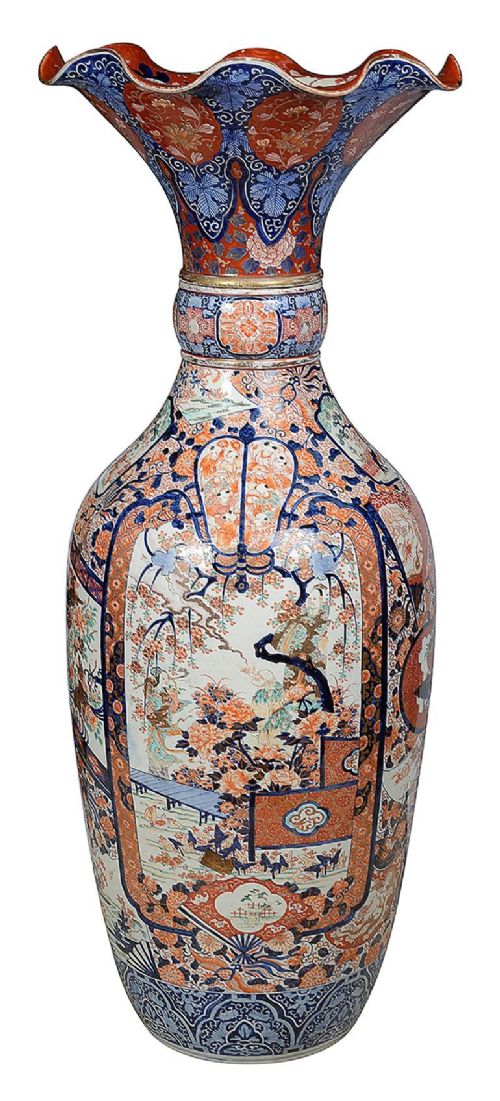
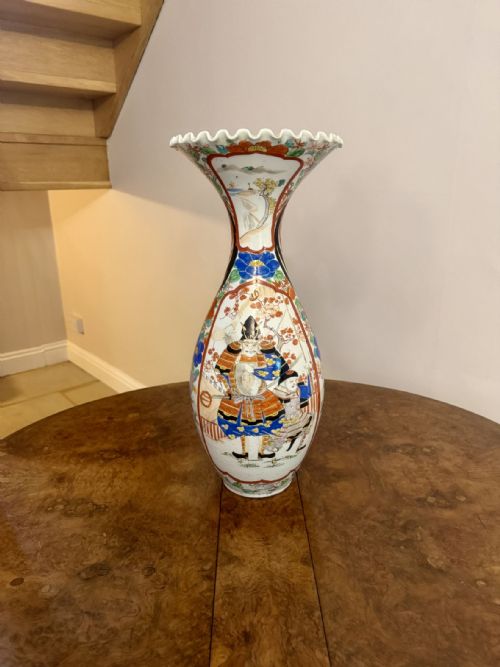


Orange Porcelain Floor Vase
These large orange porcelain floor vases make a striking impact in a hallway or drawing room.

Orange Porcelain Floor Vase
An orange porcelain floor vase brings a commanding presence to large interior spaces through its substantial scale and vibrant palette. When people search for an orange porcelain floor vase, they generally encounter tall Japanese Imari, Satsuma, and Kutani pieces originating from the nineteenth and early twentieth centuries.
The inventory on this page spans the nineteenth century up to the 1920s, featuring grand floor-standing specimens that often exceed three or four feet in height. These decorative vessels range from monumental pairs to single two-handled urns designed specifically for prominent display in principal rooms.
Buyers seeking this specific aesthetic will find that the traditional orange tones usually manifest through classic Japanese export styles, incorporating rich polychrome enamels. Each piece carries the distinct hallmarks of its period, whether produced during the Meiji era or the subsequent decades.
How they were made
These ceramic vessels are formed from high-fired porcelain and earthenware, shaped into tall, stable silhouettes capable of supporting heavy surface decoration. Kiln firing at high temperatures ensures the structural integrity required for floor-standing vases of this magnitude.
Artisans applied intricate enamel designs directly onto the ceramic body, frequently embellishing the compositions with gold leaf and gilt highlights. This meticulous hand-painting technique created the dense, colourful patterns characteristic of traditional Japanese export ware.
Orange Porcelain Floor Vase Retail Price Guide 2026
Typical asking prices for orange porcelain floor vase among the pieces listed under this phrase on Sellingantiques today, from the lower quarter to the upper quarter. They describe what is for sale here now, not the wider market.
Listings span the 1890s to the 1920s, concentrating heavily on the nineteenth century and the Meiji period with porcelain, enamel, and gold leaf.
What varies in quality
The standard of a floor vase rests upon the precision of its hand-painted enamel work and the richness of the applied gold leaf. Superior examples display exceptionally crisp detailing across complex Japanese export motifs, whereas lesser pieces show simpler brushwork.
Scale and proportion also dictate the distinction between average production and exceptional output, particularly in monumental pairs standing well over three feet high. The depth and vibrancy of the fired palette further separate standard decorative vessels from pieces of finer artistic ambition.
The Orange Porcelain Floor Vase Glossary
- Porcelain
- A hard, fine-grained ceramic material fired at very high temperatures to create a vitrified, non-porous body. It forms the essential structural base for most large decorative vases.
- Imari
- A traditional style of Japanese export porcelain originating from the town of Arita, typically characterised by a palette of underglaze blue, iron red, and gilt. It represents a major category within these listings.
- Enamel
- Opaque coloured glass fused to the ceramic surface during a secondary low-temperature firing. This technique provides the vibrant orange and secondary hues seen across the designs.
- Gilt
- A thin layer of gold applied to surface details to enhance the decorative richness of the vessel. It catches the light and outlines key motifs.
- Meiji Period
- The era in Japanese history spanning from 1868 to 1912, noted for a significant increase in decorative arts produced for export. Many items on this page date from this specific timeframe.
Orange Porcelain Floor Vase: Frequently Asked Questions
Where should I place a floor vase?
These tall vessels suit spacious entrance halls, wide landings, or empty corners where their height and colour can be fully appreciated without obstruction.
Because many examples stand well over a metre tall, they function best as standalone focal points rather than grouped arrangements.
How do I identify a Meiji period vase?
Meiji period pieces typically date between 1868 and 1912, aligning with the dates recorded across nineteenth-century and early twentieth-century listings here.
Stylistic markers include dense Japanese export motifs, traditional Imari or Kutani palettes, and robust porcelain construction designed for international markets.
Are these vases sturdy enough for daily life?
Floor vases from this era are heavy and stable by design, constructed to rest securely on firm ground in domestic settings.
Care should be taken in high-traffic corridors to avoid accidental impacts, as ceramic and enamel surfaces remain vulnerable to sharp knocks.
What is the difference between Imari and Kutani?
Imari ware generally relies on a specific combination of iron red, underglaze blue, and gilt highlights to create structured, repeating decorative panels.
Kutani pieces often showcase a broader pictorial palette, frequently centring on distinct enamel shades that give the surface a different visual weight.