
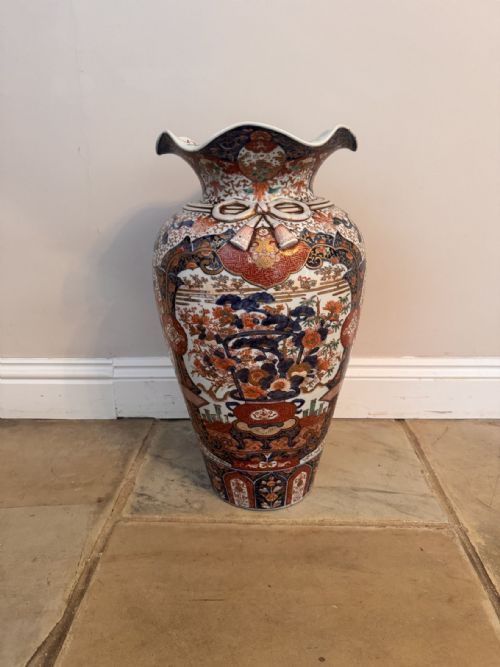
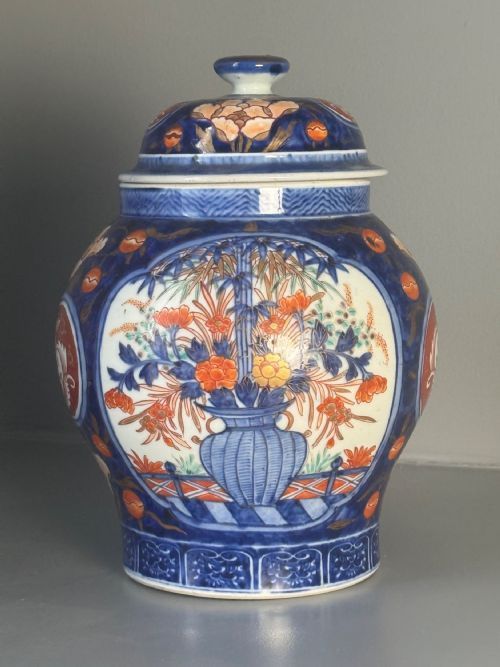
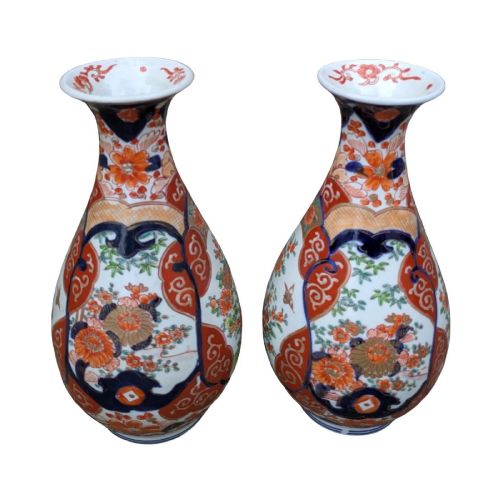


Japanese Imari Baluster Vase
A Japanese imari baluster vase brings rich cobalt enamel and iron red onto porcelain, prized for its robust shape and vibrant palette.

Japanese Imari Baluster Vase
A japanese imari baluster vase displays the characteristic curving profile of a traditional vessel, widening gracefully toward the centre before tapering.
Most examples found here date from the nineteenth century or the Meiji period, alongside earlier Edo period pieces and later Edwardian interpretations.
Forms range from single display jars and floor standing vessels to matched pairs and garnitures, occasionally fitted as table lamps.
How they were made
Potters shaped fine porcelain on the wheel before applying underglaze blue and contrasting iron red enamel.
Artisans enriched the surface with gilding, gold leaf, and detailed overglaze enamel pigments to create depth and texture.
Certain pieces incorporate ormolu mounts added in Europe to suit contemporary decorative tastes.
Surviving forms span standard table vases, lidded jars, floor standing pieces, and examples converted to table lamps.
What varies in quality
Quality rests on the crispness of the hand-painted decoration, the saturation of the cobalt and iron red, and the preservation of the gilding.
Scale and ambition separate standard vessels from monumental floor-standing pieces or complex lidded garnitures.
The Japanese Imari Baluster Vase Glossary
- Baluster
- A vase shape characterised by a rounded body that tapers towards the neck and stands on a narrower foot. This classic silhouette provides stability and generous space for decoration.
- Imari
- A style of Japanese porcelain originating from the port of Arita, traditionally decorated in cobalt blue, iron red, and gold. The palette remains distinct and easily recognised.
- Meiji Period
- The era in Japanese history spanning from 1868 to 1912, noted for a surge in export ceramics destined for Western markets. Work from this period often displays high technical precision.
- Edo Period
- The period of Japanese history running from 1603 to 1868. Early export wares from these decades are held in high regard by collectors.
- Garniture
- A set of three or more matching vases designed to be displayed together on a mantelpiece or sideboard. These matched groups require careful firing to maintain consistency across every vessel.
Japanese Imari Baluster Vase: Frequently Asked Questions
How do I date a Japanese imari vase?
Dating relies on stylistic clues, palette characteristics, and the quality of the porcelain body. Edo period pieces generally show heavier potting and softer underglaze tones, whereas Meiji examples often display brighter enamels and crisper gilding.
Later Edwardian interpretations tend to copy these earlier patterns closely. Examining the foot ring and any wear on the glaze helps confirm the age of the piece.
Were these vases made for export?
The vast majority of imari ceramics reaching Western markets were produced specifically for export to European and American buyers. Kilns in Arita adapted traditional forms into lidded jars, garnitures, and large display vessels that suited Western interiors.
As a result, many surviving examples reflect a blend of Japanese potting traditions and European decorative preferences.
What is the difference between Arita and Imari?
Arita is the Japanese town where the porcelain clay was mined and fired in the Hizen province. Imari was simply the port from which these finished ceramics were shipped.
Over time, the port name became synonymous with the distinctive blue, red, and gold decorative style produced throughout the region.
How should I display a baluster vase?
A baluster vase requires a stable surface that allows its curved profile to stand clear of clutter. Placing a large floor-standing vessel in an open corner or using a pair on a heavy sideboard lets the cobalt and iron red colours register properly.
Strong direct sunlight should be avoided to protect any delicate overglaze enamels and gilding over time.