

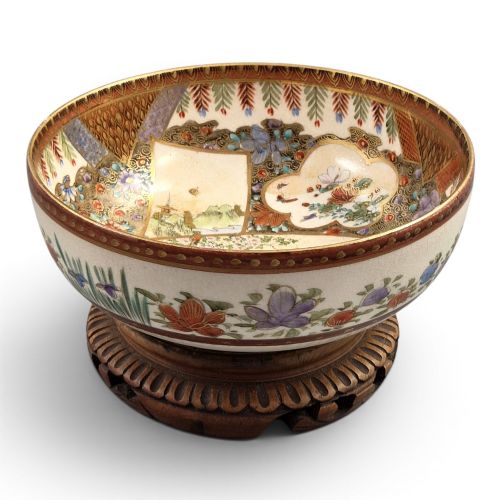


Japanese Enamel Bowl
A japanese enamel bowl brings together intricate metalwork and vibrant colour, offering a tactile piece of far eastern craftsmanship for any surface.
Japanese Enamel Bowl
When you search for a japanese enamel bowl, you encounter vessels shaped from copper, brass, and porcelain, carrying decorated surfaces that span the Edo and Meiji periods. The pieces appearing most frequently range from large cloisonne chargers adorned with dragons and birds to smaller porcelain bowls finished with rich polychrome enamel and gilding.
Makers from the 18th century onward applied meticulous detail to these forms, utilising techniques such as champleve and plique-a-jour across utilitarian and decorative items. These works reflect the shifting aesthetic movements of Japanese metalwork and ceramics, transitioning from historic regional kilns to elaborate late 19th-century export pieces.
How they were made
Craftsmen built cloisonne pieces by soldering thin metal wires onto copper or brass bases to form individual cells, which were then filled with coloured enamel paste and fired in a kiln. Porcelain versions relied on shaping clay before applying mineral pigments and gold leaf by hand, followed by high-temperature glazing.
The finishing stage required repeated grinding and polishing of the hardened enamel surface to achieve an even lustre across the design. Artisans often incorporated silver fittings or signed their work directly into the metal base or glaze.
At least one dragon found its way onto tree bark before ending up beneath glass.
What varies in quality
Quality rests in the precision of the wirework and the control of the enamel during firing, where finer lines and unblemished surfaces distinguish superior examples from simpler ones. The complexity of the subject matter, such as multi-coloured dragons or dense floral millefleur patterns, reflects the time invested by the maker.
Signed pieces and those utilising translucent plique-a-jour or layered totai shippo tree bark effects demonstrate advanced technical capability. The weight of the metal body and the crispness of the hand-painted details similarly separate standard export ware from master-level production.
Kozan·Shozo
The Japanese Enamel Bowl Glossary
- Cloisonne Enamel
- A technique where thin metal wires create compartments on a metal base to hold coloured glass paste before firing. This method allows for intricate pictorial designs across bowls and chargers.
- Meiji Period
- The era spanning from 1868 to 1912, characterised by intense artistic production and opening trade with the West. Many highly decorated export vessels originate from this time.
- Imari
- A style of Japanese porcelain featuring underglaze blue and overglaze red, green, and gold. These pieces were produced in the town of Arita for both domestic use and export.
- Plique-a-jour
- An enamelling technique resembling stained glass, where the enamel is fired without a backing metal, allowing light to pass directly through the design.
- Satsuma Ware
- Earthenware pottery featuring a fine ivory-coloured crackle glaze decorated with elaborate enamels and gilding. Bowls in this style often depict dense floral arrangements or figurative scenes.
Japanese Enamel Bowl: Frequently Asked Questions
How do I date a Japanese enamel bowl?
Dating relies on identifying stylistic markers, manufacturing techniques, and any signatures present on the base. Pieces from the Edo period often display restrained designs, while Meiji period examples frequently feature denser, highly coloured motifs.
Changes in metal composition and the refinement of cloisonne wires also help narrow the decade of production. Comparing the object to documented regional kiln outputs provides further chronological context.
What is the difference between cloisonne and champleve?
Cloisonne involves soldering flat metal wires onto a metal foundation to create raised walls that separate the enamel colours. The resulting surface shows thin metallic lines defining every part of the pattern.
Champleve carves or casts the design directly into the thick metal body, sinking the wells for the enamel beneath the surface plane. This produces a heavier, more tactile object with broader metal borders.
How were these bowls used historically?
Many large vessels served as decorative chargers and centrepieces displayed within traditional interiors. Smaller bowls functioned as tableware, tea accessories, or receptacles for sugar and cream.
Export pieces were frequently created specifically for Western mantelpieces and display cabinets as appreciation for Japanese craftsmanship grew globally.
How should I care for antique enamel and porcelain?
Keep these pieces out of direct sunlight to prevent fading in the coloured enamels and gold leaf highlights. Dust them gently with a dry, soft cloth rather than using liquid cleaning products.
Avoid displaying them in areas with high humidity or rapid temperature changes, which can stress the bond between metal bases and glass pastes.