
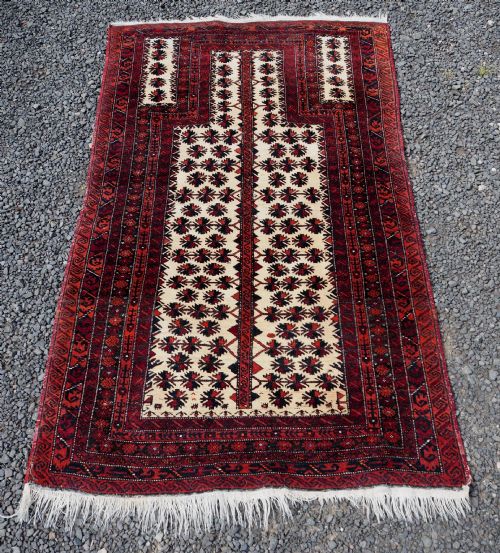


Cream Wool Prayer Rug
A cream wool prayer rug brings traditional Anatolian, Persian, and Caucasian weaving into a room, offering defined mihrab designs and soft ground colours.
Cream Wool Prayer Rug
When you search for a cream wool prayer rug, you encounter floor coverings defined by a specific niche within antique weaving traditions. These pieces typically display architectural mihrab arches designed to direct prayer, originating from workshops and villages across Anatolia, Persia, and the Caucasus. The format bridges utilitarian floor coverings and symbolic textile art.
On this page, you are most likely to meet village and tribal examples featuring ivory or cream grounds. The selection spans the nineteenth and early twentieth centuries, drawing on regional styles such as Milas, Kirsehir, Ghiordes, Baluchi, and Shirvan. Each piece demonstrates the distinct local interpretation of the prayer format.
The regional variety shows in the secondary motifs surrounding the central niche. Some pieces incorporate floral lattice patterns or central tree of life designs, while others rely on geometric borders. This mix reflects the diverse cultural centres that produced rugs for domestic devotion and export.
How they were made
The construction of these textiles relies predominantly on wool and hand-spun wool, often paired with cotton foundations. Weavers knotted the pile by hand onto warp and weft threads, securing the structure through dense packing of the rows. This physical density provides the durability expected of floor textiles.
Dyes derived from natural sources interact with the wool to create the soft colour palettes observed in these pieces. The handling of ivory and cream grounds required careful preparation of the fleece to maintain consistent neutral tones across the field. Artisans used traditional local looms suited to the narrower widths typical of village formats.
Cream Wool Prayer Rug Retail Price Guide 2026
Typical asking prices for cream wool prayer rug among the pieces listed under this phrase on Sellingantiques today, from the lower quarter to the upper quarter. They describe what is for sale here now, not the wider market.
Listings show origins spanning Anatolian, Persian, and Caucasian workshops, featuring wool and hand-spun wool materials across nineteenth and early twentieth-century dates.
What varies in quality
The distinction between tiers rests on the fineness of the knotting and the precision of the drawing within the mihrab. Tightly packed knots allow complex floral lattices and crisp architectural lines to retain their definition over decades of use. Looser structures tend to blur geometric transitions and soften pattern edges.
Material preparation also separates standard examples from superior ones. Hand-spun wool accepts natural dye variations with greater depth, producing subtle tonal shifts across a cream ground. Uniform industrial spinning lacks this nuanced interaction between fibre and pigment.
The Cream Wool Prayer Rug Glossary
- Mihrab
- The arched niche depicted on a prayer rug, symbolising the direction of prayer towards Mecca. Its shape often helps identify the specific weaving village or regional tradition.
- Pile
- The upright yarn loops that form the soft surface of the rug. It is knotted by hand onto the foundational warp and weft threads.
- Warp
- The vertical structural threads stretched tightly on the loom before knotting begins. The visible fringes at either end of the rug are extensions of these threads.
- Weft
- The horizontal threads passed alternately over and under the warp threads between rows of knots. They bind the structure together widthways.
- Millefleurs
- A pattern style filled with a multitude of small flowers. This French term describes dense botanical fields found on certain Persian and Anatolian formats.
Cream Wool Prayer Rug: Frequently Asked Questions
How do I identify a prayer rug?
A prayer rug is typically recognised by the depiction of a single architectural arch, known as a mihrab, at one end of the field. This design element points the worshipper in a specific direction during daily devotions.
The overall proportions of these pieces tend to be narrower and shorter than standard room-size carpets, accommodating individual use. Regional variations in the spandrels and borders further distinguish specific weaving traditions.
Where were these rugs made?
The pieces originate from traditional weaving regions including Anatolia, Persia, and the Caucasus. Specific towns and districts such as Milas, Ghiordes, Kirsehir, and Shirvan developed distinct local variations of the prayer format.
Tribal groups such as the Baluch also produced their own interpretations in borderlands between Persia and Afghanistan. Each origin brings particular colour palettes and structural characteristics to the wool surface.
How should I care for an antique wool rug?
Antique wool rugs require gentle maintenance, beginning with regular, low-suction vacuuming without a rotating brush roll. This removes grit from the pile without straining fragile antique foundations.
Professional cleaning should be undertaken sparingly by specialists experienced in antique textiles and natural dyes. Keeping the rug out of direct, prolonged sunlight preserves the subtle tones of the wool.