
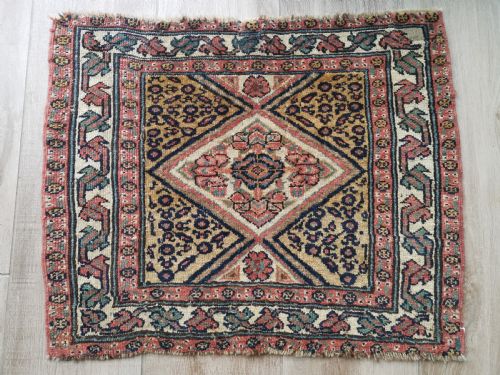
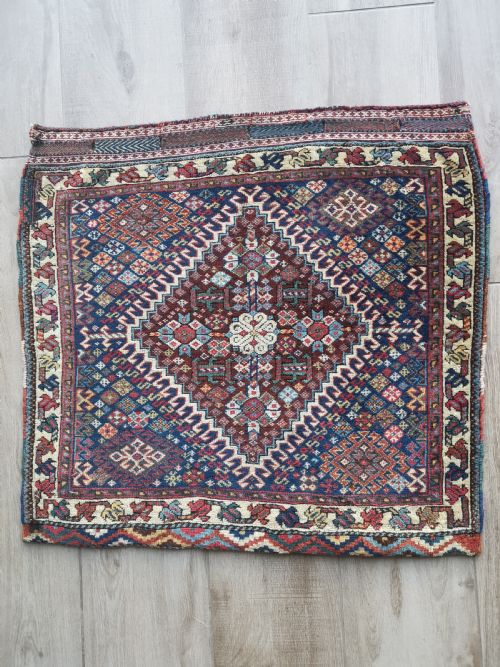
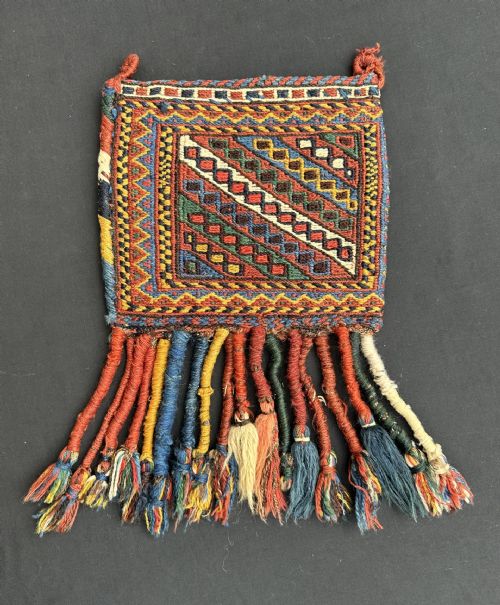


Antique Persian Saddlebag Fragment
An antique persian saddlebag fragment is a surviving piece of nomadic weaving, offering rich tribal patterns and dense wool to collectors of textile art.
Antique Persian Saddlebag Fragment
An antique persian saddlebag fragment represents the remnants of working tribal storage gear, woven by nomadic groups across Persia during the nineteenth and early twentieth centuries. These textile art pieces typically survive as single bag faces or halved portions from larger khorjin assemblies, prized for their compact geometry.
The selections available here showcase distinct regional tribal outputs, ranging from Qashqai and Afshar bag faces to Shahsavan sumac weaves and Kurdish examples. Buyers encounter formats carrying central medallions, boteh motifs, or geometric field patterns created for daily nomadic utility.
How they were made
Weavers utilised hand-spun wool for the pile and structure, combined with cotton foundations in certain regional pieces, ensuring durable construction for pack animals. Natural dyes provided the deep colour palette characteristic of these tribal textiles.
Techniques varied between hand-knotted pile construction and flatwoven sumac work, allowing different nomadic confederations to signal their specific tribal identity through structural method.
Listings feature pieces spanning the nineteenth century up to the early twentieth century, utilising hand-spun wool and natural dyes.
What varies in quality
Quality rests upon the handled wool, where lustrous and luminous fibre indicates superior grease retention and careful cleaning of the fleece. The handle ranges from stiff utility weaves to supple, dense structures.
Design execution and palette complexity separate standard utility work from master nomadic output, governed by the precision of the tribal motifs and the saturation of the natural dyes.
The Antique Persian Saddlebag Fragment Glossary
- Khorjin
- The traditional Persian double saddlebag used by nomads for transport and storage. These pieces were often separated over time, leaving surviving faces.
- Boteh
- A stylised almond or pear-shaped motif of ancient Persian origin. It frequently appears repeated across tribal bag faces.
- Sumac
- A flatweaving technique where decorative coloured weft threads wrap around the warp threads in a continuous wrapping motion. This creates a dense, ribbed structure.
- Bag face
- The decorative front panel of a storage pouch. Collectors frame these panels as independent textile artworks.
- Pile
- The upright soft loops of wool forming the textured surface of a knotted rug. Hand-knotted examples rely on dense pile to display intricate tribal patterns.
Antique Persian Saddlebag Fragment: Frequently Asked Questions
What is a saddlebag fragment?
A saddlebag fragment is the surviving portion of a larger nomadic storage bag, usually the decorative face that remained intact after the back vanished.
These pieces were originally part of working animal transport gear used by Persian tribes.
How were these bags used?
Nomadic tribes utilised these double pouches draped across pack animals to carry household goods, grain, and personal belongings during seasonal migrations.
Over decades of use, the bags wore out and owners cut them apart, leaving the decorative face as a standalone textile.
How do I identify tribal styles?
Tribal attribution relies on specific structural characteristics, colour choices, and repeating geometric motifs unique to regional confederations such as the Qashqai, Afshar, or Shahsavan.
Examining the weave type and edge finish helps pinpoint the specific nomadic group.
How should I display a fragment?
These textile pieces mount successfully on linen-backed frames or hang from custom rods to protect the wool structure from tension.
Keep them away from direct sunlight to preserve the natural dyes.