




19th Century Satinwood Table
A 19th century satinwood table brings a luminous, golden warmth to a room through finely figured timber and delicate neoclassical inlay.
19th Century Satinwood Table
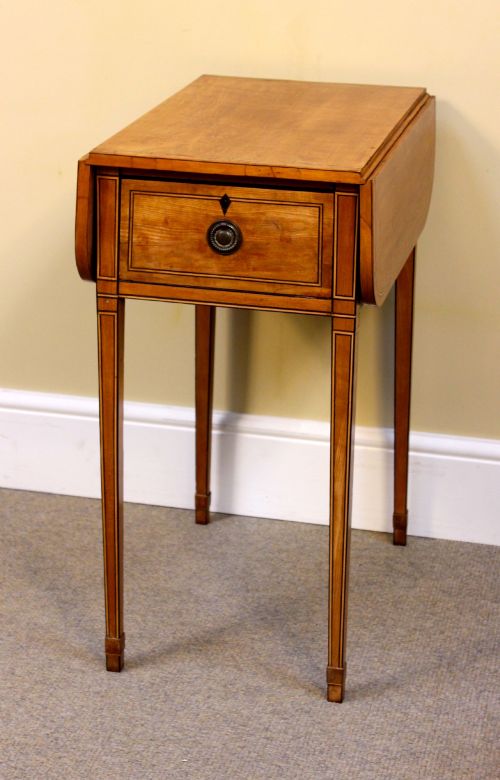
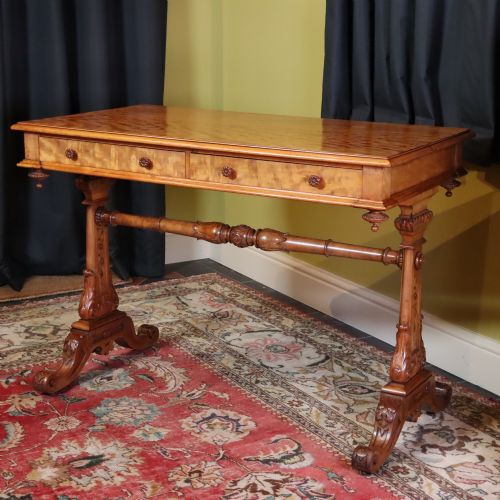
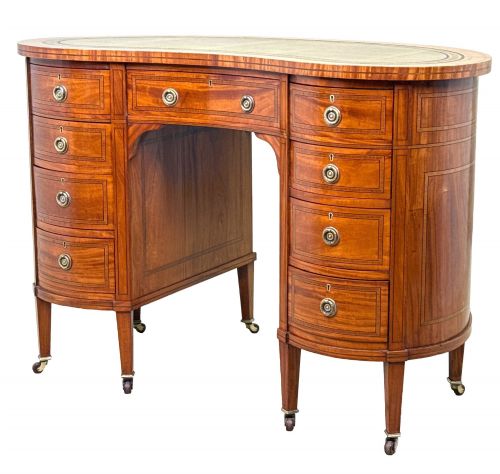
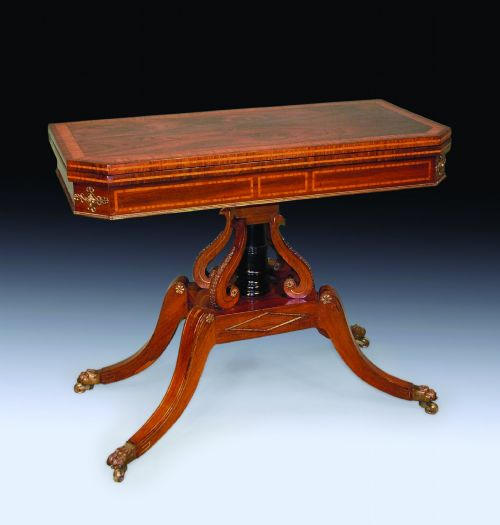
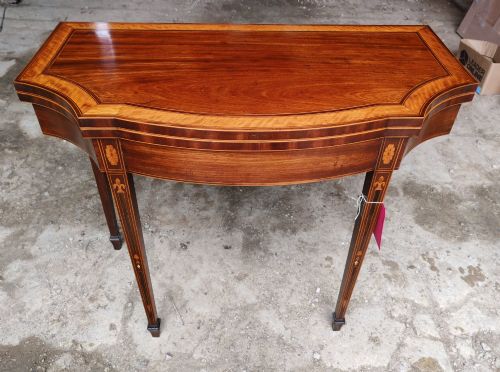
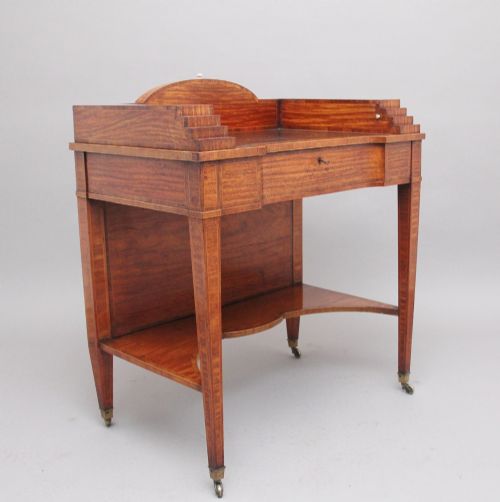
A 19th century satinwood table encompasses a variety of domestic forms designed for drawing rooms, boudoirs and libraries, including side tables, card tables, writing desks and bijouterie cabinets. The selection reflects both the Regency period and the later Victorian Sheraton Revival, when lighter woods superseded the heavy dark timbers of earlier decades.
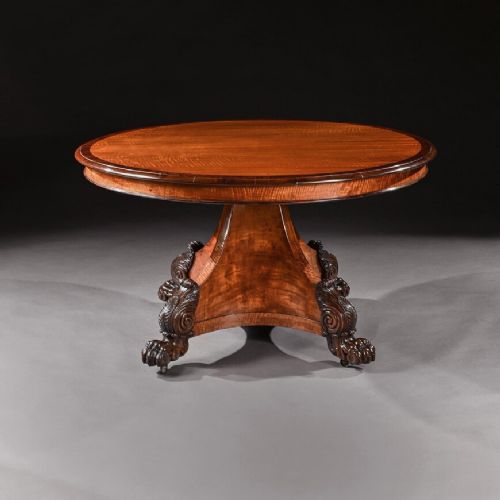
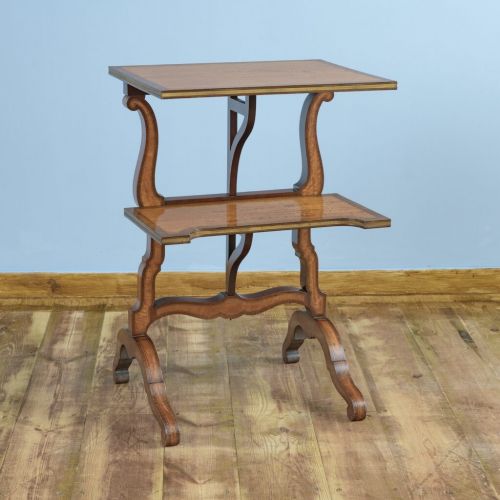
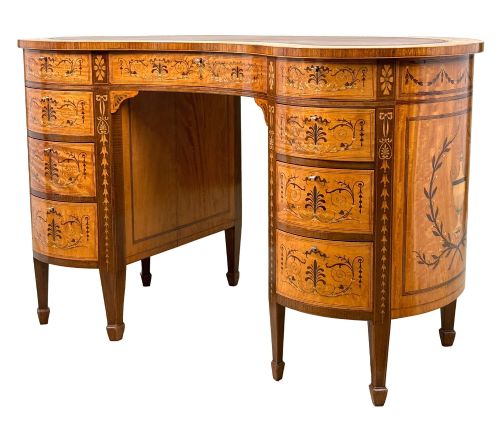
Occasional tables and side tables appear frequently alongside specialised forms like demi-lune card tables and kidney-shaped writing desks. Cabinetmakers utilised the pale timber for both freestanding centre pieces and smaller utility tables intended for display or writing.
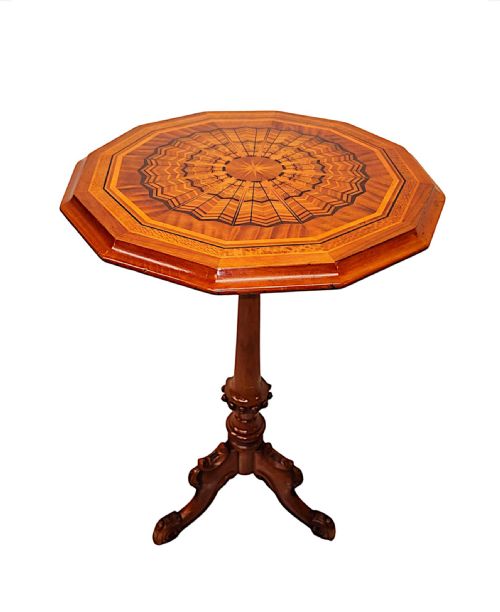
The aesthetic draws heavily on eighteenth-century design principles, often incorporating painted motifs, banding in contrasting timbers, and classical proportions. Pieces range from modest domestic examples to elaborately decorated items bearing marquetry.
Materials and construction
Cabinetmakers selected satinwood for its natural sheen and golden hue, frequently applying it as a fine veneer over a stable secondary wood like mahogany or pine. Selected pieces also employ solid construction, whilst contrasting timbers such as rosewood, kingwood, mahogany and ebony provide dark framing through stringing and geometric banding.
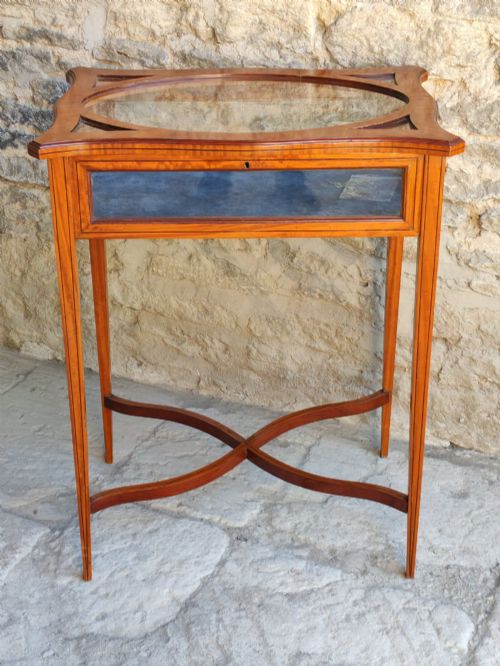
Object forms range from kidney-shaped writing desks and bijouterie display tables to demi-lune card tables and nest of four tables.
Distinctions in craftsmanship
Quality rests principally on the choice of timber and the precision of the cabinetwork. Highly figured satinwood exhibits a distinct chatoyant shimmer that shifts in the light, contrasting with plain, flat veneers found on simpler commercial outputs.
The intricacy and execution of the marquetry distinguish workshop tiers, with master makers employing tight, exact joins in contrasting woods rather than relying on heavy painted embellishment to mask inferior timber. Structural integrity in elements like folding card table mechanisms and delicate tapering legs also indicates superior production.
Gillows·Edwards and Roberts·Wright and Mansfield·Filmer and Son·Maison Giroux·Peters of Genoa
The 19th Century Satinwood Table Glossary
- Satinwood
- A dense, durable tropical timber yielding a lustrous, golden-yellow surface with a natural chatoyancy. It forms the primary visible veneer on late eighteenth and nineteenth-century revival furniture.
- Marquetry
- The art of applying decorative veneer pieces in various woods to form pictorial or geometric patterns. Craftsmen cut these elements meticulously to fit flush within the surface.
- Demi-lune
- A half-moon shape characteristic of console and card tables designed to stand flat against a wall. These tables often feature folding tops supported by a swing leg.
- Ormolu
- Gilt bronze mounts applied to furniture for decorative enrichment. This technique gained prominence in French-influenced pieces and Victorian revival outputs.
- Bijouterie table
- A glass-topped display table intended for showcasing small valuables, medals and curiosities. They frequently feature hinged lids and velvet-lined interiors.
19th Century Satinwood Table: Frequently Asked Questions
How do I care for a satinwood table?
Keep the wood away from direct sunlight and heat sources to prevent the pale timber from darkening unevenly or the veneer from drying out. Regular dusting with a soft, dry cloth maintains the surface.
Avoid using silicone-based polishes or damp cloths, which can damage the historic polish and lift delicate marquetry. Occasional application of a suitable microcrystalline wax preserves the sheen.
Were these tables used for dining?
Most surviving examples served social, writing or display functions rather than formal dining. Card tables accommodated evening games, while smaller side and occasional tables held lamps or decorative objects.
Writing desks and bijouterie tables served private domestic routines in bedrooms and drawing rooms. Larger breakfast or centre tables occasionally facilitated light morning meals or central room placement.
How can I tell a Regency piece from a revival?
Original Regency pieces typically display restrained neoclassical lines with genuine age in the timber surface and secondary framing woods. Construction methods often involve hand-cut dovetails and traditional joinery specific to the early nineteenth century.
Sheraton Revival items, made later in the Victorian period, frequently employ brighter, more uniform veneers and machine-assisted construction techniques alongside explicit homage to earlier eighteenth-century designs.
What is a card table mechanism?
A card table mechanism allows a folded top to open out and double the surface area for games. The hinged top usually swings or pivots to rest upon a framework or a pull-out leg.
Internal wells frequently store playing cards and counters when closed. The jointing around this folding action requires precise alignment to ensure the top sits level.