



Antique Coal Boxes
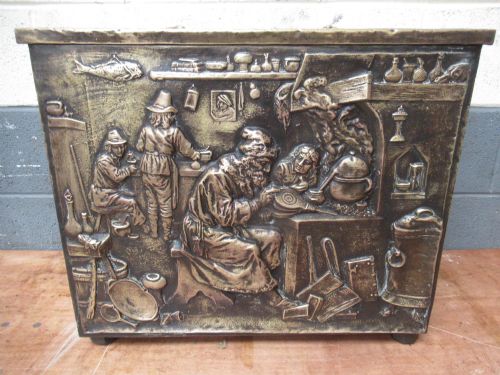
A fireside container for a day's coal beside the grate, either a lidded wooden box with a removable metal liner or a metal bucket in brass or copper.

Antique Coal Boxes
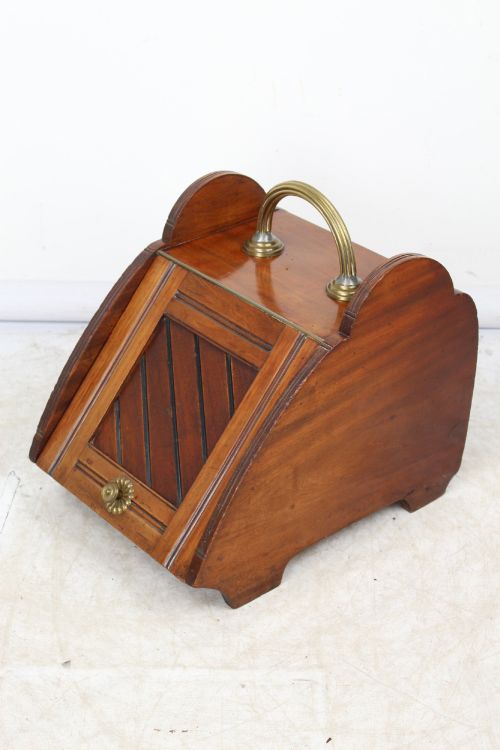
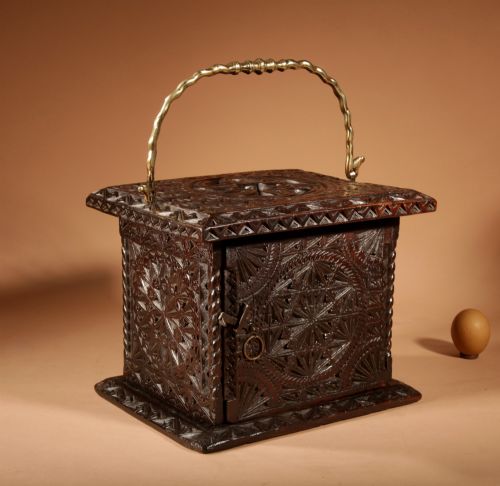
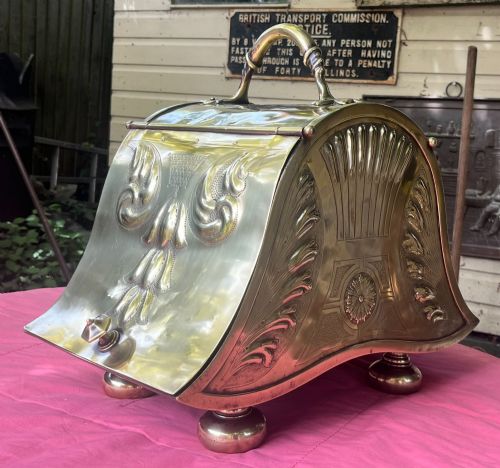
Two forms dominate. One is the lidded wooden case with a loose metal liner inside and a shovel clipped to the back, commonly called a purdonium. The other is the metal-bodied bucket, helmet or scuttle in brass or copper. Dealers use 'scuttle' and 'purdonium' loosely, and many titles use both words of the same object.
Coal boxes became standard domestic furniture as coal-burning open grates spread through British houses in the nineteenth century, giving a household somewhere clean to keep fuel within reach of the fire. The lidded, liner-fitted cabinet form belongs to the later part of that century, when the fireside was furnished for show as much as for use.
The Victorian wooden box is the version you're most likely to meet. Victorian appears in 50 of 131 titles on Sellingantiques, and the timber is usually named: oak, mahogany, walnut, rosewood. Brass and copper bodies make up the other large block. A complete box with its original liner and shovel is a normal expectation rather than a find.
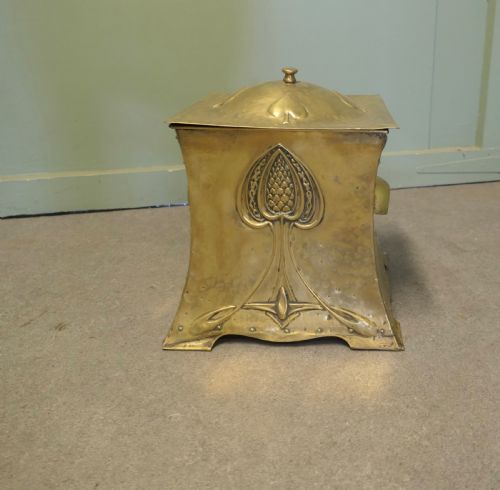
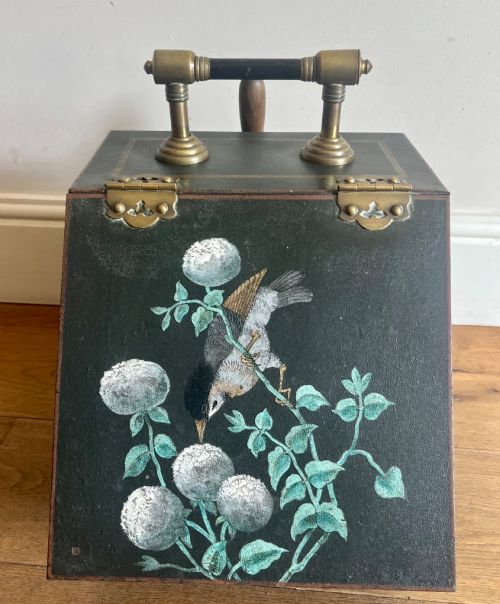
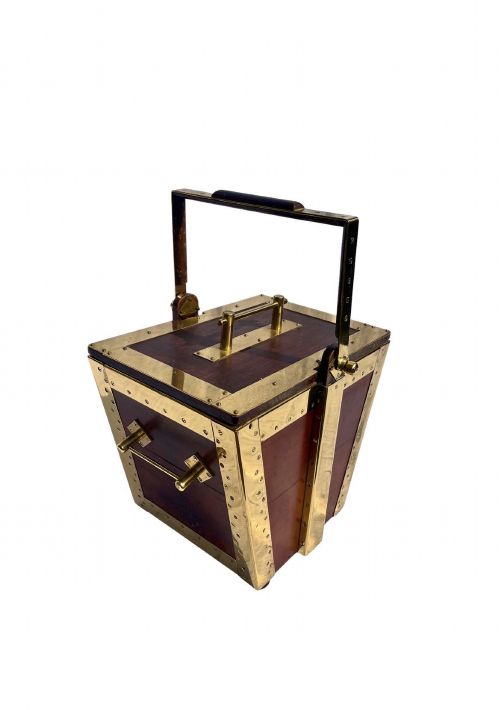
Smaller groups run alongside. Arts and Crafts and Art Nouveau pieces in riveted copper, silvered copper, or copper with wrought iron account for about a fifth. Painted tin and toleware boxes and bins form a small persistent seam. Log boxes, wheeled bins and dual-purpose fireside seats turn up throughout. Dating runs 1850 to 1920, with nothing here put earlier.
Where Value Sits
Completeness does the most work at the wooden end. A case sold with its original liner and matching shovel sits above a bare box, and dealers advertise the full set as the selling point when it survives. The liner is loose and the shovel easily parted from the box, so the two together carry weight.
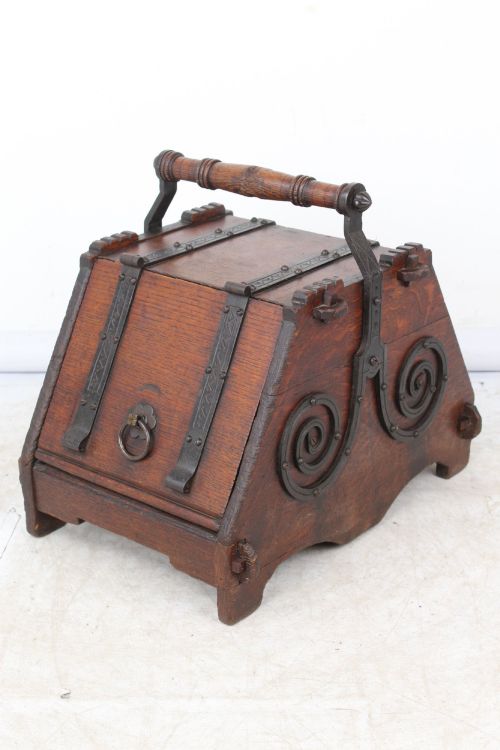
After that it's timber and surface. Plain oak and mahogany boxes sit low in the range; pollard oak, burr oak, walnut, rosewood and marquetry fronts sit high. Carving lifts a box further, as do embossed and heraldic brass panels and gilt metal mounts. Two Gothic carved oak boxes in the archive carry a Green Man mask, the only motif that recurs by name.
A named design idiom pushes upward on its own. Arts and Crafts, Art Nouveau, Aesthetic, Gothic Revival and Regency all appear as title qualifiers, and the copper-and-wrought-iron and riveted copper pieces are among the highest-priced. Scale counts too: the largest oak and copper examples, flagged only in words rather than measurements, sit near the top.
Antique Coal Boxes Retail Price Guide 2026
Typical UK retail prices for coal boxes, calculated from the Sellingantiques database of over a million retail prices indexed since 2003. This retail price guide relies exclusively on Sellingantiques data; no external sources or auction records are used, so the figures do not describe the wider market.
Victorian is the period label used most on Sellingantiques for coal boxes, with 19th Century next and the 1900s third.

The Antique Coal Boxes Glossary
- Purdonium
- A lidded wooden coal box with a removable metal liner and usually a shovel. Dealers here spell it purdonium and perdonium, both of the same form.
- Liner
- The loose metal insert that holds the coal inside a wooden case. Titles flag 'original liner' where it has stayed with the box.
- Scuttle
- General term for a coal container, used across this archive of both metal buckets and wooden boxes. It appears in 35 titles.
- Helmet
- A metal scuttle with a body shaped like an inverted helmet, usually in brass.
- Toleware
- Painted and varnished sheet metal, the material of a small distinct group of painted boxes and bins.
- Metamorphic
- Made to change function or fold away. One inlaid rosewood scuttle in the archive is described this way.
Antique Coal Boxes: Frequently Asked Questions
What is a purdonium?
It's a lidded wooden coal box with a removable metal liner inside, usually sold with a shovel. The word appears in 26 of the titles on Sellingantiques, and dealers spell it purdonium or perdonium.
Many listings use 'scuttle' and 'purdonium' of the same object, so the two words aren't sharply divided in practice.
How old are most antique coal boxes?
The dated listings run from 1850 to 1920, and nothing in the archive is dated earlier. Where a clean year is given, it clusters in the 1880s, 1890s and 1900s.
A good share of the dating is a period word rather than a year, with Victorian and 19th Century the two commonest labels. Edwardian appears on a smaller group, Regency on only three.
Which woods were used for coal boxes?
Oak leads, then mahogany and walnut. Rosewood turns up too, often inlaid or with marquetry on the front or lid.
Figured timbers appear as a separate note in the descriptions: pollard oak and burr oak are both named, and both sit at the upper end of the sampled range.
Do coal boxes usually come with the shovel?
Often, yes. Shovel appears in ten titles and the phrase 'original liner and shovel' recurs through the descriptions, so the complete box-liner-shovel set is a normal expectation rather than an exception.
Where the shovel and liner have survived together, dealers lead on it.
Are brass and copper coal scuttles common?
They're one of the two big blocks in the category. Brass appears in 38 titles and copper in 15, covering buckets, helmet-shaped scuttles and lidded bins.
Copper also carries the Arts and Crafts group, in riveted and silvered work and in combinations of copper with wrought iron.
Were any unusual forms of coal box made?
A few. The archive holds a coal bin built as an upholstered stool with needlepoint, a metamorphic inlaid rosewood scuttle, and a fender incorporating a coal box with club seats.
There's also a wheeled toleware coal bin, and a Victorian tin tea caddy made in the shape of a coal box.