



Antique Marble Fireplaces
A marble chimneypiece is the frame of jambs, frieze and shelf that sits around a fire opening, built to give a principal room its architectural centre.
Antique Marble Fireplaces
What comes to market is almost always the surround on its own rather than a fitted assembly: half the titles on Sellingantiques use the word "surround", and only a handful offer a cast iron insert as part of the lot. The marble frame is the piece; the grate that once sat inside it usually went elsewhere.
Marble chimneypieces became the standard treatment for the main rooms of British houses from the 18th century, and as fireplaces multiplied through the house in the 19th century, slate, cast iron and painted imitation followed them. Two listings in this archive are marble in appearance only, one faux marble and one ebonised, marbled and gilded slate.
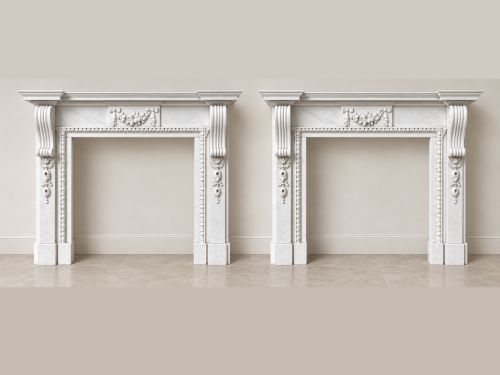
The version you're most likely to meet is a Victorian white marble surround, sometimes with corbels under the shelf or a small rebate behind the opening. "Victorian" appears in half the titles, and white statuary marble in around a quarter. Alongside it sits a French strand: Louis XV, Louis XV Pompadour and Louis 14th Style patterns, some in coloured marbles such as Breche Violet and Rance.
Dating is loose. 19th Century and Victorian between them account for eighteen of the thirty listings, and only seven carry a clean year, running from 1860 to 1920. Regency, Georgian and Edwardian each appear once or twice, so pre-Victorian and 20th-century pieces are occasional rather than a strand of their own.
Where The Range Sits
Marble does most of the work. Titles that name their stone, white statuary or a coloured marble like Breche Violet, sit at the top of the range, while an unspecified "antique marble fireplace" and the faux marble pieces sit at the bottom. Naming the stone is itself a signal of what the stone is worth naming.
Then carving. A plain surround and a figural one are different objects: a statuary white marble surround with a shepherd subject, or a frieze with real carved content, reads well above a flat moulded frame. The same goes for a named pattern, with the Louis-style French chimneypieces clustering in the upper half.
Completeness and scale settle the extremes. Fragments come to market on their own, a Regency carved statuary tablet and a plaster cast study of a surround element among them, and they occupy the bottom. At the other end is the archive's only pair, two large carved white marble fireplaces, and it stands at the very top.
Antique Marble Fireplaces Retail Price Guide 2026
Typical UK retail prices for marble fireplaces, calculated from the Sellingantiques database of over a million retail prices indexed since 2003. This retail price guide relies exclusively on Sellingantiques data; no external sources or auction records are used, so the figures do not describe the wider market.
19th Century is the period label used most on Sellingantiques for marble fireplaces, with Victorian next and the 1880s third.
The Antique Marble Fireplaces Glossary
- Surround
- The marble frame of jambs, frieze and shelf around the fire opening. It's the word used in half the titles on Sellingantiques.
- Insert
- The cast iron grate unit that seats inside the surround. Sometimes sold with the marble, more often not.
- Rebate
- The recessed step behind the opening that an insert or set of slips sits into. "Small rebate" turns up in titles.
- Statuary marble
- The fine white marble traditionally used for figure carving, and the type named most often here.
- Corbel
- A carved bracket under the shelf. Listings use both "corbels" and "corbelled".
- Tablet
- The carved central panel of the frieze, which occasionally comes to market as a piece on its own.
Antique Marble Fireplaces: Frequently Asked Questions
Do marble fireplaces come with the cast iron insert?
Usually not. Four or five listings pair the marble with a cast iron insert, but the archive is dominated by the surround alone.
Those that do include an insert cluster in the lower-middle of the range rather than at the top.
What does statuary marble mean on a fireplace?
It's the fine white marble traditionally used for figure carving, and it's the marble named most often in these listings.
Titles that specify white statuary carved marble sit at the top of the range. Eight of thirty titles specify white in some form.
Are French marble chimneypieces common on the site?
More often than you'd expect for a British marketplace. Louis XV, Louis XV Pompadour and Louis 14th Style are all named, along with a 19th century French marble fireplace.
They make up around a fifth of the archive and reach well up the range.
How are these fireplaces dated by dealers?
Mostly by century or reign. 19th Century appears eleven times and Victorian seven, between them covering eighteen of the thirty listings.
Only seven carry a clean year, and those run from 1860 to 1920. Precise decades are thin: a couple in the 1880s, one each in the 1860s, 1890s and 1920s.
Regency, Georgian and Edwardian each appear once or twice.
Which coloured marbles turn up?
Breche Violet, a violet-veined breccia, and Rance, a red-and-grey Belgian marble, are each named once. Brown marble appears too.
Colour is the exception in this category. White is specified far more often, and coloured examples tend to arrive attached to a French or Louis-pattern design.
Can you buy parts of a fireplace rather than the whole thing?
Yes. A Regency carved statuary marble tablet, probably depicting Cybele, was offered as a surround element on its own.
Stranger still is a plaster cast study of a 'Retour D'Egypte' style surround element, a record of a design rather than a working fireplace. Both sit at the bottom of the range.