





Antique Club Fenders
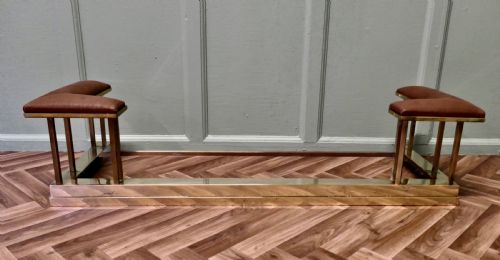
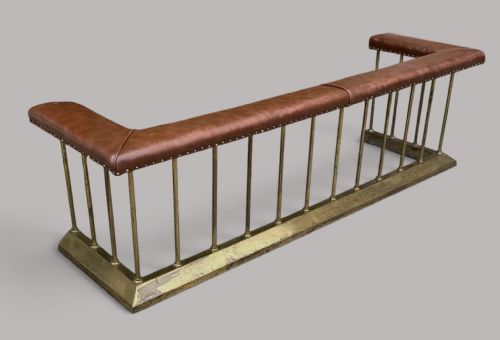
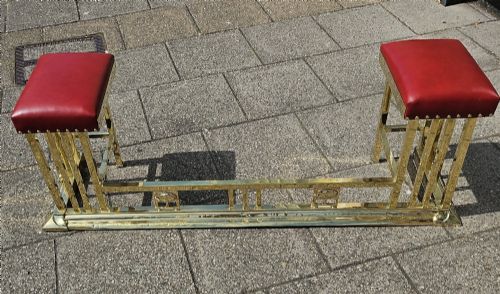
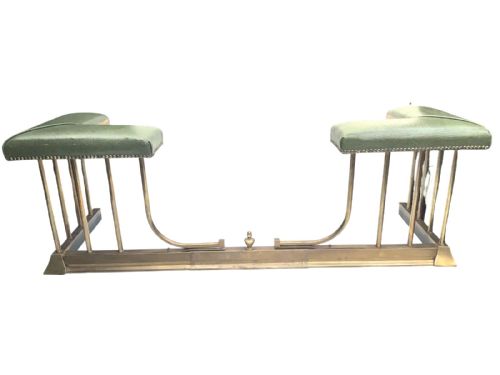
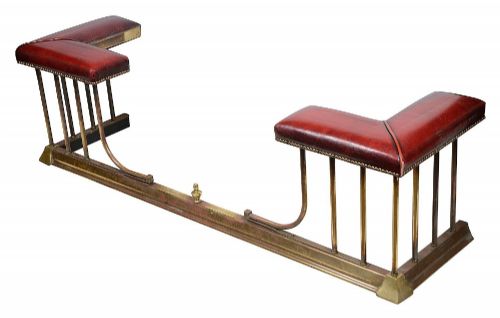
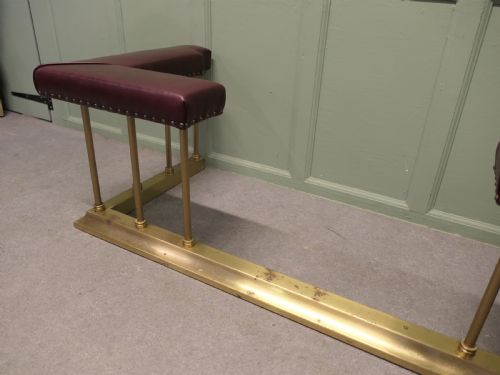
A club fender is a free-standing three-sided seat that wraps around a hearth, letting people sit close to an open fire while the frame keeps coals and clothing apart.

What Is A Club Fender?
The form is a metal frame carrying a padded top, usually leather, along the front rail or on the two end seats, or all the way round. It developed in Britain in the 19th century, took its name from use in gentlemen's clubs and large houses, and went on being made into the 20th century.
Brass is the default. It's named in well over half the titles on Sellingantiques, leather in a good two fifths, and "brass and leather" or "brass and iron" phrasings recur from the bottom of the range to the top. Iron comes next, wrought iron among it, then polished steel and copper as minority frames. Oak is the main timber alternative, with the odd walnut or mahogany top.
The rest of the category sorts into a few smaller groups. Around one in twelve listings offer the piece as a nursery fire guard or club fender without choosing between the two, and those sit at the bottom of the range. Roughly one in nine advertise a variable width, under words like extending, extendable or adjustable. Sizes run from small guard-like frames with modest upholstered ends up to nine- and ten-foot country-house pieces buttoned all round.
Dating is broad. The dealer date field spans 1860 to 1960, and the two largest labels are the vaguest: "19th Century" and "Victorian", between them a third of the archive. Read those as a bracket rather than a decade. After them come the 1900s, 1920s, Edwardian and 1910s; the 1930s thin out and the 1880s are scarce.
What Sets Them Apart
Size does most of the work. "Large" turns up in 59 titles and clusters in the upper half of the range, while "small" sits mostly among the cheapest nursery-guard examples. The only two titles that state a length, nine feet and almost ten, are both near the ceiling.
Then how much of the frame is upholstered. The bottom tier is dominated by bare brass-and-iron guards with no seating at all; leather, buttoned leather, hide and "leather seats" thicken steadily as you move up. Seat coverings named are almost all leather, in green, red, tan, burgundy and black, with velvet, suede and patterned fabric appearing once or twice.
Weight of metal and a stated style both lift a piece. Words like substantial, massive, heavy and polished appear only in the upper part of the range, as do the named idioms: Arts and Crafts in twelve titles, Art Deco in nine, plus single instances of Aesthetic Period, Jacobean Style and Art Nouveau. Adjustable width nudges upward more mildly, running from the lower-middle up.
Retail Price Guide 2026
Typical UK retail prices for club fenders, calculated from the Sellingantiques database of over a million retail prices indexed since 2003. This retail price guide relies exclusively on Sellingantiques data; no external sources or auction records are used, so the figures do not describe the wider market.
About thirty club fenders are listed on Sellingantiques each year, and sixty-four different dealers have offered one.
The Antique Club Fenders Glossary
- Club fender
- A three-sided free-standing hearth surround with an upholstered top that serves as a seat.
- Nursery fire guard
- A taller-railed hearth surround, offered interchangeably with a club fender in 26 titles.
- Extending
- A frame whose width can be altered to suit a different fireplace opening. Adjustable and extendable are used the same way.
- Buttoned leather
- Deep-buttoned upholstery on the seat top. Hide is the dealer word for the same covering, as in "real Hide Seats".
- Wrought iron
- Hand-forged frame, named in nineteen titles and sometimes described as blacksmith or estate made. Cast iron is moulded rather than forged.
- Barley twist
- Spiral-turned uprights or timber members, seen on both oak and brass examples.
Frequently Asked Questions
How many club fenders sell each year?
About thirty come to market on Sellingantiques in a year, and 64 different dealers have listed one.
That spread tells you something. It's a wide, shallow trade rather than a specialism, with a handful of pieces passing through a lot of different hands.
What are club fenders usually made of?
Brass leads, named in more than half of all titles, most often paired with leather seats. Iron follows some way behind, wrought iron making up part of that.
Beyond those, the frame list runs to cast iron, polished steel, cast steel, copper and silvered metal. Timber frames are a minority, oak the main one, with occasional walnut and mahogany tops.
Are club fenders always upholstered?
No. The cheapest tier is largely bare brass-and-iron frames with no padding, closer to a guard than a seat.
Upholstery breadth rises through the range. Some carry leather only on the two end seats, others along the front rail as well, and the largest are buttoned all the way round.
Why are so many listed as nursery fire guards?
Twenty-six titles offer the piece as a nursery fire guard or club fender without picking one. At the bottom of the range the two objects blur.
A taller-railed surround with modest padded ends can be described either way, and dealers often leave both words in.
Which design styles appear on club fenders?
Named idioms are sparse but varied. Arts and Crafts appears in twelve titles and Art Deco in nine.
Single instances cover the Aesthetic Period, Jacobean Style and Art Nouveau. These labelled pieces sit disproportionately above the middle of the range.
Do any club fenders come in unusual forms?
A few one-offs surface once and nowhere else in the archive: a step-over fender with a low rail meant to be crossed, a bow-fronted Arts and Crafts example, a Gothic barley-twist bergère and a polychromed fender.
One listing sold a pair of matching fenders together.