
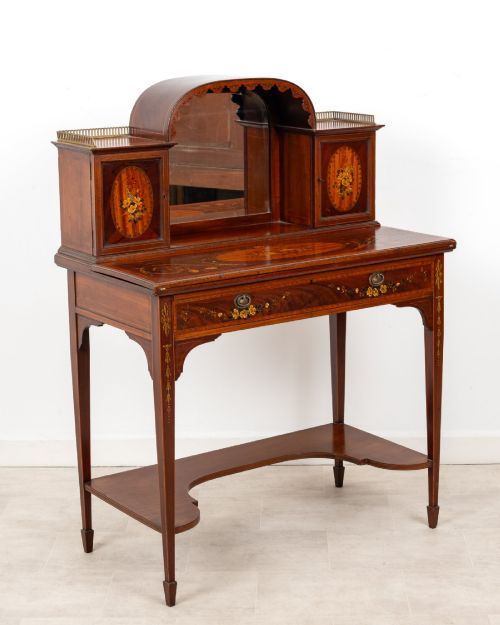


A 2026 Guide by Sellingantiques
Painted finishes on these desks often mimicked more expensive veneers or lacquerwork from the East.
Demand grew throughout the eighteenth and nineteenth centuries. Regional cabinetmakers built the frames, while specialist painters applied the surface designs.
A cheaper alternative to mahogany or walnut. Some were simply updated later with a coat of paint to suit changing room fashions.
Look at the Scandinavian traditions. Swedish and Danish examples often carry lighter, muted colours favoured in darker northern climates.
Documented makers of these are rare. The trade was largely anonymous, split between rural joiners and local decorative painters.
Alpine and Bavarian regions produced distinct floral designs. These workshops operated on a local scale, supplying farming estates rather than city gentry.
English provincial towns. Local craftsmen would paint a standard pine carcase to mimic fashionable Japanning or mahogany grain.
The 2026 retail price guide for Antique Painted Bureau is drawn from a proprietary archive of over 1.1 million retail prices indexed by Sellingantiques since 2003. This guide relies exclusively on their own internal data; no external sources or auction records are used.
Analysing nearly 25 years of UK antique market history alongside current retail values, the data indicates that typical UK retail prices for Antique Painted Bureau range between £1,000 and £4,000. Entry-level prices generally fall under £1,000 and premium examples upwards of £4,000.
The sloping fall-front defines the form. It drops down onto pull-out lopers to create the writing surface.
Fitted interior. Expect small drawers and open pigeonholes. A central cupboard is sometimes included to organise correspondence.
Graduated drawers usually make up the lower section. They get deeper towards the base to balance the visual weight of the piece.
Mortise and tenon joints secure the main frame. Pegs often lock these joints tight on older rural pieces.
Painted decoration evolving from simple flat colours to complex faux marbling and panelling over the centuries.
Check the backboards. They are usually rough-sawn and nailed directly into the frame rebates to keep the whole structure rigid.
"Hidden compartments. Small drawers pull right out to reveal secret slides tucked behind the pigeonhole dividers."
"The interior paint is often much brighter than the outside. Shutting the fall kept the sunlight away and preserved the original pigments."
"Smoke creating faux tortoiseshell effects. Craftsmen held a candle under wet glaze to produce intricate, swirling soot patterns."
Based on almost 25 years of Sellingantiques UK antique market data, Antique Painted Bureau appeared 282 times (out of 1,100,000 antiques) which gives it a rarity score of 95/100.
This score measures scarcity within the Sellingantiques archive only and is not a survey of the entire antiques market, so these statistics may not be indicative of the general availability of Antique Painted Bureau elsewhere.
Dry dusting is the safest approach. Use a soft bristle brush or a microfibre cloth to lift loose dirt from the surface without catching on any flaking paint.
Damp cloths risk softening old water-based paints or lifting fragile gesso. If a spill happens, blot it quickly rather than rubbing.
Most original keys for these locks were simple iron or brass barrel types. They usually had a plain oval or kidney-shaped bow, designed to be functional rather than ornate.
Keys were easily lost when pieces moved between houses. A replacement key from a later period is standard and won't affect the function of the old iron lock.
Small interior drawers held writing materials. Sand, ink powder, sealing wax and spare nibs were kept out of sight here.
Larger compartments sometimes held rolled paper. The varied sizing helped organise a messy desk.
Chalky finishes often mean the piece was painted with milk paint or a simple distemper. These traditional mixtures dry to a matte, powdery surface and lack the sheen of oil-based paints.
Over time, dust and dry air can make them look even flatter. A gentle coat of microcrystalline wax is sometimes used by conservators to protect the surface, which also brings back a slight, subtle gloss.
Please note: This Antique Painted Bureau guide and its associated pricing data are provided for general informational purposes only. It does not constitute formal financial, investment, or appraisal advice and should not be relied upon as the sole basis for any commercial activity, purchasing, or sales decisions. Sellingantiques.co.uk accepts no liability for any actions taken in reliance on this information. Always consult with a qualified professional or independent appraiser.
