

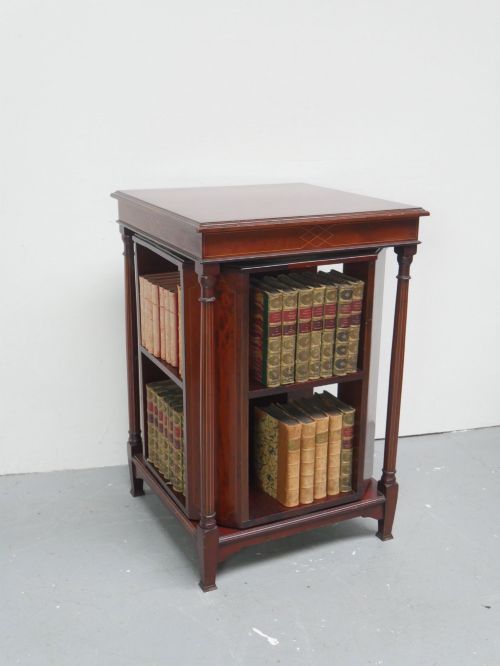


Antique Troughs
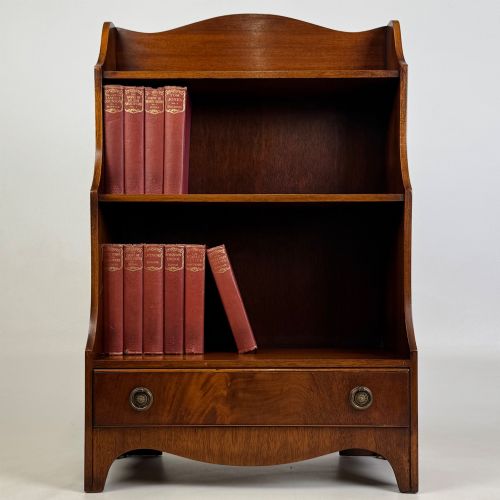
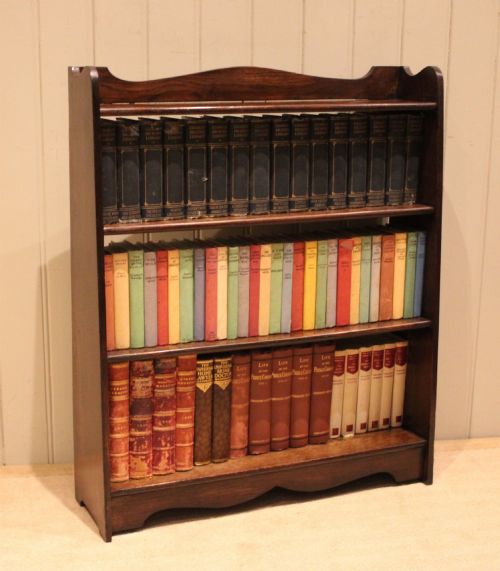
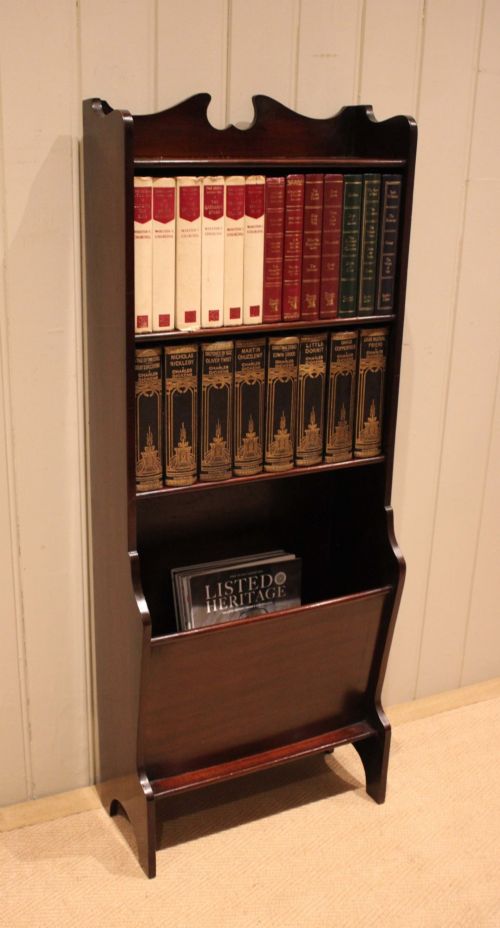
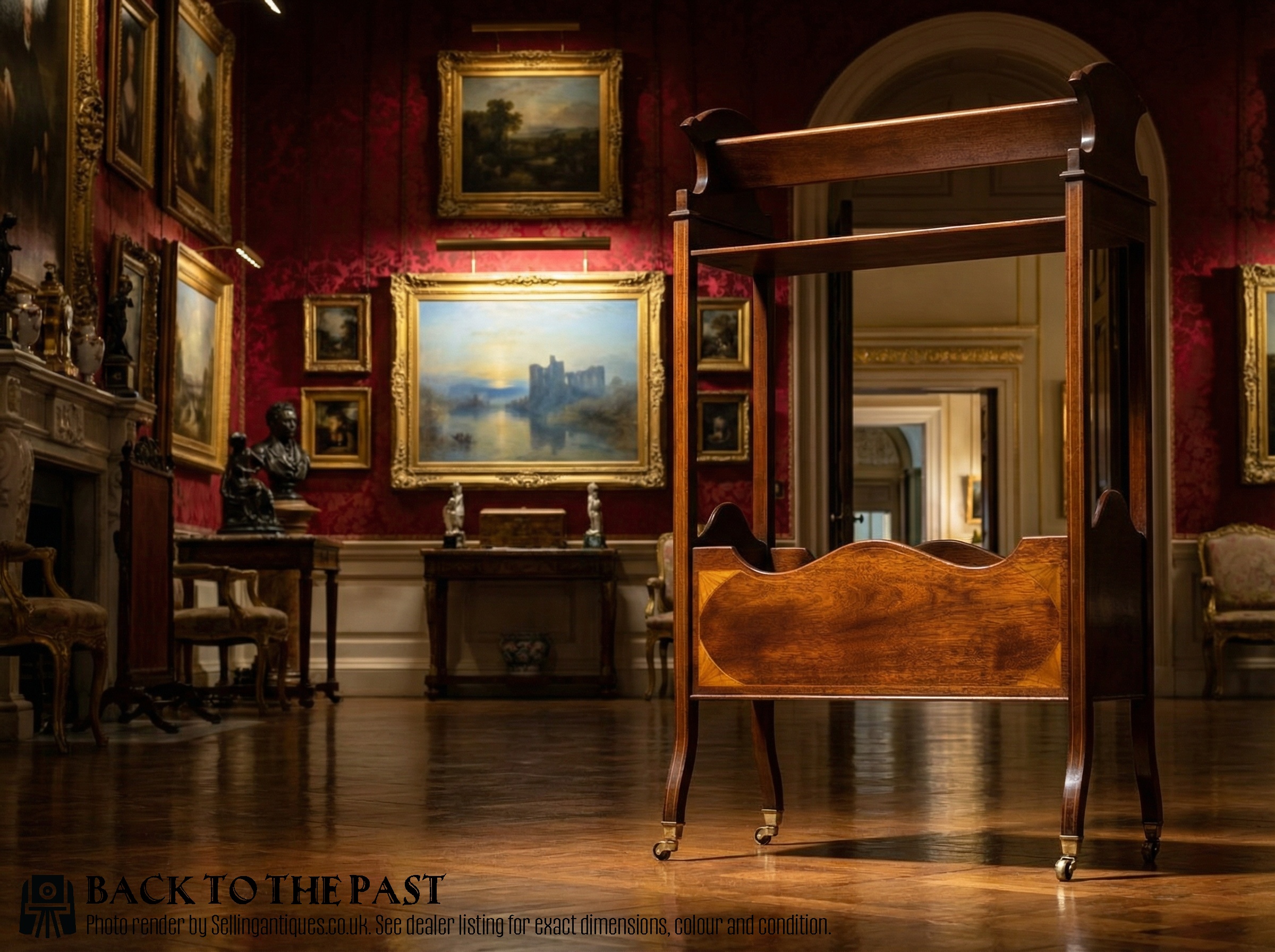
A book trough is a small open wooden cradle, usually V-sided and standing on short legs or feet, made to hold a handful of books or magazines upright on a desk, a table or beside a chair.
Antique Troughs
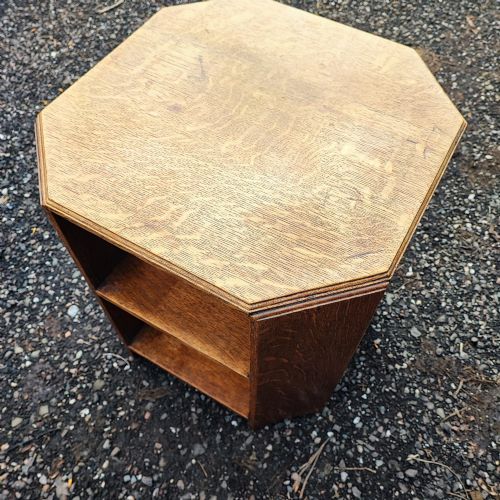
The word "book" appears in 72 of the 83 titles on Sellingantiques, and the large majority are described simply as book troughs. The rest borrow neighbouring words: bookcase, stand and table, which cover the table-top and revolving forms. Either way, the piece holds one shelf's worth of books, not wall storage.
The version you're most likely to meet is Edwardian and in mahogany or oak. Mahogany appears in 35 titles, oak in 25, and "Edwardian" in 33. A dozen titles carry "Edwardian mahogany" together. Inlay turns up in 14 of them, usually as banding or small motifs.
Dates run from 1880 to 1930 and no further back, with 55 listings giving a clean year. Half the category sits in a twenty-year window: 18 in the 1900s, 17 in the 1910s, 17 labelled only Edwardian. A "Victorian" or "19th Century" label here reads as a bracket rather than a year, and a title's stated circa doesn't always match the dealer's dated field.
Beyond the plain trough, three smaller groups recur. Arts and Crafts or Art Nouveau oak accounts for roughly a quarter. Table-top, desk-top and revolving variants make up around one in eight. Extending book slides and novel rests, whose ends draw apart on runners, appear in a handful of titles.
The Range
Timber sets the floor and the ceiling. The bottom of the range is plain oak or an unspecified "wooden", while the pieces at the top name satinwood, figured or flame mahogany, walnut and boxwood, satin walnut, even apple wood. Mahogany and oak between them cover almost three-quarters of titles, so the odd timber is the thing that stands out.
Decoration pushes in the same direction. Inlay clusters in the upper half of the range, and so do carved oak, painting, gilding, shell ends and pokerwork. Scale works alongside it: titles using "Small" sit low, while "Large", "Library", "Country House" and "Lawyers" sit high, borrowing the manner of a proper library fitting.
Two other things lift a trough. Named-style association is one, with Regency style, Regency Revival, Georgian Revival, George III style and Italian Rococo all in the upper half. Pairs are the other, unusual enough that dealers say so in the title, and all three pairs in the sample sit above the singles. Mechanism cuts both ways: extending slides appear cheaply, but extending novel rests and revolving forms reach higher.
Antique Troughs Retail Price Guide 2026
Typical UK retail prices for troughs, calculated from the Sellingantiques database of over a million retail prices indexed since 2003. This retail price guide relies exclusively on Sellingantiques data; no external sources or auction records are used, so the figures do not describe the wider market.
Troughs have been listed on Sellingantiques since 2011.
The Antique Troughs Glossary
- Book trough
- An open, usually V- or slope-sided wooden cradle holding books upright. The term used in the large majority of titles in this category.
- Novel rest
- A dealer's name for a small book trough, used in five of the sample titles and often paired with "extending".
- Book slide
- A trough whose ends slide apart on runners to take more books. Four titles use the term, and they sit at both ends of the range.
- Revolving bookcase
- A table-top or column form that turns on a central pivot, listed alongside troughs in three sample titles.
- Pokerwork
- Decoration burnt into the surface with a heated point. One title in the whole archive, on an apple-wood novel rest.
- Canterbury
- A partitioned stand of related purpose, borrowed once here to describe a trough form.
Antique Troughs: Frequently Asked Questions
How often do book troughs come up for sale?
Around a dozen come to market on Sellingantiques in a year, so the category moves steadily rather than in waves.
Forty-one different dealers have listed one. That means the typical dealer has handled a single trough rather than a run of them.
Are there Georgian book troughs?
Not in this archive. The dated field starts at 1880 and runs to 1930, and nothing is claimed as earlier.
Where you see Georgian Revival, Regency style or George III style, those are revival descriptions of later pieces. They tell you about the look, not the date.
What woods were used?
Mahogany and oak dominate, together covering almost three-quarters of titles. Mahogany appears in 35, oak in 25.
The outliers are where it gets interesting. Satinwood, satin walnut, sycamore, apple wood and boxwood each turn up once or twice across the whole sample.
Which period do most examples date from?
The concentration is 1900 to 1919. Eighteen listings are dated to the 1900s, 17 to the 1910s and 17 simply as Edwardian.
The 1920s account for ten. The thinnest decades are the 1880s, 1890s and 1930s, with three or four listings each.
Do book troughs come in pairs?
Rarely. Three sample titles offer troughs as a pair, and dealers say so in the title because it's unusual.
All three sit in the upper half of the range.
Were book troughs made outside England?
Overwhelmingly English. The word "english" appears in eight titles, against two Irish pieces, one Scottish and one Italian in the entire sample.
That isn't enough to describe Continental production as a group. It's a handful of one-offs.