



A 2026 Guide by Sellingantiques
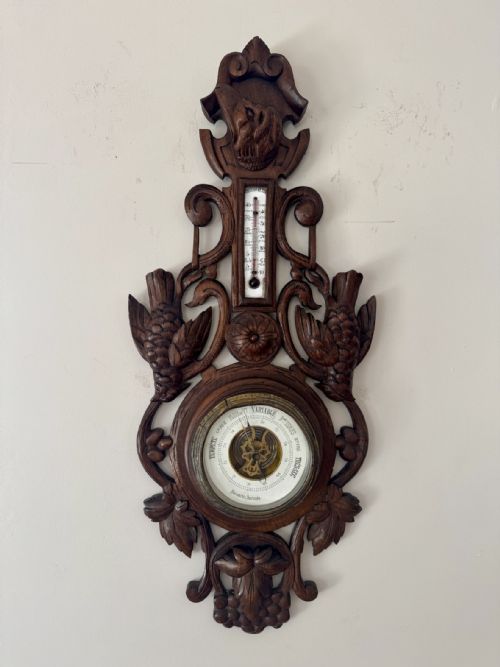
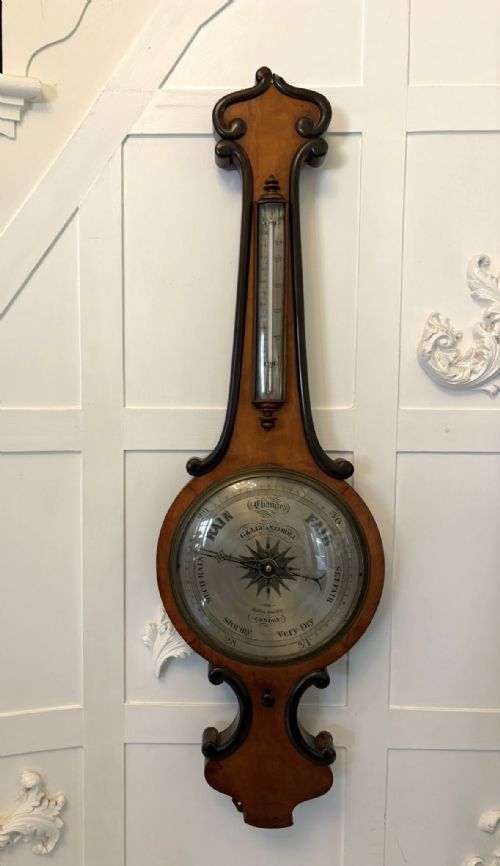
Quality Antique Victorian Carved Walnut Banjo Clock Barometer, 1880
Priced at £895 from Unique Antiques by Emma Jade
Early adoption of these scientific instruments in the late seventeenth century among wealthy households.
Look at the early stick forms, which predate the familiar banjo shape by several decades.
Demand for antique walnut barometers grew alongside a broader interest in domestic science during the Georgian period.
Watchmakers often assembled the delicate internal movements while local cabinetmakers produced the veneered cases.
Daniel Quare produced high-end stick barometers in the late seventeenth and early eighteenth centuries.
Italian immigrants working in London, such as the Cetti and Negretti families, dominated nineteenth-century commercial production.
Search the main dial for an engraved signature, which often includes the town or city of origin.
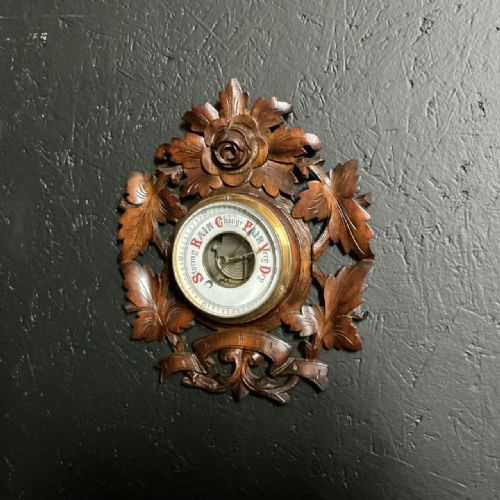
Quality Antique Victorian Burr Walnut Carved Banjo Barometer, 1860
Priced at £1,495 from London City Antiques
The 2026 retail price guide for Antique Walnut Barometers is drawn from a proprietary archive of over 1.1 million retail prices indexed by Sellingantiques since 2003. This guide relies exclusively on their own internal data; no external sources or auction records are used.
Analysing nearly 25 years of UK antique market history alongside current retail values, the data indicates that typical UK retail prices for Antique Walnut Barometers range between £200 and £1,300. Entry-level prices generally fall under £200 and premium examples upwards of £1,300.
A visible glass tube holding a column of mercury, often protected by a wooden cover or hinged glass plate.
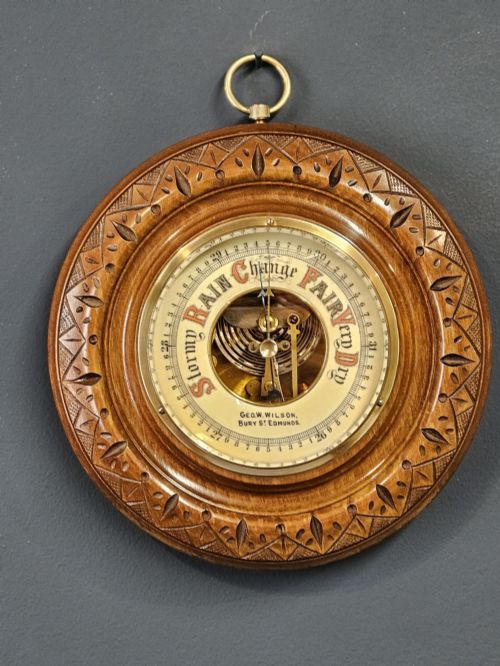
The main dial features engraved weather indications ranging from stormy to very dry.
Notice the set hand, a manually operated pointer used to track changes against the main indicator.
Makers cut thick veneers by hand before gluing them to a stable, cheaper carcase wood.
Engraved silvered brass dials, filled with black wax to create high contrast for the lettering.
Look for boxwood stringing set into routed channels around the outer edges of the case.
"The grain patterns on burled cases are often mirrored across the centre line to create a symmetrical book-matched design."
"Note the small spirit levels built into some dials, designed to ensure the instrument hangs straight on a crooked wall."
"Hidden adjustment screws sit under the base to calibrate the mercury level before taking a fresh reading."
Based on almost 25 years of Sellingantiques UK antique market data, Antique Walnut Barometers appeared 396 times (out of 1,100,000 antiques) which gives it a rarity score of 92/100.
This score measures scarcity within the Sellingantiques archive only and is not a survey of the entire antiques market, so these statistics may not be indicative of the general availability of Antique Walnut Barometers elsewhere.
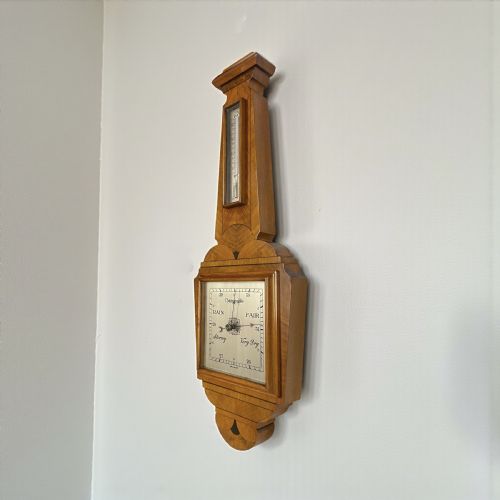
The smaller dial on the neck usually shows the temperature. It relies on a separate mercury or alcohol thermometer mounted to a silvered scale.
You read it independently of the main barometer face. It just gives you the current room temperature, not a weather forecast.
That bubble means air has entered the mercury column. The vacuum at the top of the tube is compromised, stopping the instrument from registering pressure changes correctly.
A specialist needs to empty the tube, clean the glass and refill it under a vacuum. Do not attempt to fix it yourself, as handling mercury requires specific safety equipment.
Turning the knob moves the set hand.
You align this brass pointer with the main steel indicator. Check back later to see if the steel hand has moved.
That bulge is a turned wooden cistern cover. It protects the glass reservoir at the base of the tube.
Most cases have a hole at the top for a fixing screw. You let the instrument hang freely from that point, and the cistern cover acts as a natural spacer against the wall.
Please note: This Antique Walnut Barometers guide and its associated pricing data are provided for general informational purposes only. It does not constitute formal financial, investment, or appraisal advice and should not be relied upon as the sole basis for any commercial activity, purchasing, or sales decisions. Sellingantiques.co.uk accepts no liability for any actions taken in reliance on this information. Always consult with a qualified professional or independent appraiser.
