






Antique Wheel Barometers
A wheel barometer is a wall-hung weather instrument read from a circular dial, hung in halls and passages across Britain through the 19th century.
Antique Wheel Barometers
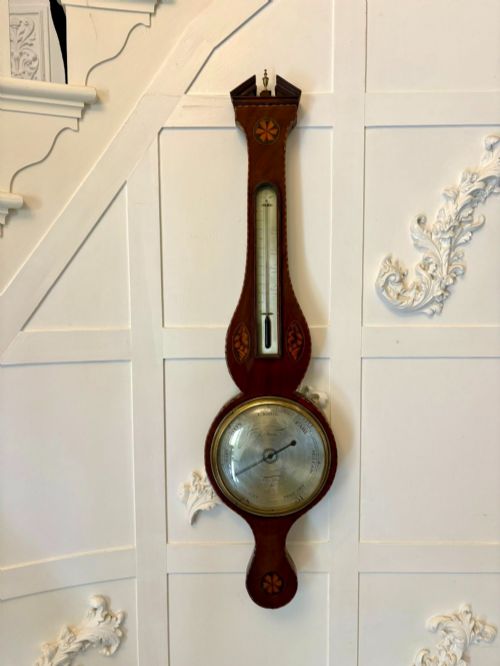
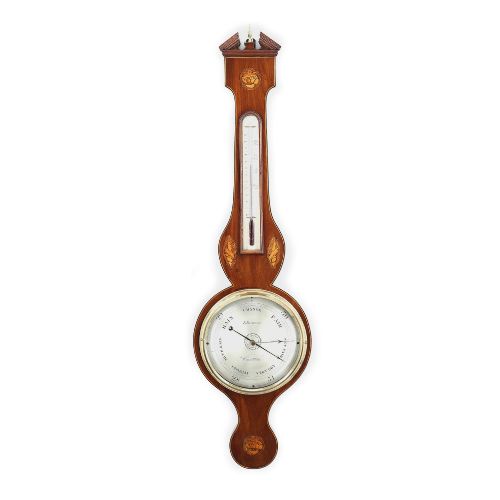
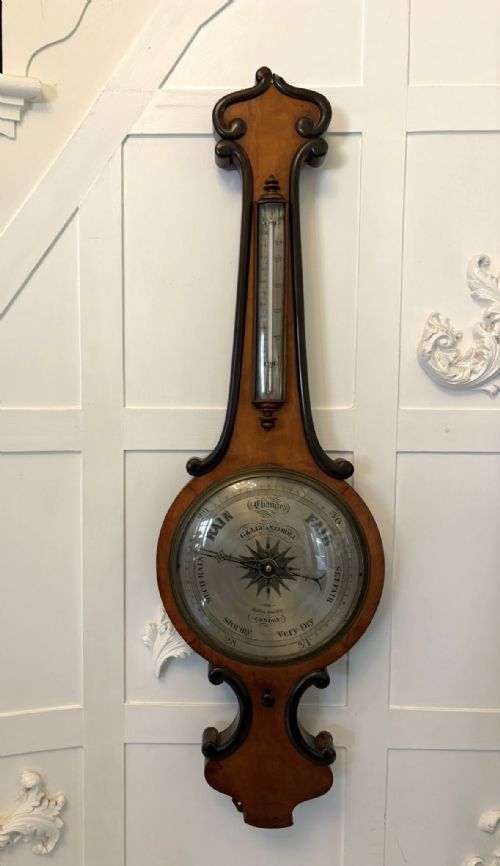
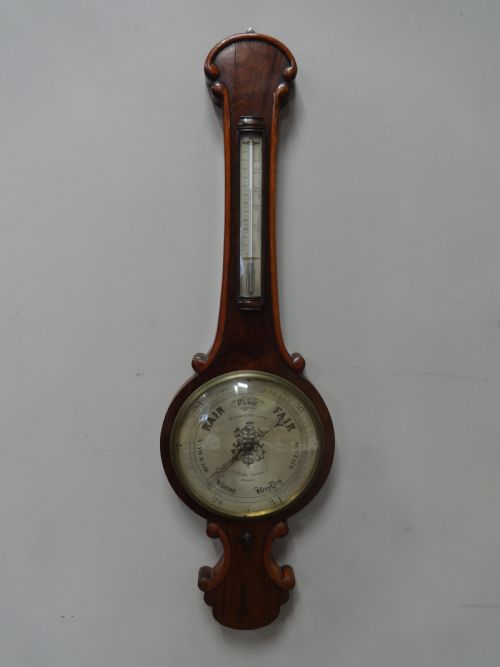
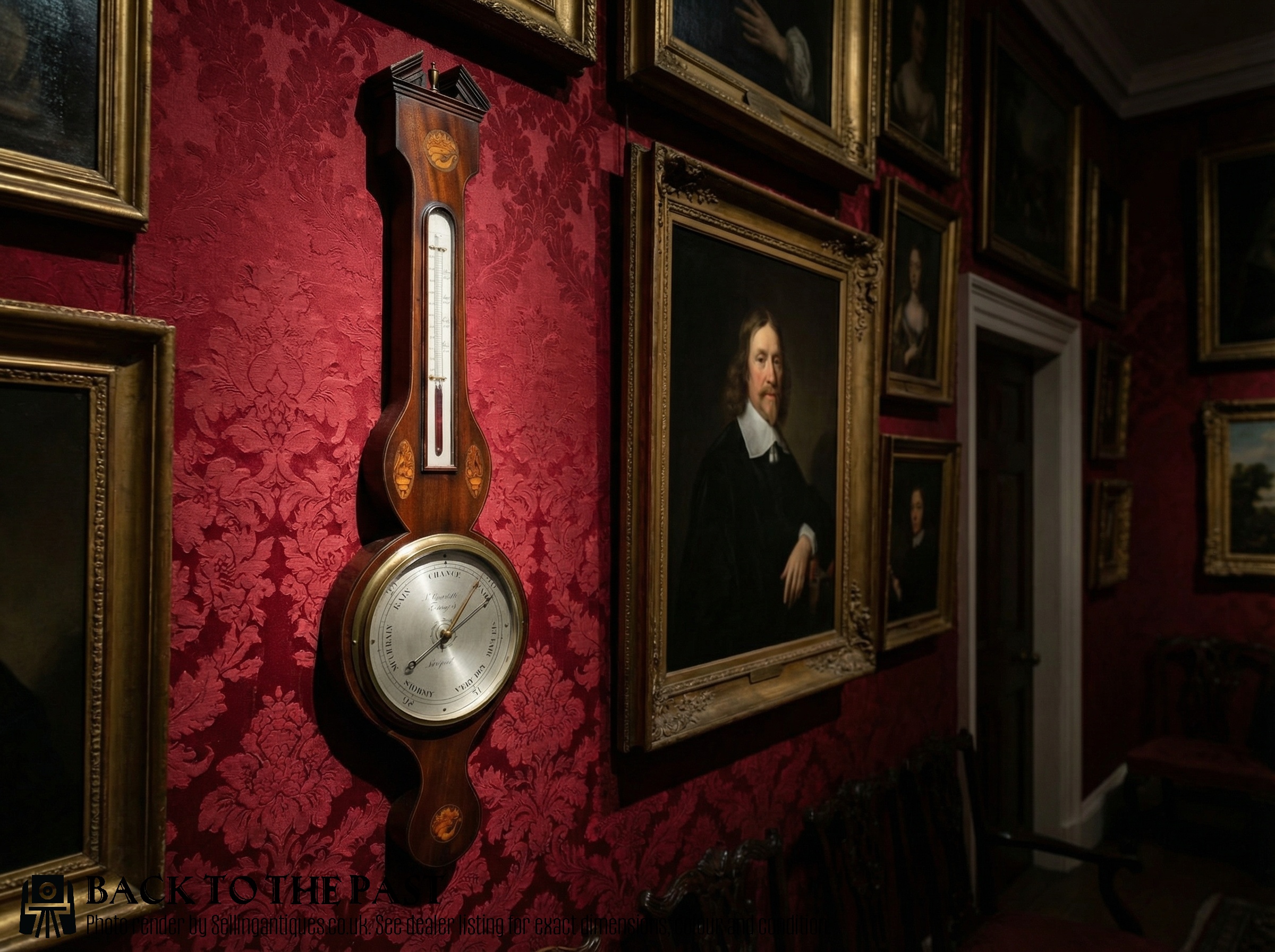
The circular dial is what defines them. A float sitting on a mercury column drives a pointer round the dial through a cord and pulley, so small shifts in pressure are far easier to read than on a plain straight scale. The round dial over a tapering waisted case gives the outline dealers call banjo.
The version you'll meet most often is a mahogany-cased banjo with a named dial, English, first half of the 19th century. Mahogany leads the timbers by some way, with rosewood next, then walnut, oak and satinwood. Mercury is the movement named on the Georgian and Regency pieces; aneroid, the later sealed-capsule type, turns up on a small number of late oak and walnut cases, including ones labelled Art Nouveau and Art Deco.
Dates in listings run from 1790 to 1930, though half the archive gives a clean year and the rest sits under looser tags: 19th century, 1800s, Regency, Georgian, Victorian. Treat a bare "1800" as shorthand for about the turn of the century. Only a handful of listings are pushed back into the 18th century, and the decade buckets thin after mid-century.
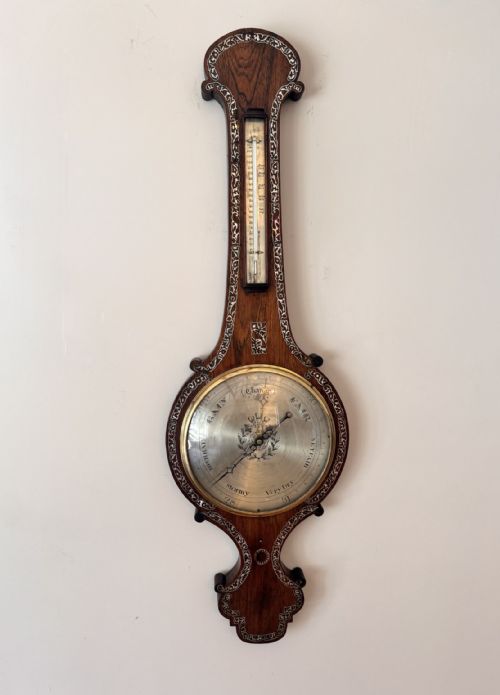
Beyond the Georgian and Regency named-dial cases sit Victorian carved oak and walnut examples, and a group with inlay: shell motifs on mahogany, mother-of-pearl on rosewood, occasional marquetry. Around 13 come up a year on Sellingantiques and 43 different dealers have handled one, so it's a form widely carried rather than a specialist corner.
The Range
A signature does more work than anything else. The upper half of the range is almost all signed and located dials, engraved with a retailer's name and an English town. The bottom is generic: a Victorian carved case, a 19th-century wheel barometer, no name on the dial at all. Signed towns run from Swindon and Louth to King's Lynn and Colchester, with London on a good number.
Timber and decoration sort the rest. Satinwood cases are few and cluster at the top, as do rosewood examples with mother-of-pearl inlay. Carved oak and walnut Victorians sit at the bottom. Date pulls the same way: pieces around 1790 to 1810 stand well above mid- and late-Victorian carved cases, and mercury outranks aneroid.
Dial diameter is the other measure, stated in inches in titles from 4 up to 14. Ten and twelve inch dials appear repeatedly in the higher part of the range, but scale cuts both ways at the extremes, and the smallest dials are treated as a curiosity rather than a cheap option.
Antique Wheel Barometers Retail Price Guide 2026
Typical UK retail prices for wheel barometers, calculated from the Sellingantiques database of over a million retail prices indexed since 2003. This retail price guide relies exclusively on Sellingantiques data; no external sources or auction records are used, so the figures do not describe the wider market.
The oldest on Sellingantiques is a ten-inch London-signed example of about 1790. The latest is a chrome ship's bulkhead pair of 1930.
The Antique Wheel Barometers Glossary
- Banjo
- The common case outline, a round dial over a tapering waist. It appears by name in a good number of titles and describes the shape rather than any particular period.
- Mercury or mercurial
- The traditional movement, a mercury column driving the dial pointer through a float. The term attaches to the Georgian and Regency pieces here.
- Aneroid
- A later sealed-capsule movement needing no mercury. Named in only a small number of titles, mostly on late oak and walnut cases.
- Dial size
- Given in inches in the title, from 4 up to 14, with 10 the most frequently stated. Used as a measure of scale and of cost.
- Shell inlay
- A conch or fan motif inlaid into the case, recurring on Georgian mahogany examples. Mother-of-pearl inlay does the same job on rosewood.
- Fecit
- Latin for "made it", following a signature on the dial. Flame mahogany, figured veneer with flame-like grain, is the other phrase titles reach for.
Antique Wheel Barometers: Frequently Asked Questions
What does banjo mean on a wheel barometer?
It's the case outline: a circular dial above a tapering waisted body, which reads a little like the instrument. Around one in seven titles uses the word.
Banjo describes shape, not date or movement. It covers Georgian mahogany cases and Victorian carved ones alike.
Which timbers turn up most often?
Mahogany dominates, at roughly a third of titles, with rosewood next and walnut, oak and satinwood behind. Flame mahogany is called out when the veneer is figured.
Satinwood cases are only a handful, and they sit at the top of the range. Carved oak and walnut Victorians sit at the other end.
Rosewood is the timber that most often carries mother-of-pearl inlay.
How old are these barometers usually?
Listed dates run from 1790 to 1930. Half the archive gives a clean year; the rest uses looser labels, with 19th century and 1800s the two largest groups.
Regency, Georgian and Victorian are used as period tags rather than dates. Only six listings are tagged 18th century.
Is mercury or aneroid more common?
Mercury is named far more often, and it's the term attached to the Georgian and Regency examples. Aneroid appears in only a small number of titles.
Those aneroid cases carry the latest style labels in the archive, including one Art Nouveau and one Art Deco, and they're generally oak or walnut.
Movement internals are rarely described either way.
Why do dials carry a town name?
The dial was engraved with the retailer or maker's name and the town they worked in. It's often the only description a dealer needs for the title.
The towns range widely across England: Swindon, Louth, Ludlow, Shrewsbury, Tiverton, King's Lynn, Weymouth, Colchester and more, with London on a fair share.
Examples from outside England are scarce, with single pieces from Belfast, Perth and Glasgow.
Does dial size affect where a piece sits?
Larger dials sit higher as a rule. Ten and twelve inch dials appear repeatedly in the upper part of the range.
The extremes work differently. A four inch and a five inch dial are both flagged as unusual rather than modest, so small doesn't automatically mean bottom of the range.