




Antique Pocket Barometers
A pocket barometer is a small aneroid instrument in a watch-shaped case, carried by travellers, walkers and surveyors to read air pressure, and from it the weather ahead or the height underfoot.
Antique Pocket Barometers
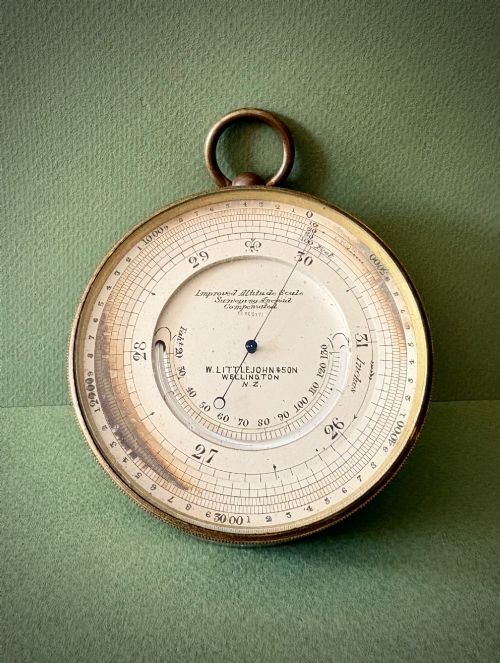
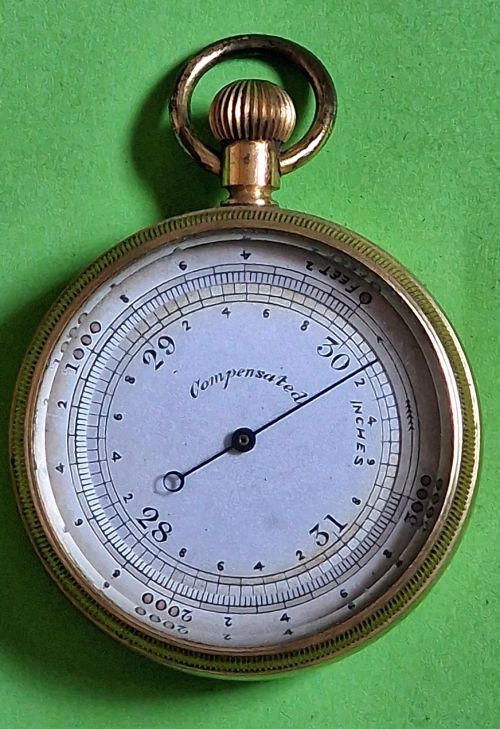
The aneroid barometer works by a sealed vacuum chamber rather than a column of mercury, and that is what made a portable instrument possible. Patented in the middle of the 19th century, it was quickly shrunk into a case a few inches across, engraved dial behind glass, and sold to people who wanted a pressure reading away from home.
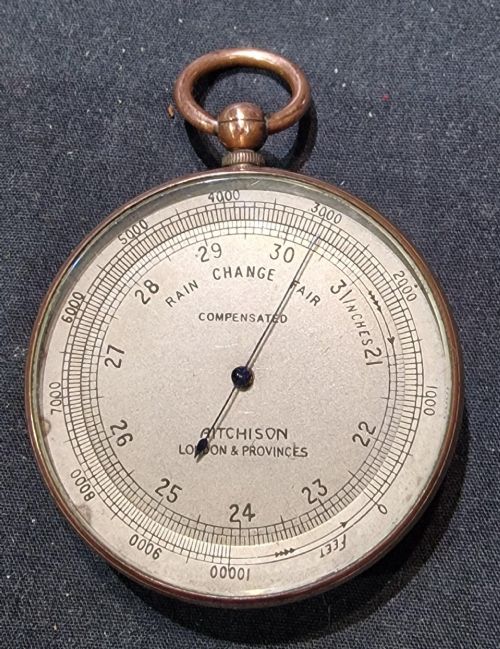
The one you'll meet most often is gilt or polished brass, English, and signed on the dial by a retailer or optician. London appears in sixteen of the ninety-five listings on Sellingantiques, though signatures also run to Brighton, Bristol, Leicester, Liverpool, Cheltenham and Edinburgh. Many titles name no metal at all, which by default reads as brass.
Away from the plain brass instrument there are three smaller groups. Silver cases account for under one listing in ten, with a single 9ct gold table-top example. Combinations pair the barometer with a compass, a thermometer or both, one of them double sided. Then the working end of the trade: altimeter scales on eight titles, and two sold outright as surveying barometers.
Fifty-nine listings carry a clean year, running 1850 to 1930, with the 1890s the busiest decade in the dealers' own dating and the 1900s close behind. Nothing here is dated before 1850. A fifth of the dated entries are period labels such as 'Victorian' or '19th Century' rather than years.
What Sets Them Apart
Case metal does most of the work. Silver sits above gilt and polished brass, and the one gold example sits near the very top of the range, while a plain unsigned gilt-brass instrument sits near the bottom. Engine turning on a silver case adds to that.
After metal, it's how much the instrument does and whose name is on it. Barometers combined with a compass, or with compass and thermometer together, sit consistently above plain ones. A legible signature pushes upward too: unsigned examples are listed as nothing more than 'pocket barometer', while signed dials carry a retailer or optician's name and town.
The last two lifts are survival and oddity. An original leather case, presentation box or the printed instructions still with the instrument all count. So does anything out of the ordinary run: a skeletonised case, a visible movement, a South American or American retailer, a balloonist's altimeter.
Antique Pocket Barometers Retail Price Guide 2026
Typical UK retail prices for pocket barometers, calculated from the Sellingantiques database of over a million retail prices indexed since 2003. This retail price guide relies exclusively on Sellingantiques data; no external sources or auction records are used, so the figures do not describe the wider market.
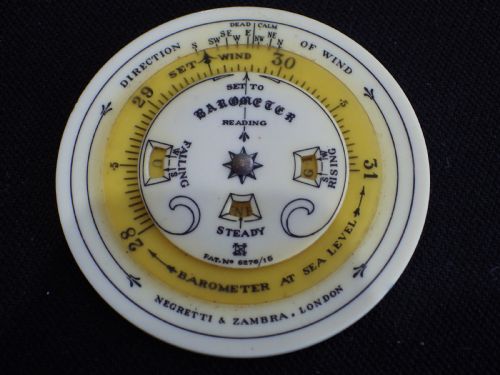
Negretti & Zambra is the name that turns up from the most dealers on Sellingantiques.
Negretti & Zambra
The Antique Pocket Barometers Glossary
- Aneroid
- A barometer working by a sealed vacuum chamber rather than mercury. It is the mechanism that let the instrument shrink to pocket size.
- Altimeter
- A second scale, usually the outer ring, converting pressure to height in feet. Eight of the ninety-five titles carry one.
- Gilt brass
- The standard case material in this archive: a brass body with a gilded finish. Polished brass turns up throughout as well.
- Cased or boxed
- Supplied in its leather, presentation or fitted box, sometimes with the printed instructions. Named in eight titles.
- Compensated
- Fitted with a mechanism intended to correct the reading for changes in temperature. Named in several titles.
- Skeletonised
- Case cut away so the movement shows. One Victorian example is described this way, and another sold with a visible movement.
Antique Pocket Barometers: Frequently Asked Questions
How does a pocket barometer differ from a wall barometer?
Everything in this category is aneroid and portable, built into a watch-shaped case a few inches across rather than hung on a wall.
The dial is engraved, glazed, and often carries a second scale round the edge. Many came with a leather or fitted case for carrying.
What does the altitude scale on the dial do?
It converts air pressure to height in feet, so a reading gives you roughly how high you are standing. Eight of the ninety-five listings carry such a scale.
Two instruments go further and are sold as surveying barometers, made for measuring height in the field. These were working tools, not only travellers' pieces.
When were pocket barometers made?
The dated listings run from 1850 to 1930. Nothing on Sellingantiques is dated earlier than that.
The 1890s are the busiest single decade in the dealers' own dating, with the 1900s close behind. Numbers thin out through the 1860s to 1880s on one side and the 1910s and 1920s on the other.
Are silver pocket barometers common?
No. Silver accounts for under one listing in ten, and gilt or polished brass dominates the rest.
Among the silver examples are an engine-turned case, a combined pocket watch and barometer, and a hot air balloonist's altimeter of the 1920s. A single table-top instrument is 9ct gold.
Whose name appears on the dial?
Usually a retailer or optician rather than the person who made the movement, with the town alongside. London appears in sixteen titles.
Outside London the signatures reach Brighton, Bristol, Leicester, Liverpool, Cheltenham and Edinburgh. Unsigned instruments are listed simply as pocket barometers.
Do combination instruments turn up?
They do, at roughly one listing in ten. The barometer is paired with a compass, a thermometer, or both in a single case.
One is double sided. These sit consistently above plain barometers in the range.