




Antique Walnut Barometers
A weather instrument in a walnut case, hung in a hall or parlour to read atmospheric pressure and give a day's warning of rain.
Antique Walnut Barometers
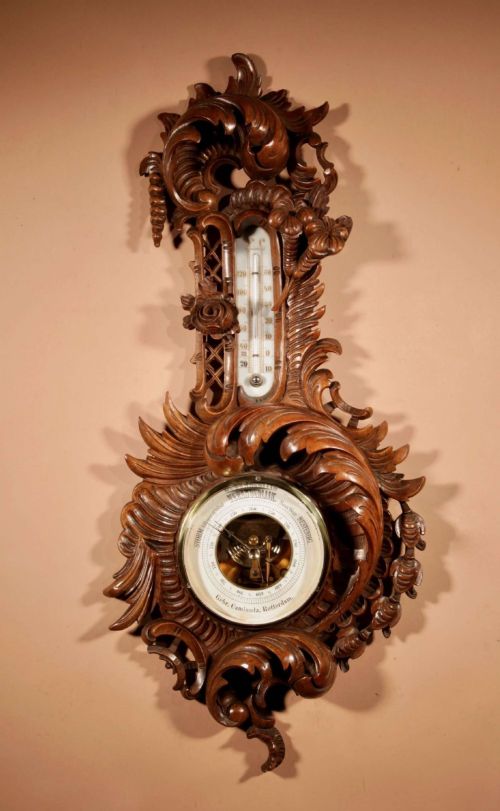
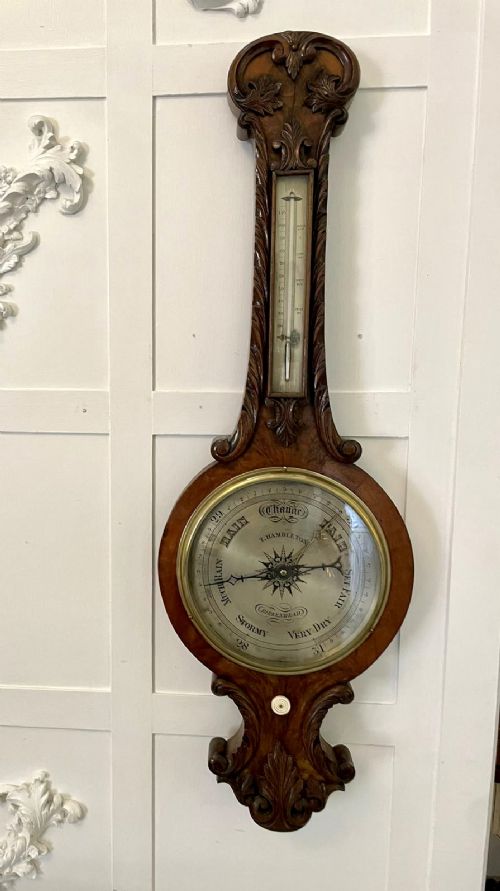
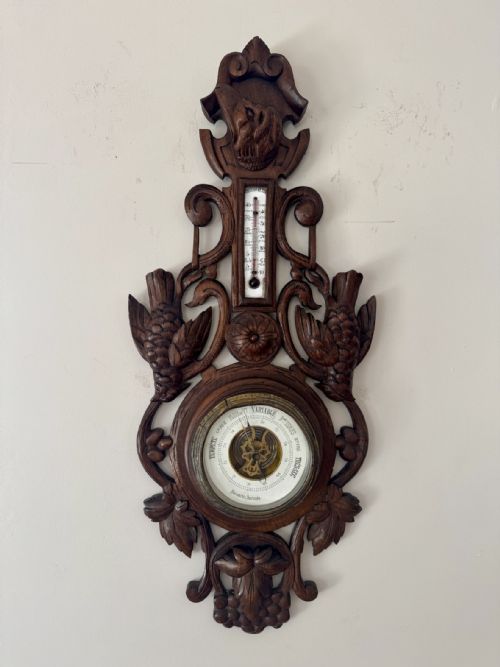
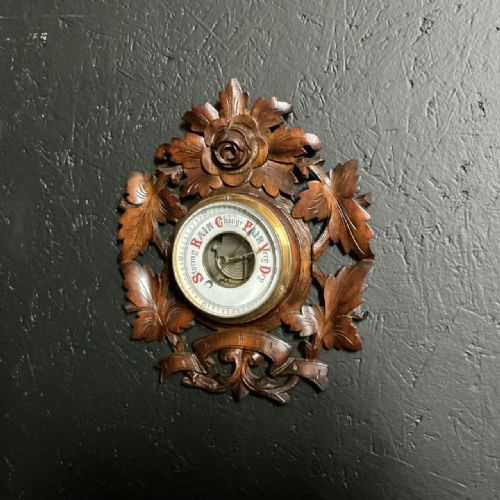
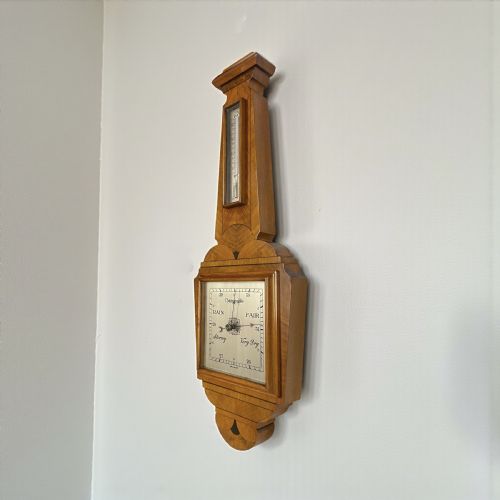
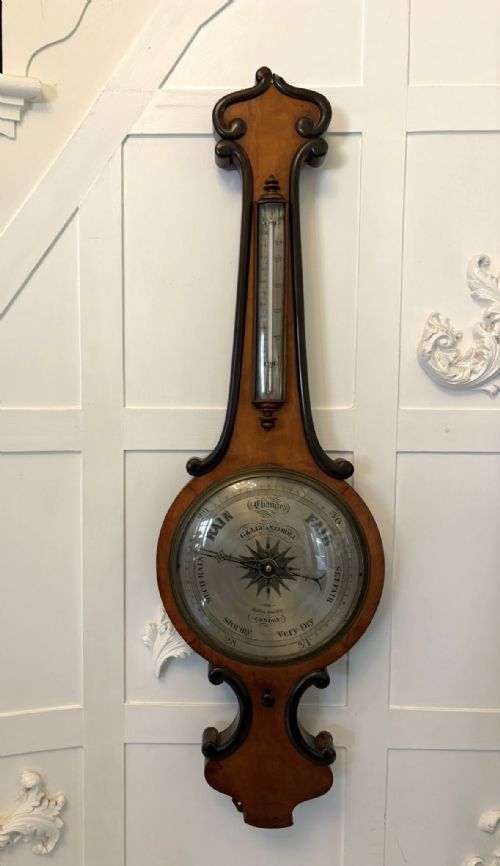
The everyday piece under this heading is a Victorian aneroid wall barometer: a circular dial set in a walnut surround that has been carved, turned or cut away. Victorian appears in 153 of 237 titles, and the aneroid dials, banjo and pendant outlines and skeletonised cases together make up the clear majority of the archive.
Barometers began as mercury tubes in the mid-17th century. The aneroid, a sealed metal capsule that flexes with pressure and needs no liquid, arrived in the mid-19th century and made a small, light wall dial possible. Walnut came in as the instrument moved out of the study and became a piece of house furniture.
Alongside the dials sit two smaller groups. Mercury stick barometers, upright tubes on a long backboard, run to about one in ten of the listings, often in burr or figured walnut, bow-fronted or chequer-outlined, with sea coast and marine variants. Clockwork barographs in walnut cases, which ink a paper chart, account for roughly one in fourteen.
Dating is heavily late Victorian. A hundred listings fall in the 1880s and 1890s, against four in the 1850s and four in the 1870s, with only single figures for the Edwardian years and the 1930s. Georgian and 18th-century walnut barometers exist in the archive but can be counted on one hand, and a handful of dealers use vague period words as shorthand rather than a date.
What Separates Them
Mechanism does most of the work. Mercury stick barometers and recording barographs cluster in the upper half of the sampled range, while unqualified aneroid dials fill the bottom. A dial that records, or one that reads a real column of mercury, is a different order of instrument from a capsule behind a printed register.
Then the timber and the case work. Burr walnut appears in 14 titles and figured walnut on several stick barometers, both sitting near the top; plain polished walnut, named in 30 titles, sits low and mid-range. Deep carving, skeletonised fronts with the movement showing, and the eight Black Forest pieces all push upward against a simply turned surround.
Size and extras count too. Twenty-two titles say small and those sit at the lower end, while large dials, double scales, combined thermometers and the one barometer paired with a clock sit higher. A named instrument-maker or an English town on the dial lifts a piece as well, though every signature in the archive comes from one or two listings rather than a run.
Antique Walnut Barometers Retail Price Guide 2026
Typical UK retail prices for walnut barometers, calculated from the Sellingantiques database of over a million retail prices indexed since 2003. This retail price guide relies exclusively on Sellingantiques data; no external sources or auction records are used, so the figures do not describe the wider market.
The most expensive walnut barometer ever sold on Sellingantiques was a Black Forest carved walnut aneroid, in April 2024.
The Antique Walnut Barometers Glossary
- Aneroid
- Pressure sensed by a sealed metal capsule rather than a column of mercury. Named in 55 titles, and the standard mechanism behind the Victorian wall dial.
- Banjo
- The round-dialled, waisted wheel-barometer outline, in 40 titles. Often paired with pendant, a hanging drop-shaped case, which appears in 24.
- Stick barometer
- An upright mercury tube on a long backboard, described in 22 titles. Bow-fronted and chequer-outlined versions turn up among them.
- Skeletonised
- Case or dial cut away so the movement shows through the front. Nineteen titles use the word, and others say visible works.
- Barograph
- A clockwork recording barometer that inks a trace onto a paper chart, usually under a glazed cover. Sixteen titles, eight of them described as cased.
- Burr walnut
- Figured veneer cut from a burr growth on the tree. Fourteen titles name it, mostly on stick and banjo forms.
Antique Walnut Barometers: Frequently Asked Questions
What is the most common type in walnut?
A Victorian aneroid wall dial. Roughly a quarter of titles say aneroid outright, and the carved, banjo, pendant and skeletonised cases around those dials account for the bulk of the archive.
The everyday size is modest. Twenty-two titles call the piece small against twelve calling it large, so a hall dial rather than a long-case instrument is the norm.
How old are walnut barometers usually?
The dealers' dating runs from 1700 to 1950, but the weight is late Victorian. Seventy-two listings say simply Victorian, and another hundred fall in the 1880s and 1890s.
Earlier work is thin on the ground. Four listings sit in the 1850s and four in the 1870s, and 18th-century walnut barometers can be counted on one hand.
Does a mercury barometer sell for more than an aneroid?
The mercury sticks and the clockwork barographs cluster in the upper half of the sampled range. Plain aneroid dials, with no other qualifier in the title, fill the bottom.
Case work shifts things as well, so a deeply carved or burr walnut aneroid will not sit at the foot of the range.
Are Black Forest walnut barometers common?
No. Eight titles use the term, plus one each described as Danish, French and American carved walnut. Continental and overseas pieces are the small seam in an otherwise English category.
Where they do appear, the deep carving puts them mid-to-upper range.
What does skeletonised mean on a barometer?
The case or dial is cut away at the front so the movement is on show. Nineteen titles use the word, and a few others say visible works instead.
It was a recurring Victorian idea rather than a one-off, and it turns up alongside carved and turned surrounds throughout the archive.
Which makers turn up on walnut barometers?
Signatures do appear, but each one comes from only one or two listings, so no name runs through the category. Where a maker or retailer is given, it is engraved or printed on the dial and quoted in the title.
Place names are more consistent. London shows in 15 titles, with Manchester, Liverpool, Bristol, Newcastle, Norwich, Chester, Oxford, Exeter, Macclesfield and Dublin each appearing.