

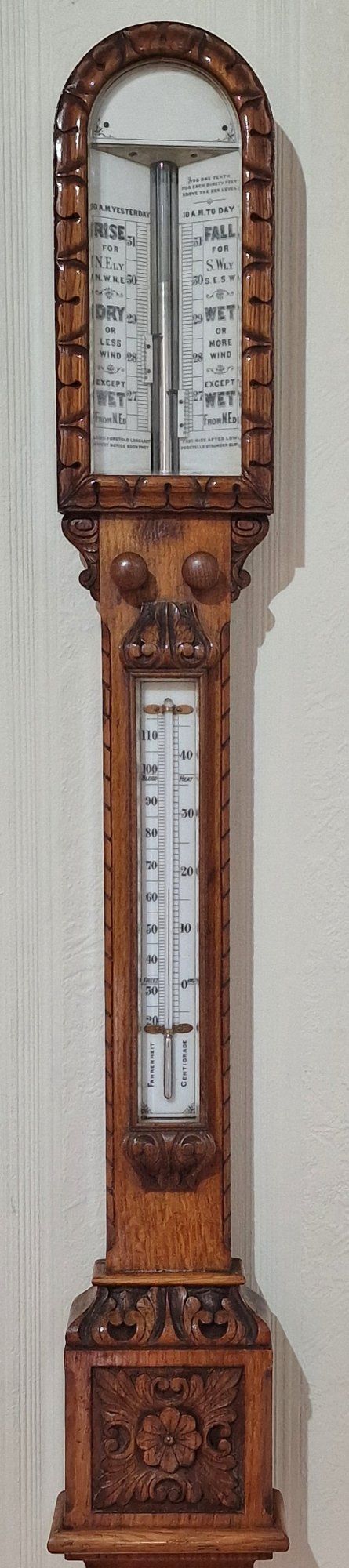


Antique Marine Barometers
A marine barometer is a pressure instrument built for a ship, made either as a brass dial screwed to a bulkhead or as a mercury tube in a wooden case hung in gimbals, and kept aboard to read the coming weather.
Antique Marine Barometers
Almost all of these are aneroid barometers: a circular dial in a brass, bronze or steel case, made to hang on a bulkhead or stand on a desk, very often with a curved crescent thermometer fitted below the dial. The aneroid works from a sealed metal capsule, so there is no mercury column to spill and the whole instrument can simply be screwed flat to a wall.
The ordinary encounter is a late Victorian brass-cased dial. Victorian appears in more than half of all titles on Sellingantiques, brass in a quarter, and bulkhead in about a fifth. Where a decade is stated the weight falls in the 1880s and 1890s, so read Victorian in this field as shorthand for that late bulk rather than a firm date. The dated field runs 1800 to 1930, but only a handful of listings sit at either end.
Two other dial patterns turn up throughout. Skeletonised cases, cut away so the movement shows behind the dial, account for about one in ten titles, and some listings say visible works instead. Another tenth are desk-top or cased examples, sold with a presentation case, a stand or an oak plinth. RNLI and fisherman's barometers, plainer and more robust, are a small recurring group, and the two names often describe the same instrument.
The mercury stick barometers are a distinct minority, around two dozen titles, in rosewood or mahogany and frequently gimballed. Titles here lean on case metal, case treatment and a British port or city rather than a maker: London leads by a wide margin, then Liverpool, Glasgow, Edinburgh, Cardiff, Aberdeen, Hull, Bristol and Plymouth. Foreign origins are scarce, a couple of French pieces and a single Berlin holosteric.
What Lifts One
Type does more than anything else. Every stick barometer in the archive sits in the upper part of the range, and the rosewood or mahogany examples hung in gimbals hold the highest positions of all. The aneroid dials, for all their numbers, spread across the whole span below them.
Among the dials, case and size sort them out. Bronze, steel and cast cases cluster above plain brass, and titles reading steel and brass or cast bronze sit well above the brass middle. Larger dials go higher too: where a size is stated it tends to be seven or eight inches, and those titles beat comparable small ones, while small and miniature sit at the bottom.
After that it comes down to how much instrument you get. Twin registers, twin thermometers, a compass or storm scales all read above a single dial, and so does completeness: a presentation case, an original stand or an oak plinth pushes a barometer up against a bare one.
Antique Marine Barometers Retail Price Guide 2026
Typical UK retail prices for marine barometers, calculated from the Sellingantiques database of over a million retail prices indexed since 2003. This retail price guide relies exclusively on Sellingantiques data; no external sources or auction records are used, so the figures do not describe the wider market.
One-offs through the archive include a barocyclonometer for tracking typhoons, a cast iron 'Universal', a barometer built into a compass, and two sympiesometers.
The Antique Marine Barometers Glossary
- Aneroid
- A dial barometer worked by a sealed metal capsule rather than a column of mercury. This is the form nearly all marine barometers here take.
- Bulkhead
- The ship's wall. A bulkhead barometer is made to be screwed flat against it, and about a fifth of titles say so.
- Stick barometer
- The mercury-tube form in a tall wooden case, named in around two dozen titles and sitting at the top of the range.
- Skeletonised
- A case cut away so the movement is visible behind the dial. Roughly one title in ten uses the word, and others say visible works.
- Crescent thermometer
- A curved thermometer mounted below the dial, named outright in some titles and implied wherever a thermometer is mentioned.
- Holosteric
- A French term for a particular aneroid movement, appearing in a small run of titles.
Antique Marine Barometers: Frequently Asked Questions
What is a gimbal on a marine barometer?
A gimbal is a pivoting mount that lets the instrument stay upright while the ship rolls. Without it a mercury column cannot be read on a moving deck.
Gimbals turn up with the stick barometers, spelled gimbal or gimble in the titles. The aneroid dials do not need one, since they screw flat to the bulkhead.
Why do so many listings name a city instead of a maker?
Port and city names do the work maker names usually do in this category. London leads by a long way, followed by Liverpool, Glasgow, Edinburgh, Cardiff, Aberdeen, Hull, Bristol, Plymouth and a string of others.
Signed examples do exist, but they are scattered singletons rather than a run of familiar names, so titles fall back on the place, the case metal and the case treatment.
How old are most marine barometers on the market?
The dated field runs from 1800 to 1930. Two-thirds of the dated decades fall in the 1880s and 1890s.
A great many entries carry a period word instead of a year, Victorian above all, with a scattering of 19th century and Edwardian. In this evidence Victorian usually means the 1870 to 1900 bulk.
Are mercury barometers different from aneroid ones?
Yes. A mercury barometer reads pressure from a column of liquid in a tube; an aneroid reads it from a sealed metal capsule linked to a pointer on a dial.
The mercury type at sea is the stick barometer, tall, in a rosewood or mahogany case, usually gimballed. From the mid-19th century the aneroid capsule made a compact dial instrument that could be screwed straight to a bulkhead, and that is what dominates the category.
What does a fisherman's barometer look like?
It is a plain, robust dial pattern rather than a decorative one, made to work rather than to furnish a saloon.
Fisherman's and RNLI appear in nine titles apiece on Sellingantiques, and they are frequently the same instruments described from two angles.
Do unusual types ever come up in this category?
Occasionally. The archive holds two sympiesometers, an early gas-and-liquid pressure instrument, and a single barocyclonometer with storm-track scales, described as a typhoon barometer.
Other one-offs include a cast iron model, a Rapid Indicating pattern and a barometer combined with a compass. Around thirty marine barometers reach the site in a year, carried by sixteen dealers, so these appear rarely.