




A 2026 Guide by Sellingantiques
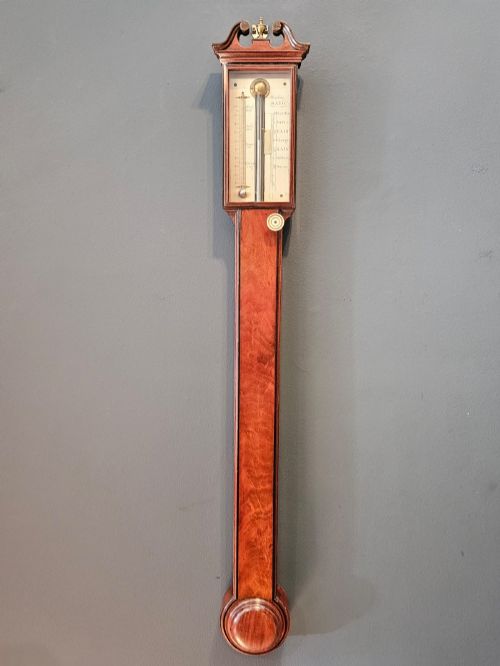
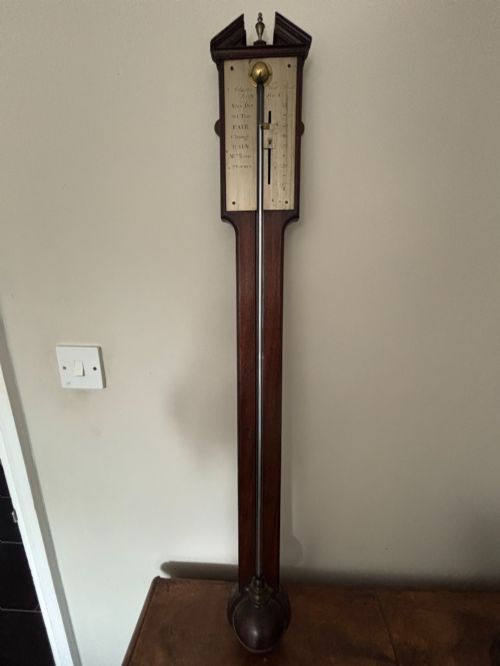
Mahogany Stick Barometer - Jb Bergna, Newcastle, 19th Century
Priced at £1,450 from Athey Antiques
Invented in the mid-seventeenth century following Evangelista Torricelli's experiments. These early instruments were functional tools for weather prediction.
Domestic antique stick barometers became standard hallway furniture by the eighteenth century. You find them transitioning from plain scientific apparatus to polished household fixtures.
Watch the design shift during the Georgian period. Case styles echoed fashionable clock cases of the same decades.
Marine versions emerged later for shipboard use. They featured gimbals to keep the tube upright during rough weather.
Daniel Quare worked in London during the late seventeenth and early eighteenth centuries. He produced high-quality portable barometers with folding legs.
Somalvico family makers dominated the nineteenth-century London trade. These Italian immigrant craftsmen are heavily documented producing domestic mahogany stick models.
John Whitehurst operated in Derby from the mid-eighteenth century. His workshop turned out distinctive regional instruments alongside his better-known clocks.

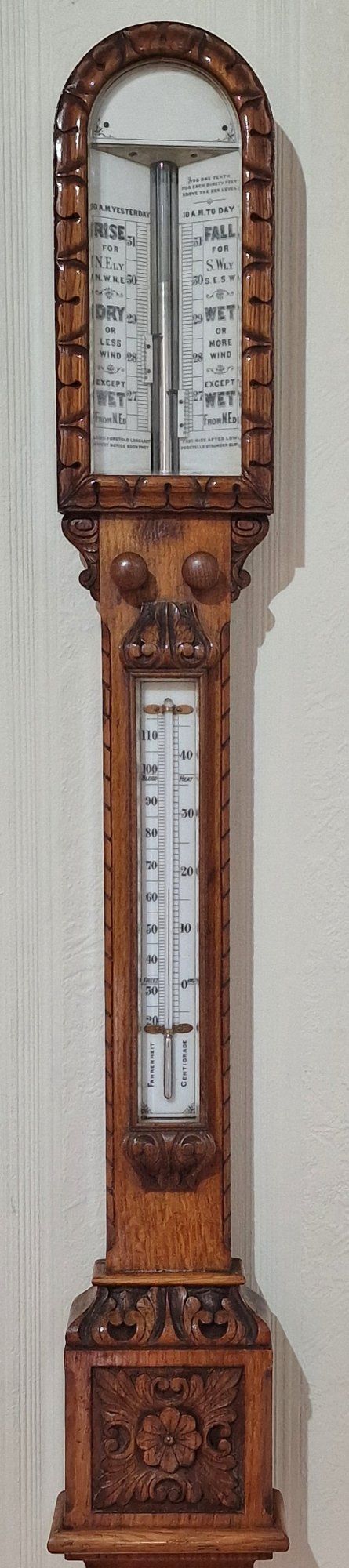
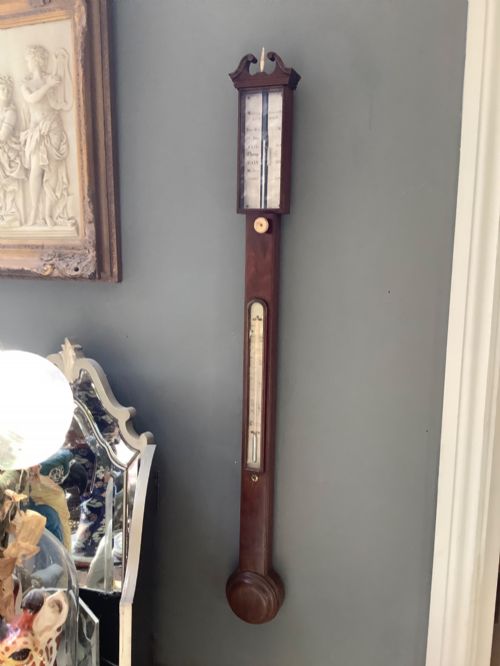
Oak Cased Stick Barometer by J Hughes London, 19th Century
Priced at £1,095 from Shackladys Antiques
The 2026 retail price guide for Antique Stick Barometers is drawn from a proprietary archive of over 1.1 million retail prices indexed by Sellingantiques since 2003. This guide relies exclusively on their own internal data; no external sources or auction records are used.
Analysing nearly 25 years of UK antique market history alongside current retail values, the data indicates that typical UK retail prices for Antique Stick Barometers range between £900 and £3,000. Entry-level prices generally fall under £900 and premium examples upwards of £3,000.
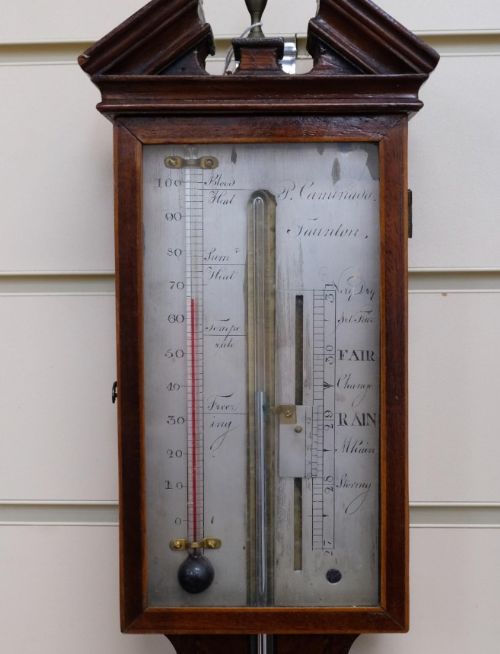
The main scale always reads inches of mercury. You read the current pressure against this engraved metal or ivory plate.
Vernier scales slide up and down the main register. This secondary marker allows reading the height to a hundredth of an inch.
Turn the set pointer. This small brass knob lets the owner record yesterday's pressure against the main scale.
Early makers concealed the glass tube behind wooden panels. Later Georgian craftsmen left the long central section exposed.
Bow fronts required skilled veneer work. Cabinetmakers curved thin sheets of mahogany over a shaped pine core to create the rounded body.
Inspect the engraving on the register plates. Hand-cut letters and numerals required sharp gravers and steady pressure to bite into the brass.
"Portable versions were taken up mountains. Scientists carried them to measure altitude changes by observing the pressure drop."
"Traditional weather words are arbitrary. Phrases like 'Much Rain' or 'Set Fair' serve as general guides rather than rigid scientific laws."
"Some cases feature secondary instruments. You might find a functioning alcohol thermometer neatly set into the lower trunk."
Based on almost 25 years of Sellingantiques UK antique market data, Antique Stick Barometers appeared 700 times (out of 1,100,000 antiques) which gives it a rarity score of 87/100.
This score measures scarcity within the Sellingantiques archive only and is not a survey of the entire antiques market, so these statistics may not be indicative of the general availability of Antique Stick Barometers elsewhere.
Transporting these requires careful handling to keep air bubbles out of the mercury tube. You must slope the instrument slowly until the mercury hits the top of the glass.
Keep it at a forty-five degree angle while moving. Carry it flat on its back if you must, but never upright and never upside down.
Empty tubes are a common issue when the mercury has leaked or been drained for storage. It is not ruined.
Specialist restorers can clean the original glass and refill it with fresh mercury under vacuum conditions. The process requires specific workshop equipment to ensure no air gets trapped in the column.
This curve is called the meniscus. Mercury does not wet the glass, so surface tension pulls it into a convex dome.
You always read the pressure by aligning the vernier scale with the very top of this dome. If the dome flattens, the pressure is about to fall.
You should not attempt to clean a tarnished register plate with liquid metal polishes. The silvering is merely a micro-thin layer of chemical paste on top of the brass.
Rubbing it with household cleaners will strip the remaining silver layer off instantly.
The plate needs professional re-silvering. A restorer will remove the old lacquer, rub in fresh silver chloride powder, and re-seal the surface with wax.
Please note: This Antique Stick Barometers guide and its associated pricing data are provided for general informational purposes only. It does not constitute formal financial, investment, or appraisal advice and should not be relied upon as the sole basis for any commercial activity, purchasing, or sales decisions. Sellingantiques.co.uk accepts no liability for any actions taken in reliance on this information. Always consult with a qualified professional or independent appraiser.
