


Wooden Stacking Coffee Tables
These wooden stacking coffee tables offer modular surface space that tucks away neatly when floor room is required.
Wooden Stacking Coffee Tables
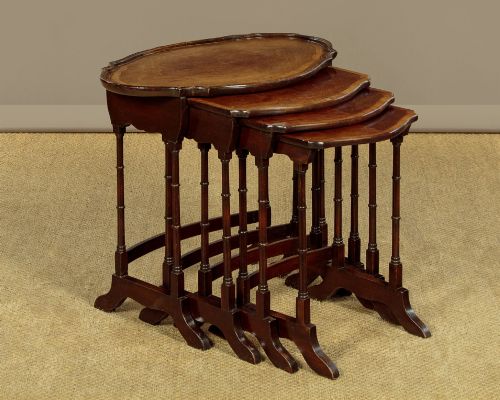
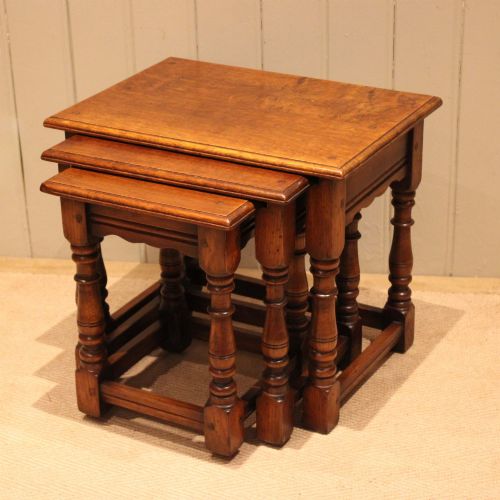
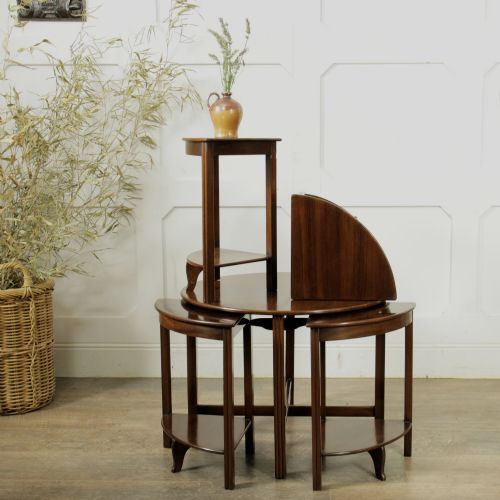
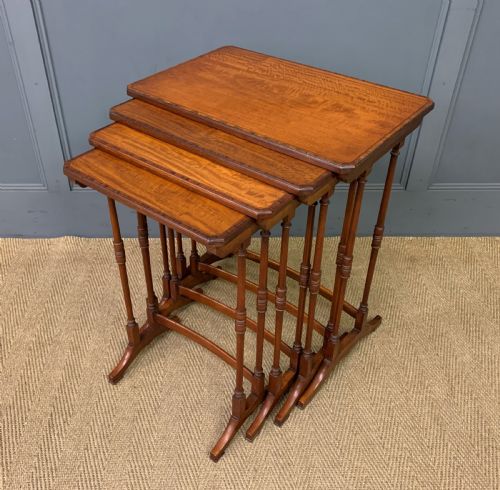
Wooden stacking coffee tables, also known as nests of tables, provide multiple surfaces that slide beneath one another to save space. Buyers frequently encounter sets of three or four pieces, often termed quartetto tables, dating from the Victorian and Edwardian eras.
The materials and styles span from golden oak and figured mahogany to inlaid satinwood and Chinese export pieces. Edwardian examples in mahogany dominate the selection, alongside walnut sets from the nineteen thirties and earlier nineteenth-century variants.
Materials and construction
Cabinet makers utilised solid timbers and veneers such as mahogany, walnut, oak, and rosewood. Satinwood inlay and embossed leather tops frequently decorate the upper surfaces of Edwardian and nineteenth-century pieces.
Construction techniques include graduated sizing to allow each smaller table to fit smoothly under the one above it. Carved Chinoiserie detailing and shaped tops appear across various regional workshops.
Some sets hide a fourth table so small it feels like a secret compartment.
Materials and execution
Quality rests upon the selection of timber figures, such as figured mahogany or matched walnut grains, and the precision of the graduating frame sizes. Smooth sliding actions and tight joints distinguish finer workshops from simpler utility pieces.
Decorative elements like fine satinwood inlay, parquetry, and carved borders separate standard production sets from exceptional examples. The crispness of the carving and the depth of the polish indicate the level of craftsmanship invested in the set.
Heal's
The Wooden Stacking Coffee Tables Glossary
- Quartetto
- A matched set of four stacking tables designed to fit neatly together. This term appears frequently in nineteenth-century and Edwardian listings.
- Inlay
- A technique where contrasting woods or materials like satinwood are inserted into the primary timber surface to form decorative patterns.
- Chinoiserie
- European decorative art influenced by Chinese artistic styles and motifs. These pieces often feature intricate carving and oriental designs.
- Parquetry
- Geometric mosaic woodwork used for decorative surfaces on table tops. It employs various wood species to create repeating patterns.
Wooden Stacking Coffee Tables: Frequently Asked Questions
What is a quartetto table?
A quartetto table refers to a coordinated group of four stacking tables designed to slide progressively beneath the largest one. This arrangement provides multiple surfaces while occupying the floor space of a single small table.
Cabinet makers in the nineteenth and early twentieth centuries produced these sets in mahogany, walnut, and satinwood for drawing rooms and parlours.
How do I date a nest of tables?
Dating relies upon timber selection, structural styles, and decorative details such as inlay or carving. Victorian and Edwardian examples often employ figured mahogany or satinwood, whereas Art Deco sets from the nineteen thirties show distinct geometric forms.
The presence of specific revival styles, such as Jacobean or Regency influences, further helps place the manufacture into a general period.
Are these tables sturdy enough for daily use?
Most wooden stacking coffee tables are built to handle everyday placement of cups, books, and lamps. Their tiered design distributes weight across multiple frames when the tables are separated for use.
Care should be taken with older joints and delicate inlaid surfaces to maintain the stability and appearance of the timber over time.
What timber was used most often?
Mahogany is the predominant timber found across these tables, appearing in numerous Victorian and Edwardian listings. Walnut, oak, and rosewood also feature prominently in sets from various decades.
Cabinet makers frequently combined these primary woods with lighter veneers like satinwood to create contrasting borders and decorative panels.