




Oak Nest of Tables
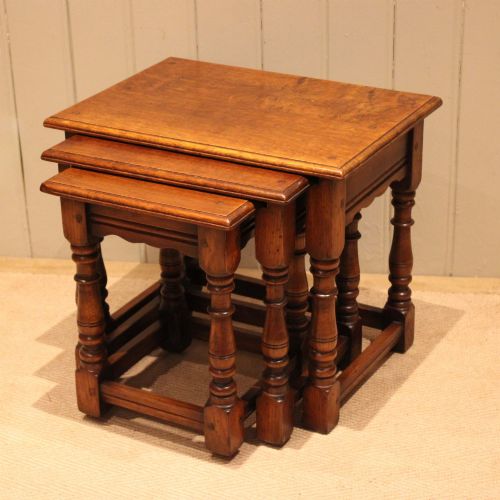
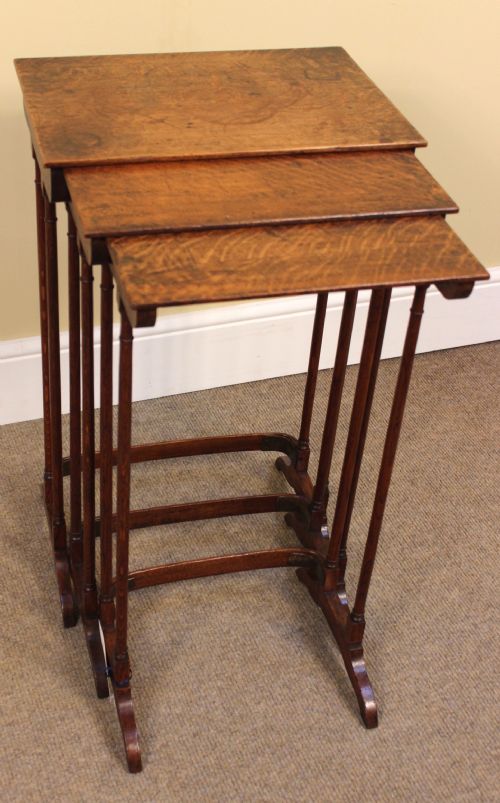
An oak nest of tables is a clever space-saving set that slides together tightly when not in use, offering multiple surfaces whenever required.
Identifying an oak nest of tables
When you search for an oak nest of tables, you are looking at sets of matching occasional tables designed to fit neatly beneath one another. These practical tiered assemblies appear in various configurations, most commonly as sets of three or four.
The pieces on this page span from the nineteenth century through the 1920s and 1930s, encompassing styles such as Victorian, Edwardian, English Country, Art Deco, and Jacobean Revival. Rectangular forms are standard, alongside oval, round, and tall variations.
You will also find specialised formats including quartetto and quintetto arrangements, as well as distinct regional and maker-marked examples like French pieces and Old Charm or Mouseman productions. The majority function as side, coffee, or wine tables within domestic spaces.
Materials and construction
These pieces are constructed primarily from solid oak and wood veneer, utilising traditional joinery methods suited to domestic furniture. Timber selection ranges from golden and country oak to darker finishes.
Structural supports vary significantly across periods and styles, incorporating turned legs, bobbin turning, and barley twist columns. Stacking designs rely on precise dimensional scaling so each smaller table slides smoothly into the frame of the one above.
Retail Price Guide 2026
Typical UK retail prices for oak nest of tables, calculated from the Sellingantiques database of over a million retail prices indexed since 2003. This retail price guide relies exclusively on Sellingantiques data; no external sources or auction records are used, so the figures do not describe the wider market.
Keep an eye out for carved wooden mice hiding on the legs of specific Yorkshire workshop tables.
Judging quality and character
Quality in these sets rests upon the integrity of the timber and the precision of the nesting mechanism. Solid oak versions with thick tops and sturdy underframes represent a higher standard than lighter veneer alternatives.
Artistic detailing also separates standard production from finer examples. Hand-carved elements, distinctive turning such as bobbin or barley twist work, and branded workshop signatures add considerable distinction to individual sets.
Old Charm·Mouseman
The Oak Nest of Tables Glossary
- Quartetto
- A matching set of four small tables designed to nest together. This historical term often appears in nineteenth-century and Art Deco listings.
- Barley twist
- A spiral turning technique resembling a twisted rope, commonly used for the legs of tables from the Victorian era and the 1920s.
- Bobbin turned
- A style of furniture leg or stretcher shaped with a series of rounded, spool-like spheres carved from solid wood.
- Veneer
- A thin layer of fine wood applied over a secondary timber base to provide a decorative surface figure.
Frequently Asked Questions
How do I use a nest of tables?
These tables stay stacked together against a wall or beside a chair as a single compact unit until guests arrive or extra surface space is needed.
You simply slide out each smaller table individually to hold drinks, books, or lamps, then return them to the stack when finished.
What periods do these tables come from?
The listings include examples originating from the nineteenth century, the Edwardian period, and the 1920s and 1930s.
Styles range from Victorian and Arts and Crafts to Art Deco and Jacobean Revival, reflecting changing domestic tastes across generations.
What is a quartetto nest?
A quartetto is a matched set consisting of four tables that scale down in size to fit completely beneath the largest one.
This format appears in nineteenth-century pieces as well as later Art Deco designs, offering maximum surface utility with minimal storage space.