


Sterling Silver Bread Basket
A sterling silver bread basket brings table service alive with pierced metalwork and swing handles from Georgian to Art Deco periods.
Sterling Silver Bread Basket
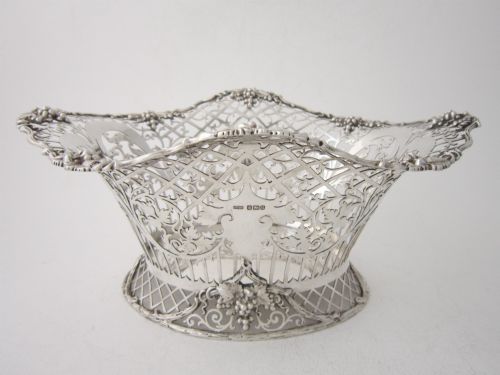
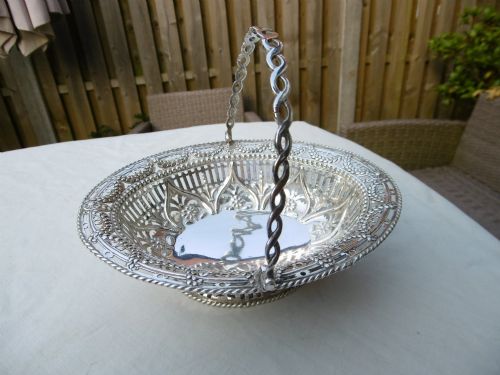
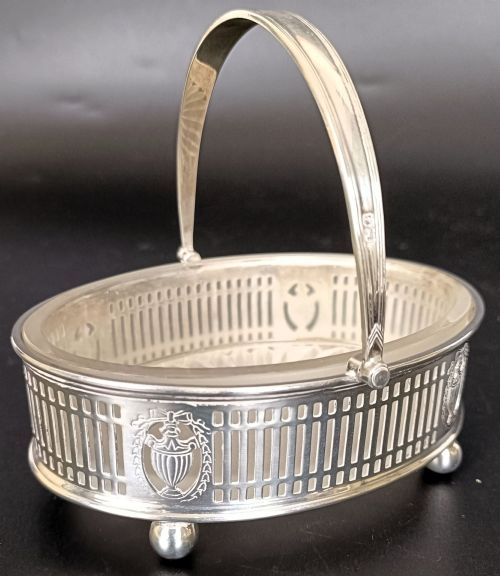
A sterling silver bread basket provides an elevated centrepiece for dining tables, spanning Georgian origins through to the 1940s. The most common forms met here are oval pierced baskets and swing-handled dishes intended for serving bread or fruit.
Examples appear across multiple eras including Victorian, Edwardian, and George V reigns, often featuring decorative borders or footed bases. These pieces reflect shifting dining customs from formal Georgian service to twentieth-century domestic entertaining.
Materials and construction methods
Makers utilised sterling silver and solid silver, shaping metal through hammering, casting, and piercing techniques. Pierced-work and fretwork panels reduce weight while creating intricate lattice patterns across the body of the dish.
Smiths incorporated embossed detailing and swing handles attached to reinforced rims. Silversmiths applied hallmarks to confirm metal purity and trace the production origin to assay offices in London, Sheffield, Newcastle, and other centres.
Some baskets weigh over three hundred grams, turning an ordinary slice of bread into a heavy lifting exercise.
Distinguishing quality across examples
The standard of workmanship rests in the precision of the piercing and the crispness of embossed relief work. Superior pieces display finely balanced symmetry in fretwork patterns and sturdy construction at handle joints and feet.
Substantial gauge metal and clear, legible hallmarks separate high-grade output from lighter domestic vessels. Maker attribution to notable silversmiths further elevates the standing of an individual piece.
John Hunt·Samuel Herbert·William Comyns·Hammond Creake and Co·James Deakin and Sons·William Hutton and Sons·James Dixon and Sons Ltd·Martin Hall·John Walton·Gorham·Woodside Sterling Co
The Sterling Silver Bread Basket Glossary
- Sterling silver
- A silver alloy consisting of 92.5 percent pure silver by mass and 7.5 percent other metals, usually copper. This standard ensures durability while maintaining a bright metallic lustre.
- Swing handle
- A movable arched handle attached to opposite sides of a basket by pivots. It folds flat against the rim for storage or stands upright for carrying.
- Pierced-work
- A decorative technique where material is cut away to form openwork designs or geometric lattices. It lightens the vessel while displaying intricate patterns.
- Hallmark
- An official stamp applied to precious metals indicating the standard of purity, the assay office, and the year of manufacture. These marks provide a secure method of dating antiques.
- Fretwork
- Ornamental openwork created by cutting intricate patterns into sheet metal. This technique defines many Edwardian and Victorian serving dishes.
Sterling Silver Bread Basket: Frequently Asked Questions
How do I date a sterling silver bread basket?
Examination of the stamped hallmarks provides the exact assay office and year letter for the piece. Comparing the overall style, such as Georgian neoclassical revival or Edwardian fretwork, corroborates the hallmarked decade.
Assay marks from London, Sheffield, and Newcastle appear frequently across these listings. Reference books match the stamped maker's mark to active working dates.
Were these baskets only used for bread?
Historical domestic use extended well beyond bread to include fruit, cakes, and general serving functions. Many pieces in the archive carry dual descriptions naming fruit or bread interchangeably.
Large shallow bowls accommodated various dining table requirements during the eighteenth, nineteenth, and twentieth centuries. The versatile shallow form suited dry food presentation across multiple meal courses.
What is a swing-handled basket?
A swing handle connects to pivot joints on the rim, allowing the handle to arch upright or drop flat. This mechanical feature facilitated compact storage on sideboards and easy passing at the table.
Craftsmen engineered these joints to support the weight of the silver body when lifted. The handle design remains a defining trait of Georgian and later serving baskets.
How do I clean an antique silver basket?
Maintenance requires specialised silver polish and a soft cloth to protect the embossed detailing and pierced edges. Avoid harsh abrasive cleaners that wear down fine hallmarks and thin metal walls.
Regular gentle dusting preserves the natural patina accumulated over decades of use. Storing the piece in a dry environment prevents rapid tarnishing of the sterling surface.