
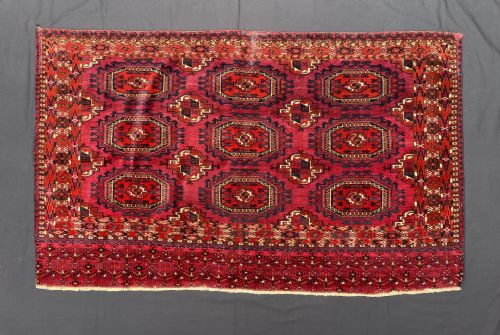


Small Turkmen Bag
A small turkmen bag brings the tactile geometry of Central Asian nomadic weaving directly into your hands.
Small Turkmen Bag
When you search for a small turkmen bag, you encounter tribal domestic weaving designed for storage and daily use in Central Asia. These pieces originate primarily from the nineteenth century, spanning decades from eighteen fifty up to nineteen twenty.
The selections here consist predominantly of torba faces, chuval faces, and small mafrash or kap storage bags. Tribal groups such as the Tekke, Yomut, Saryk, and Ersari produced these textiles as essential components of dowry and household furnishings.
Most examples appear as bag faces rather than complete vessels, though complete specimens with original backs occasionally survive. Their structures reflect the traditional nomadic lifestyle of the Akhal Oasis and surrounding regions.
Materials and construction
Weavers constructed these textiles primarily from handspun wool, utilising natural dyes to achieve rich crimson, madder, and deep brown tones. Cotton and silk appear as supplementary materials, particularly in highlighting specific gul motifs and elem borders.
The density of the weave varies according to the intended function of the weaving, with dowry pieces often displaying exceptionally fine knotting. Finished surfaces combine pile construction on the front with plain weave backs or sturdy kilim structures.
Nomadic weavers packed these small bags with dowry treasures, hoping the geometric guls would ward off evil spirits.
What separates examples
The hierarchy among these pieces rests upon knot density, handle, and the clarity of the natural dye palette. A finer weave allows complex gul designs, such as the Salor or kepse patterns, to maintain crisp geometrical precision.
Preservation of the original structure also influences the standing of a piece. Examples retaining complete backs, intact elem panels, and vibrant crimson silk highlights command greater attention from collectors.
The Small Turkmen Bag Glossary
- Torba
- A small Turkmen wall storage bag used in nomadic tents for household belongings. These items typically feature horizontal formats and prominent tribal gul motifs.
- Chuval
- A large tent bag utilised for bedding and heavy storage. They share similar wool foundations and natural dye palettes with smaller torbas.
- Gul
- The repeating primary medallion motif characteristic of Turkmen tribal weaving. Each tribal group utilised distinct gul variations to signify lineage and origin.
- Mafrash
- A rectangular storage container or compartment of a saddle bag assembly. They often display structured panel designs including tree motifs and geometric borders.
- Elem
- The decorative lower panel of a bag face or rug. This section frequently incorporates specialised secondary motifs distinct from the main field.
Small Turkmen Bag: Frequently Asked Questions
How were these bags used?
Nomadic families utilised these small textiles primarily for organising possessions within the tent. They hung against the lattice walls or served as functional containers during seasonal migrations.
Over time, many of these storage pieces lost their plain weave backs through daily wear or separation. Today, surviving bag faces function predominantly as decorative wall hangings and textile art.
How do I identify tribal designs?
Tribal attribution relies heavily on the specific repeating medallion known as a gul, alongside the overall colour palette and border structures. Tekke, Yomut, Saryk, and Ersari weavers each employed distinct structural traits and drawing styles.
Examining the weave fineness and secondary ornamentation provides further clues. Comparing piece characteristics against documented nineteenth century examples helps clarify the likely origin.
How do I care for antique wool?
Preserving antique wool textiles requires gentle handling and protection from direct, prolonged sunlight to prevent natural dye fade. Regular, careful vacuuming through a mesh screen removes surface dust without stressing the fragile foundation.
Keeping the environment dry prevents moth activity and mildew growth. Professional textile conservators should handle any necessary cleaning or structural stabilization.