


Tekke Tribal Rug
When buying a tekke tribal rug, you are acquiring Central Asian nomadic textiles woven with distinct primary guls and natural dyes.
Tekke Tribal Rug
A tekke tribal rug typically manifests as a torba, chuval, main carpet, or tent band originating from Turkmen weavers in Central Asia. These items span the nineteenth and early twentieth centuries, encompassing dowry pieces, wall hangings, and functional tent bags.
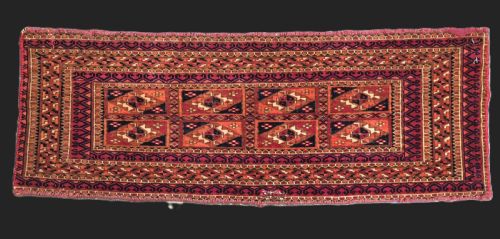
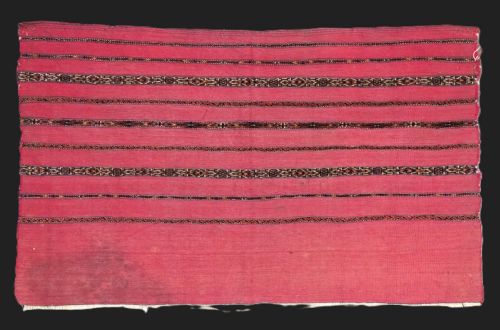
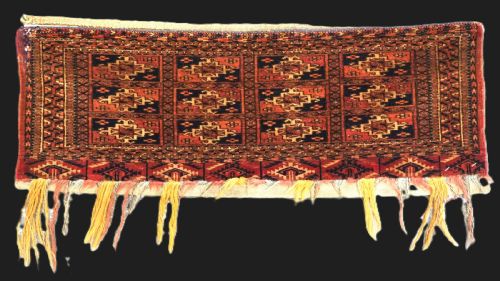
The format you encounter most frequently on this page is the torba face or chuval face, often preserved with its original plain weave back or hanging loops. These smaller bag faces display the traditional repeat guls that define the Turkmen aesthetic.
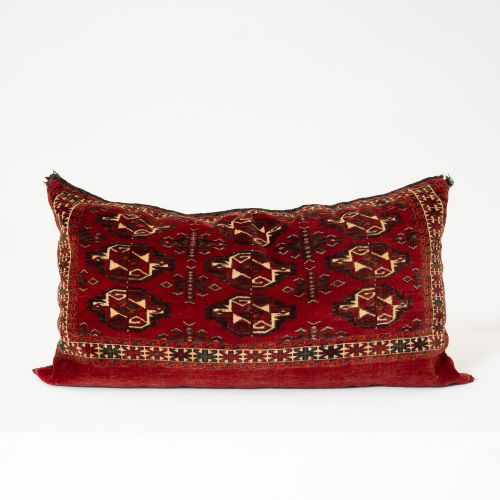
Larger formats such as main carpets and engsi doorways appear alongside utilitarian tent bands and cushions. Each category reflects the nomadic lifestyle and the specific domestic role assigned to the textile within the yurt.
Materials and Construction
Construction relies primarily on wool foundations and pile, frequently supplemented by cotton highlights and occasional silk or linen threads. The wool is knotted densely to create a durable, resilient surface designed for practical use in nomadic dwellings.
Natural dyes provide the characteristic palette, yielding deep madder reds, ivory grounds, and contrasting dark tones. These vegetable colourants interact with the wool over decades to produce nuanced patination.
Weaving techniques vary from standard pile carpets to supplementary weft-faced structures on torba and chuval backs. Fine weaves incorporate tight knot counts that allow intricate rendering of secondary motifs and border patterns.
A fifty-foot yurt band survives here, ready to encircle an entire nomadic dwelling.
Assessing Quality
Quality rests in the precision of the drawing and the clarity of the primary guls. Superior examples exhibit balanced proportions, crisp geometry in the minor ornaments, and an absence of crowding in the field.
The handling of colour determines visual impact, distinguishing standard village output from master dowry weaving. Depth in the red grounds and harmonious saturation in the secondary motifs separate the top tier from ordinary work.
State of preservation and structural integrity complete the hierarchy. Complete pieces retaining original plain weave backs, elem borders, and hanging loops command greater respect than fragments or heavily restored surfaces.
The Tekke Tribal Rug Glossary
- Gul
- The primary octagonal medallion motif repeated across Turkmen carpets and bag faces. Different tribal groups utilised distinct gul variations to signal lineage and origin.
- Torba
- A small storage bag used within the nomad tent, typically wider than it is tall. These pieces frequently display rows of major guls and detailed lower borders.
- Chuval
- A large tent bag utilised for bedding and household storage, larger in format than a torba. Chuval faces are commonly encountered as individual collector items.
- Engsi
- A specialised carpet designed to hang over the doorway inside a yurt. They feature a distinctive quartered field design separated by a candelabra motif.
- Elem
- The decorative lower panel of a chuval or main carpet, often woven with floral or shrub motifs beneath the main field of guls.
Tekke Tribal Rug: Frequently Asked Questions
How were these bags used?
Nomadic families utilised torbas and chuvals inside tents for storing clothing, bedding, and household goods. They hung against the lattice walls or stacked upon camels during migration.
These functional items doubled as expressions of tribal identity and status, woven specifically for dowry trousseaus.
What is an ak chuval?
An ak chuval is a specific variety of storage bag featuring an ivory ground or lighter palette. These pieces are less common than the standard red ground varieties.
Collectors prize them for the striking contrast the light ground provides against traditional dark gul arrangements.
How do I date a piece?
Dating relies on assessing the saturation of natural dyes, the handling of wool, and structural fineness. Pieces attributed to the nineteenth century generally show softer wool patination and organic dye variations.
Later examples from the early twentieth century often present firmer structures and slightly more standardised drafting.
Can I hang these on a wall?
Many torba faces and tent bands arrive with original hanging loops attached, making wall display straightforward. Their textile structure distributes weight evenly when supported properly along a rod.
Wall mounting removes foot traffic wear while allowing the geometric patterns and natural dyes to be appreciated as visual art.